Showing posts with label evolution/natural selection. Show all posts

Saturday, July 6, 2019

Domestication Stories: The Death and New Life of the Guardian

The bear came in the dead of night, when the fire was low and everyone was asleep except one watchman. Later, his father told him the bear had been very thin, and had come out of hibernation too early. Drawn to their temporary camp by the smell of the fresh horse meat hung in strips from the drying rack.

All the boy knew is that he woke to a frightening weight crashing down on him and a roar so loud and close it seemed to shake the whole earth. For three terrifying heartbeats, he couldn't move or breath, or see. Then, just as suddenly, the crushing weight lifted, and he jumped to his feet, throwing off the blanket fur and looking around wildly. He froze. The weight that had pinned him to the ground a moment ago was a bear, and now its huge, humped back was now less than two arm lengths away.

Time seemed to slow. He was vaguely aware of the others around him, rising from their blankets and groping for weapons, and of the odd, jerky motions of the bear as it bit and clawed at a spear that protruded from its shoulder. He took one step backward, then another, and that's when the bear paused and turned its eyes to him.

There was nothing between it and the boy. He heard his father shout something, but it was too late, the bear, full of hunger and frustration and pain, swung his body around and took a single step toward him, lowering its head. There was no time to run, or to grope for his spear. The bear would maul him to death in seconds, before his father or the other hunters would have time to attack.

But then, a dark furry shape hurtled out of the darkness and rammed into the bear. A wolf, from the Pack-that-Follows. It clung to the bear's neck ruff and shook and scrabbled and snarled. The bear roared again and swiped frantically at the wolf with both arms. Attention diverted, the boy wasted no time and threw himself backwards into the bushes, out of the way.

He looked up in time to see the bear throw the wolf to the ground, but it had given the hunters time to grab their weapons and now they closed in on the bear from all sides. The fight was over in moments, spears and finally a stone club finished off the bear. and it lay limp right next to the fire. There was a round of shaky, tired cheers and then several family members set to work immediately to skin and butcher the bear. It would be bad luck to try to sleep with it lying there in the middle of camp.

But the boy had eyes only for the still form of the wolf. He crawled over on hands and knees and touched the wolf with a shaking hand. It didn't respond, the muscles slack in that familiar way of of an animal newly-dead. He carefully turned the head toward the fire light, and it was as he feared: The wolf's face had a striking dark stripe from forehead to nose tip. His favorite wolf from the Pack-That-Follows, one of the handful who had a name.

Uncle came up and laid a comforting hand on his shoulder as he began to weep. He stroked the wolf's fur for the first, and last time. Even the friendliest wolves like this one, the ones who would venture close to the fire for dinner scraps, wouldn't allow a person to touch them. So incredibly soft and thick. For a moment, the boy wondered what it would be like to have a wolf sleep next to you at night. How safe and warm you would feel.

"Stripey was so brave," he said. "He saved my life."

"Yes," Uncle replied. "He was Her gift to us, we must be thankful for the time he was with us."

The boy looked over his shoulder at the activity around the bear's carcass, then into the brush where the rest of Stripey's pack would be. He couldn't see or hear them, but they were probably watching, as they always did.

"We should give the Pack some of the meat," he said. Uncle nodded.

"I'm sure your father will agree."

"What will we do with Stripey's body?" It seemed to wrong to butcher it, even for the luxurious fur. This was not just any wolf.

Uncle seemed to understand. He went around to the rest of the family and told them to leave Stripey where he lay. None argued. In the morning, he and the boy wrapped an old blanket hide around Stripey's body.

"Come," he said to the boy, and picked up the wolf and walked out into the brush.

They walked for some time, pausing now and then to collect branches. By the time they reached an appropriate place - a low spot between hills, where stones peeked out of the earth to show it was a favored place of the Stone Mother - he was carrying an armload of branches so large he could barely see over it.

Uncle chose a place with a natural depression in the earth, next to a large boulder, and placed Stripey's body into it. He took out his knife and gently removed Stripey's head and set it aside. The rest of the body he re-wrapped in the blanket and together they covered it in all the branches and twigs they'd collected.

"How will he hunt without his head?" The boy asked, his tears returning. Uncle put an arm around his shoulders.

"He has a different job now."

A week later, when the hunting party returned to the Winter Caves with their bounty of food to share, Uncle also helped the boy clean up Stripey's skull and choose a place for him near the doorway to his family's dwelling. The boy had never paid much attention to the Guardian bones that others had placed in different parts of the cave. They were just part of his landscape. Now he realized that each one was significant. He made sure to listen more carefully when stories were told, and to tell Stripey's as well, and he also made sure to bring extra scraps to the Pack-That-Follows. As long as he lived, he would make sure no one forgot the bravery of this Guardian.


~~*~~


Notes:
125,000 years ago, a family of Neanderthals in what is now called England placed wolf skulls at the entrances to their dwellings. It was around the same time that an important genetic divergence event took place among wolves in Eurasia, (according to mDNA, anyway) possibly showing the beginning of the separation between wolves and wolves who would later become dogs. We don't know much else about that period of time. We don't know Neanderthal's relationship with wolves, or their rituals or spirituality, but placing their skulls near doorways implies a spiritual connection. I think it's possible those skulls could have been from camp-following wolves. Wolves who are physically identical to, but were just a little different, from other wolves. Just a little more likely to hang out close to people, and for people to start to recognize individuals and form favorites and attachments to them, even if these wolves weren't yet very "tame".

Friday, December 7, 2018

Domestication Stories #2: What it Means to be Alone


Content warning: some violence and gore


Flatnose was going to die. He knew it would happen soon, and he knew he deserved it. He'd accidentally killed his own brother during a squabble. His own father had been the one to begin the banishing-chant, and he hadn't fought it, simply walked out of camp with the clothes he was wearing and a single spear in his hands.

That was over a season ago, and he wasn't quite ready to lay down and let the cold take him. But it might be out of his hands now that winter was fully upon the land. He'd never been great at plant identification, or at trap-making - those had been skills that other family members had excelled at so that he didn't need to. He hadn't eaten anything but bark and lichen for many days, and his last protein had been a handful of moth larvae barely worth the calories expended to dig them out of the rotting stump. This hunt might be his last chance.

So here he was: on his belly on the frozen ground, crawling toward a small group of deer bedded down in some shrubs. He'd been stalking them for hours, and was almost close enough to strike. It was a desperate way to hunt large animals. The best way was to steer a herd into a ravine or bog where they couldn't escape or fight well, but that method required familiar lands, and a family working together. Nearly impossible for a lone man.

Suddenly, he heard something approaching from the hill behind him and to the east, crashing through the brush, making no effort to be stealthy. Flatnose lifted his head and watched in silent despair as the deer sprang from their beds. A pack of wolves ran past him and charged after them. In the span of a few breaths both wolves and deer had run over the next hill and out of sight.

He lay for awhile, listening to the wind and fighting the urge to lay his head on the ground. Wolves were often messengers of the Stone Mother, She may have sent them to tell him it was time to stop hunting and give up. One could never fully know the minds of the Gods, though, and there was one, small hope: if the wolves made a kill, he might be able to scavenge from it.

It took several tries to rise to his feet, he was that weak. He backtracked his own trail to where he'd stashed the small bundle of belongings he'd managed to make and collect since his banishment, and  started to follow the wolves' tracks. It was easy tracking when the trail was this fresh: perfect little paw marks melted in the top layer of frost.

Within a couple hours, he saw birds circling up ahead. The wolves must have made a kill. Would it do him any good, though? Alone, he didn't have a chance of scaring them off, but it was possible that once they'd filled their bellies they would leave - the pack had looked strong and healthy, they may not feel the need to guard the carcass. If he could beat the bears, lions, hyenas, eagles and birds to it, anyway. He crested a ridge and there, at the bottom of the slope, were the wolves. The pack had indeed managed to take down one of the deer, an adult, and were were eating voraciously, the way wolves do, as if it were their last meal. Flatnose's mouth watered at the sight of all that food, so close, and yet untouchable.

He made a fire while he waited. The wolves didn't even seem to care, another jarring sign of his loneliness. A group of humans would have caused a pack of wolves to stop everything to watch them, or maybe even preemptively attack. A lone human held little threat. As long as he kept his distance, they ignored him.

Flatnose huddled by the fire, and concentrated simply to stay awake. He was running out of time. The sun was sinking, and he wasn't sure he could survive another winter night without either calories, or proper shelter. The wolves had slowed down, the two larger ones had finished, and he had some hope he'd be able to try his hand at stealing some meat soon. Just as he thought this, he caught sight of movement out in the distance. A large, dark shadow, coming down from another hill. A lion.

The wolves noticed at about the same time, and turned in unison, hackles and tails raised. Six wolves could take a single lion, but they might not want to risk defending food from such a dangerous foe when they had full bellies. If the lion took possession of the meat, Flatnose chances of getting any disappeared. A lean, lonely lion was much more likely than a fat and healthy wolf pack to guard the carcass or drag the entire remains to a lair and guard it until it was completely eaten.

This, then, must be Her test. He had to do something before the wolves decided to leave. He took a deep breath and threw off his hood and gloves. He broke off the biggest branch of heather he could find, and lit it in the fire. And then, with his only spear in one hand, makeshift torch in the other, he ran down the hill.

He kept wide and far away from the deer carcass, circling to get the lion between him and the pack. It would divide the lion's attention. Some of the wolves looked his way, but the lion was still their priority for the moment. They snarled and danced outside the range of its claws, making feint attacks as the lion was snarled back and swiped at them with deadly claws, slinking closer to the deer. Neither predator wanted to engage quite yet, and there was a temporary standoff. Now or never.

Flatnose only had one spear. He had to aim for a spot that was impossible to miss, that wouldn't simply glance off bone. As he got close to the lion, it stopped and turned toward him, ears pinned and teeth bared. Before it could attack, he threw the torch in its face. It flinched and swatted at the fire. In the one heartbeat that the lion was distracted, Flatnose leapt forward and thrust his spear into the lion's belly. It screamed and spun around, yanking the spear from his hands as the cat swiped wildly at him. He fell backwards, rolling out of reach, but bruising his ribs and elbow in the process.

It was a huge risk, spearing it in the gut. It could make it even stronger and angry, and now it might target him instead of the wolves. He scrambled to his feet as quickly as possible, backing away, but the lion wasn't coming after him yet; it was pawing and chewing at the spear stuck in its body, glancing back and forth between the wolves and Flatnose. In pain, surrounded by threats, it couldn't decide what to do. For a moment, Flatnose felt great sympathy for the lion. It was a gaunt young male, hungry and alone, just like Flatnose. It didn't realize that its life was already over, one way or another.

Mercifully, it didn't need to die the agonizing, drawn-out death of a gut wound, for at that moment, the wolves decided to attack after all. Flatnose stumbled away from the furious swirl of animals as quickly as his weak limbs would carry him. Back to the relative safety of his fire. He was dizzy with exhaustion and relief: he'd attacked a lion, by himself, and survived mostly unhurt.

He couldn't see the battle, obscured by brush and gathering darkness, but he could hear it just fine, and could tell it was not going well for the poor lion. Shortly, everything went quiet and the wolves came trotting back into view. Several were limping, but none seemed seriously hurt. He could swear they seemed smug. They settled in near the deer carcass, laying down to lick at wounds or curl up to sleep. They weren't leaving the area anytime soon. Flatnose wouldn't be eating any venison tonight, but he didn't need it now. He had roast lion in his future.

He made a new pair of torches and took them back down the hill, once again keeping well clear of the wolves and their food. They watched him, but none made a move toward him. Whether it was their exhaustion, full bellies, or that they still didn't see him as a threat, or maybe even that they saw him as an ally who helped them with a common enemy, or simply the grace of the Stone Mother, tonight they would tolerate him. Now that they weren't competition for a meal, he actually hoped they would stay for awhile. After being alone so many months, it was comforting, having other creatures nearby that were neither food nor enemy.

The lion's body was resting just a few lengths from the deer, in a small hollow. Flatnose used the torch to make two new, bigger fires, one on each side of the lion. It might be enough to keep away other scavengers that came in the night. It was all he had the energy for, but he was optimistic. For the first time in awhile, he had some plans to make for the future: Tonight, he would eat until his belly was swollen and painful. Then he would sleep. Then he would get up and eat some more. He would keep the fires going; he would build a shelter; he would find some water to drink; he should try to tan the lion skin, it would be a welcome addition to his pathetic bedroll of stitched-together small animal hides, or maybe he would try to make a water-tight cooking bag so he could make stew, which was a less-wasteful way to cook than roasting. His only spear was shattered, and he was banished from all the sacred yew groves, but perhaps the Stone Mother would see fit to show him the way to a different grove of trees so he could make more. She seemed to think he should live for tonight, maybe he would live through the winter after all.


~~*~~


Notes:
While I was in the middle of writing this story, an extremely pertinent interview was published in Psychology Today: 'Dumping the Dog Domestication Dump Theory Once and for All' I highly recommend reading it.

'What it means to be alone' takes place 150,000 years ago. Not much has changed since the time of SmallWatcher. Although the climate has fluctuated in that time, both people and wolves have adapted with no apparent changes to their habits or tool-uses. Flatnose's people, Neanderthals, still dominate the hunting grounds of Eurasia, living in traveling family groups and sharing the landscape with wolves and other predators. The creature we know today as the dog is still 100,000 years away from being fully created, but humans and wolves still have frequent interactions that are leading up to that final domestication.

Humans and wolves share what Christoph Jung in the above interview describes as, "astonishing similarities in their social behavior, their psychology and social communication." Both are also excellent hunters. Part of being a successful hunter, especially a human with a big brain, is to put yourself inside the mind of other animals, so you can predict their moves and habits. From there, it's a short step for a social creature to sympathize and feel close kinship to other animals, especially predators that are so like himself, even when those predators are often competition for the same food.

Tuesday, November 13, 2018

Stop Being Terrible at Werewolves: A Friendly Guide for Fantasy Writers


The modern concept of werewolves originated some time after we stopped being hunter-gatherers -  who weren't afraid[1] of wolves, and in fact made friends of them and turned them into dogs - and sometime before the Renaissance. Wolves were the last widespread, man-eating large predator in Eurasia. They could leap out of the dark woods to attack livestock and eat children and unarmed peasants. The perfect animal to hang our collective monster fears on.

This wolf, the "werewolf-wolf", is not based on real Canis lupus; it's simply a stand-in for all things savage and animalistic. Fantasy need not be "realistic", but a problem arises when writers create a werewolf that isn't a generic savage beast, but a detailed, fleshed-out species with its own society based on the way wolves actually operate in the wild. And it's almost always done poorly. I don't care if your lycanthropy is based on magic, Magik, viruses, or aliens;  If you want to base your fantasy creature on real-world animals, you need to base it on real, up-to-date science about those animals.

I recently had to quit an urban fantasy series[2] I liked because I just couldn't stand the werewolves any longer. The rest of the world-building was great, but bad science will get to me every time. Here's an excerpt from the first chapter of the first book in the series:

"'...eat, then come back out when you're ready.' ... He heard the command and stiffened, raising his eyes to meet mine. ... I knew better than to give orders to a werewolf - it's that whole dominance reflex thing. Werewolf instincts are inconvenient - that's why they don't tend to live long. Those same instincts are the reason their wild brothers lost to civilization, while the coyotes were thriving[3], even in urban areas."

Keep in mind, the werewolf character in that excerpt is young, injured, and came to this person for help. And yet even in such a state he still "instinctively" hates receiving even the mildest form of an "order", to the point that the person trying to help worries that he'll attack her because of the way she phrased a single sentence.

This lays the ground work for werewolf social interaction for the rest of the multi-book, best-selling series. Werewolves are obsessed with hierarchy and dominance. To the point of stupidity - they often get distracted in the middle of things they're doing, including fighting an enemy, to turn on each other and fight their own comrades and family. All of them (except for some very rare individuals) are constantly, every moment, every single interaction, battling to become the "Alpha" and control the rest of the group.

I read a fair amount of contemporary urban fantasy, and this is a very typical example of how werewolves are portrayed. And it stems from an outdated and over-rated idea of wolf psychology, which can be summed up in one word:

The "Alpha"

Please, for the love of doG, stop with the "alpha wolf", "pack leader", "dominance is everything" crap. That's not how real wolves (or dogs, for that matter) work. We (western science anyway) used to think that's how canines worked. But we've learned a lot in the last 40 years. In fact, one of the originators of the term "alpha wolf", who is still a wildlife researcher, has since strongly rejected it, going so far as to beg publishers to stop reprinting his older work.

I get why fantasy authors continue to use this outdated theory of dominance as a framework for werewolf world-building. It's simple, most laypeople are familiar with the concept, and it's satisfying to the chimpanzee inside our brains. But it's boring, it's unscientific, and it's a sign of lazy researching.

How To Be Better at Writing Canine-Based Fantasy Creatures 

Wolf packs are families. There is a father and a mother, who mate for life, and their children. There may also be aunts, uncles, grandparents, and cousins in the same pack. There is no all-powerful king. The mom and dad may not even have many leadership roles. They often do, simply because they're also the oldest and most experienced in the family, but it's by no means a given. It may be other family members who decide when and where to hunt, or where to get water, or when and where to explore/check territorial marks, how harshly to discipline trespassers, etc.

The main thing the "alphas" are concerned with is that they are the only ones allowed to have babies (this isn't a strict rule either! More on that in a moment). This is for good, evolutionary reason: puppies survive better if the whole pack focuses on sustaining just one litter at a time, sharing the duties of babysitting, providing food, and teaching. Too many puppies at once, and all the puppies starve or die from accidents because there weren't enough adult eyes watching.

This "law" of no babies is loosely enforced by the mom and dad by discouraging the rest of the family from mating. The type of discouragement, and how rigidly it is enforced, will vary a lot from pack to pack and depend on how plentiful resources are. There's no need to "fight" their parents for leadership - if a son or daughter wants to have babies, they just leave and start their own pack. Even if one of them did feel the need to fight their parent, what would be their prize? Wolves mate for life, and they choose each other. If a son kills his father, there is no crown or queen to inherit, he's just as likely to be driven off by the rest of the family as he is to "win" a kingdom.

If a daughter does get pregnant while still living with her natal pack, it is usually by a rogue male (scientifically known as a "Casanova male", which is fantastic) who's been creepin' around the edges of the family's territory. Under normal circumstances, these puppies would be ignored by the rest of the pack, and die of neglect. It's possible they may be outright murdered by their own grandparents and/or the daughter may be shunned or kicked out of the pack. When resources are plentiful, however, sometimes the parents allow their daughters to have puppies, too, and the whole pack raises all of them at once.

Another "law" that is often bent and broken: territory. Wolves are often very territorial, and spend a good amount of time patrolling and marking the family's property line. Trespassing wolves may be killed on sight, but not always. Sometimes, new wolves are welcomed into the pack. Sometimes, they're allowed to visit and even mate with some of the females, but aren't really welcome to hang out very long. Sometimes, families join together into "super packs" for awhile, then go their separate ways after awhile. Some children are kicked out of the pack when they're mature; some choose to leave on their own; some choose to stay with their parents for many years; some may leave for awhile and then come back.

Like human families, each pack is different. Some will be more egalitarian, while others will indeed have authoritarian parents that are every bit the stereotypical "alpha". But they are also dynamic. If a father or mother is too much of an a-hole, members may simply leave, which would be detrimental to the "alphas" because then they have less help raising their puppies, deincentivizing extremely aggressive kin behavior. If a younger member of a family fights or kills their parent (which does happen sometimes), it's a lot less less about "fighting to be dominant" and a lot more, "jeeze, dad was such an abusive dick, it's so much better since he moved out".

Wolves can indeed be brutal, but it's not a given. Wolves are flexible, adaptable, social, and intelligent. It makes no sense for werewolves to be mindless, rigidly adhering to hierarchy, and wasting energy fighting each other. The real lives of werewolves could be just as complex, dynamic, rich, brutal, bloody, as real wolves. Let's not limit ourselves.

Some examples of good werewolf world-building

Shout out to Hemlock Grove for creative and well thought-out werewolves that have an animalistic nature and all that fun duality symbolism without the weird baggage of dominance theory.

Shout out to DiscWorld for a well-formed and complex werewolf society that does not involve any "alpha dog" nonsense (that I've seen; I haven't read all the DiscWorld books). Although werewolves are quite harshly hierarchical, in typical Pratchett fashion, it's allegory about human monarchy/authoritarianism rather than anything to do with real wolf "pack dynamics". Bonus love to Pratchett for pointing out many times that wolves and dogs are not very different at all.

Shout out to Harry Potter, in which lycanthropy is treated mostly as a disfiguring disease. There isn't so much a society of werewolves, as there is a loose association of people who come together because they're infected by the same disease, and therefore face the same discrimination from the rest of the world. Werewolves who are bad, violent, or authoritarian, would be so whether or not they were infected with lycanthropy, not because of anything to do with wolf psychology. J.K. Rowling goes out of the way to point out in the text that werewolves don't act much at all like real wolves.


~~~*~~~


Footnotes
[1] The old paradigm of early dog domestication (where cave men hated wolves and wolves were scared of cave men) is falling out of favor. The newer theory, is that wolves and early humans were hunting partners to one extent or another as far back as the Neanderthals or earlier. For more info, read the wonderful book How the Dog Became the Dog, by Mark Derr (or google his essays), and the many essays on the subject by Scottie Westfall. This is also something I explore in my "Domestication Stories" series of short stories.
[2] Which I won't name. You can probably figure it out
[3] A side note of irritation for this quote specifically: new research suggests coyotes are much closer genetically to wolves than originally thought, and may actually be a subspecies of wolf, or that wolves and coyotes make up a species complex. This makes sense, because they are identical in almost every way to wolves. The only reason they're currently thriving, and wolves aren't, is that they are smaller. They can live off smaller prey and lower quality foods like fruit and garbage that simply won't sustain the mass of a wolf, a diet that means they slip under the radar easier than an animal that requires large prey. It means that  a century ago, when the government was giving out bounties on a whole list of "unwanted" animals, coyotes weren't as heavily persecuted as wolves were. Coyotes only managed to expand their range after humans systematically killed off most of the wolves in North America. Not because they're smarter or have somehow less "volatile instincts" than wolves.

Tuesday, October 30, 2018

Domestication Stories: Talking to Animals


(Content Warning: graphic description of hunting and butchering)

When the faint howl rose from over the ridge, SmallWatcher and the rest of the nearby Family leapt to their feet. They'd been wandering together along the bottom of a ravine not far from the den,  alternating between lounging and halfheartedly digging for mice. The last big kill had been days ago, and they hadn't scented any Prey of decent size since then. They were all starting to get hungry, and the the howls were a very welcome sound. It was GreenPaw's voice. He'd found Prey.

SmallWatcher whined in delight and danced around Aunt, begging her to start the run. The oldest in the Family, and the best hunter, everyone watched to see what she would do, even Father. Aunt lifted her nose to the wind. There was no fresh scent there yet, but she must have decided to trust GreenPaw, for she started off at a trot toward the sound of his voice. SmallWatcher stayed right on Aunt's heels, just far enough back to avoid annoying her. The rest of the Family spread out on either side (except for those who remained with Mother back at the den).

As they crested the ridge, Aunt suddenly let out an excited wuff and broke into a gallop, turning downhill. A moment later, SmallWatcher caught the scent as well: an aurochs, not far away, running alone, its sweat and fear a delicious beacon billowing up from the forest below. The chase commenced. Every muscle stretched and trembling, the scent of prey hot in her nostrils, breath burning in her throat, the feeling her Family around her, joined in the same joyous motion, hunger pangs forgotten.

Soon, she could hear it - like an entire herd of deer crashing through the brush. Finally, she caught a glimpse of the prey with her eyes. A flash of black through branches. Her stride faltered for a step. This was no calf or cow, but a full grown male, with two enormous horns. Just like the one that had killed an older Sibling this past winter. SmallWatcher and her litter siblings had been younger then, they mostly observed during that hunt. Aunt had cleverly chased the bull into a swamp, but even exhausted and mired down, it had still managed to hook its horns through VoleChaser's body. The Family stilled mourned him.

SmallWatcher's heart clenched, fear replacing excitement. It wasn't winter any longer, they weren't that desperate, were they? Surely there were easier prey to hunt today. But Aunt did not slow. She was running along side the prey, trying to pass it, get in front. SmallWatcher's heart gave another surge of fear, but she quickened her pace to catch up.

They broke out of the forest into the wide river valley filled with grass and low shrubs. Here it easier to see and smell, but also easier for the prey to outrun them. But the prey didn't run faster. In fact, it was slowing down. It dawned on SmallWatcher that it was far more exhausted than it should have been. It must have been running for far, far longer than the Family had been chasing him. Sweat had dried in salty streaks along its flanks, and blood dribbled from its nose and from a mysterious wound on its hind leg.

The whole family was running parallel to the prey now, keeping pace with ease. Aunt began to slow and veer toward it, staying just outside the range of the terrible weapons on its head. Greenpaw and Father were on the other side, mirroring Aunt's action, staying alongside without attacking. It swung its massive head back and forth, unsure if it should attack any of them. As it slowed further, Aunt took the opportunity to cross in front of it. It made a perfunctory swipe at her with the horns, but she was well out of range. The motion tired it even more (as Aunt knew it would) and it slowed to a limping walk.

The rest of the family followed Aunt's lead and started to circle the prey, taking turns to make feinting attacks. The prey snorted and swung his horns again and again, but the action did nothing but tire it more. Aunt and Father still weren't attacking yet, even though they had the prey trapped. SmallWatcher tucked up her tail with anxiety. Eventually, if they wanted to eat, they would have to attack for real, and someone would probably get hurt.

But before she could worry further, she suddenly caught another scent on the air. She froze in her tracks and jerked her head up. Father noticed, scented the air, and then trotted over to her. He rubbed against her shoulder reassuringly. Wait, watch. He trotted back to continue to circle the prey.

Smallwatcher walked away from the Family to stand on a rock. She had the best view when the Travelers arrived. They trotted out of the forest, from the same direction the chase had come from, slow but confident. It was her first time live-scenting a Traveler. Last autumn, when she was just old enough to start roaming the Family's territory, Aunt had showed her their empty camps near the river. Their live-scent was just as smokey as their cold camps, as if they carried fire with them under their skin, although they didn't look very imposing.  They were tall and gangling, not much bigger than a Family member. They had no horns or antlers or sharp hooves or large teeth, but they approached the prey without fear or hesitation.

The circle of the Family became a half circle, as they made way for the Travelers. Aunt, Father, and GreenPaw were wary, but not afraid or surprised by their arrival. Only SmallWatcher's litter siblings, who'd only been hunting for two seasons, were uncertain.

The prey lifted its head and swung around, eyes rolling,. This is what the it had been running from. It was more scared of them than it was of the Family. The Travelers stopped outside the range of his horns, and started a slow dance, shifting their weight from foot to foot, long sticks raised in their front hands. One of them began to sidle around to one side. The bull tensed, eyeing both of them, as if to choose which one to charge. Just then, Aunt raced forward and attacked the prey's flanks, tearing at them. I tensed. Was it time? Would the rest of the Family rush in? But no other family member joined her.

The prey bellowed and swung back around, kicking out, but she'd already let go and retreated. It was not a real attack, but a distraction. The two Travelers immediately took the opening as if they'd been waiting for it, leaping forward to stab their sharp sticks into the Prey's ribs and soft belly. They stuck there, deeply entrenched in flesh as the Travelers jumped back. The prey screamed and kicked, now at its most dangerous and unpredictable. Pain would bring renewed strength and bravery; It could attack any of them, now.

Each of the Travelers pulled another spear from their behind their backs, and the dance repeated itself, with one of them trying to hold its attention while the other circled around. Once again, the bull started to charge, and once again, Aunt bravely rushed into to attack its rear. This time, one spear went into the ribs behind the elbow, the other into the neck. The prey went down on its side, kicking and thrashing, its horns digging a deep furrow into the moss and dirt.

SmallWatcher twitched and whined in excitement. The prey was down! Now was the time the Family should rush in. But Aunt and Father had retreated again, and went back to just watching. The Travelers waited, too. They backed away and squatted on their heels, patient and unhurried.

Finally, after what felt like days, the prey lay completely still. One of the Travelers rose to his feet and circled around behind its head to pull out the spear from the neck. The food did not react, nor did it move when he gave one last thrust to the spine to make sure it was dispatched.

SmallWatcher marveled that the hunt was already over. The entire hunt had taken less than half a day. Some hunts of large animals took the Family days to complete. No one injured. And before them lay enough food to feed the family for two weeks. But would they get to eat any of it?

Saliva dripped from SmallWater's mouth. The scent of sweet blood and dark, rich offal filled the air.  but still, none of the family came forward to eat. Aunt and the rest of the family still paced in a rough half-circle, but slow now, at a further distance, eyeing the Travelers, and the Travelers eyed them back. But unlike if the situation had involved a lion or hyena, or a rival Family, Aunt and Father did not make any aggressive moves to claim the kill for their own. Everyone remained calm and watchful.

While the one kept watch, the other Traveler pulled a small stone from the animal skin around its middle and used it to cut into the skin on the auroch's hind leg. Two mighty blows from another, larger rock, and the lower leg was severed below the hock. He repeated the action for the other hind leg, and paused in his work long enough to suck some marrow from the end of the crushed leg bone. He tossed the second leg to his companion, who did the same. When he was finished, the dropped the leg to the ground. That's when Father made his move.

He rushed in and snatched up the leg. Both Travelers yelled, and the guard swung with his spear, but Father was already out of range. He took his prize deep in the grass to gnaw on, and in the moment of distraction Father, Aunt snatched up the other discarded leg and ran in the opposite direction. I listened with mouth-watering envy as she settled in the bushes to chew on it. My litter Sibling, FastPaws, whined and started to dart forward as well, but Aunt left her treasure long enough to block him, growling and snapping at him. Not yet. They are dangerous. Wait.

The Travelers ignored the Family as long as they stayed back, and continued to cut into the kill, slicing away at skin and tendon and muscle, until the entire hind quarter was separated from the rest of the body. The Traveler dragged the quarter off to the side by the flap of extra skin. By the time the sun began to set, the other hind quarter joined the first, and then a shoulder quarter, then more Travelers arrived.

 These ones carried more things. More sticks of all sizes; more animal skins wrapped around objects; more rock tools; more exotic scents. They dropped their things and milled around the food for awhile, chattering and waving their front limbs. Then they all sorted themselves and got to work. Some stood guard as others helped butcher, and others fiddled with their belongs, arranging sticks and animal hides in some pattern that SmallWatcher couldn't understand. SmallWatcher stared in wonder as one of them knelt and produced fire from the ground. This caused some excitement from her siblings, but when Aunt and Father continued to stay calm, they soon settled down.

None of them ate, until at one point, one of them emerged from the bloody center of the food with the liver.  SmallWatcher's favorite, though she rarely got a taste since Aunt, Mother, Father or older siblings usually got to it first. Everyone stopped work and passed chunks of liver around, each cutting off pieces small enough to put into their tiny mouths.

SmallWatcher couldn't stand it any longer. The scent of warm liver and blood were so close, even the alarming smell and crackle of the fire couldn't keep her away. She slunk down off the rock and inched toward the food. One of the Travelers shouted and pointed at her, and a couple guards came toward her, sticks raised. They were so close to her, they could have stabbed her with their spears with one lunge. They smelled exotic, dangerous; they carried on their bodies the relics of so many successful hunts - skins and tendons and bones and teeth and claws from all different animals, even teeth from a lion. She heard Father's distant growl and whine, but he wasn't coming close. SmallWatcher shivered with nerves, but didn't retreat. They hadn't attacked yet. And if there was even a chance...

Without thinking, she lay down on her belly, flattened her ears, and licked her lips beseechingly, chin almost touching the ground. She'd never seen anyone try to talk to other animals before. It felt odd, like play-bowing to a rock. But, SmallWatcher was the smallest in the Family, not counting the new pups; the last-born of a large litter, last to the teat as a pup, and last to the kill now that she was old enough to hunt. Begging was second nature to her.

It worked. They lowered their spears and looked at each other and chattered with their strange voices. And then, one of them flicked a small piece of liver at her feet. She gulped it down at once, possibly the best thing she'd ever eaten. Her actions elicited more chatter from them, and then another Traveler tossed a pair of vertebrate at her, still stuck together and covered in scraps of meat. She snatched it and ran back to her rock to chew on it. Her instincts told her to run much further away, but she sensed that her siblings wouldn't dare come and try to steal it if she stayed closer to the Travelers and their fire.

She was right: her Siblings never tried to steal her bones. She ate at her leisure, nibbling every last scrap of meat, and watched the Travelers work. When they finished their work, and had a mound of their butchered meat covered in a hide tarp, they - all except a guard - lay down near the fire to sleep.

Only then did Aunt and Father allow the rest of the Family to approach the food. Aunt's demeanor said, it's ok to eat now, as long as you stay away from them. And she seemed to be right - the guard watched them, but made no moves against them as they dragged away portions of food. Father, the strongest, grabbed the head. The Travelers had cut off the horns and scooped out the brain, but left all the face meat for the Family. There was also offal, all four lower legs, the pelvis and tail, big pieces of neck, some skin, many bones still coated in meat. There was plenty for everyone.

The Family stayed near the carcass most of the night, taking turns to drag bits away into the grass, gulping down the soft bits as fast as possible and gnawing on the bones. Aunt and Father were the first to leave, after they'd filled their bellies. They would go back and share the feast with Mother at the den.

The Siblings stayed until almost dawn, squabbling over bones and nibbling every scrap of meat they could, some of them carrying bones with them as they left. SmallWatcher was the last to leave. She nibbled on a rib and watched as the Travelers got up with the sun, buried their fire, and each took up a load of the meat to carry. They walked away, toward the river, probably to the camp that SmallWatcher had seen last year.

SmalWatcher stayed near the auroch's scattered bones until the last Traveler disappeared from view. They were returning to their den, just as SmallWatcher's Family returned to theirs. But they'd meet again, soon, out on the hunting fields.


~~~*~~~


SmallWatcher's story is set in Europe 200,000 years ago and the people she encounters are Neanderthals. Her clan wouldn't meet Homo sapiens, the humans who would eventually mold them into the dog we know today, for at least another 100,000 years, but it's very likely Neanderthals and other archaic humans started wolves on the path to domestication, simply by virtue of having the same habitat, prey sources, and sharing the wolfish traits of being opportunistic, adaptable, and curious.

Imagine how many of these encounters like what I write here must have happened over the millennia, and you can see how ancient humans could have naturally shaped wolf populations to be some degree of people-friendly, long before their "true" domestication by H. sapiens 35,000 years ago.

My series of 'domestication stories' are speculative, but are based on the most recent data we have on early people and wolvesScience used to believe that to domesticate the dog there had to be intent. It's hard to imagine selective breeding without an end goal in mind, but the more we learn, the more we understand that that's exactly how the dog (probably) came about. As canine historian Scottie Westfall puts it: "it had to be so easy, a caveman could do it". 

Friday, December 30, 2016

Unlikely Friends


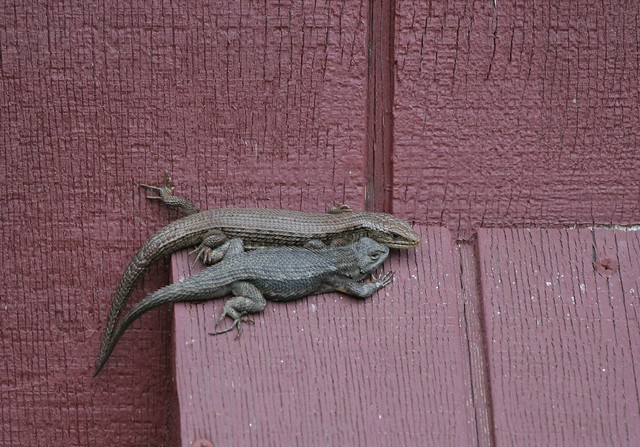
IMG_9785a

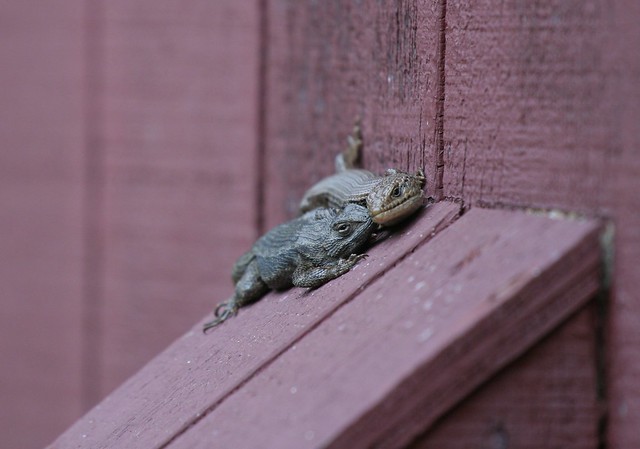
IMG_9784a


A western fence lizard (Sceloporus occidentalis) and a northern alligator lizard (Elagaria coerulea) sharing the weak sunlight of a cool spring day in Oregon (taken last April. Because I'm slow these days).

They look very similar, and occupy similar niches, but they're not too closely related. It's probably the equivalent of a pig and a deer cuddling up together.

Saturday, August 1, 2015

When Taxonomy Meets Dunning and Kruger

This started out as a short rant about how some people purposely misinterpreted a recent scientific paper because they have an agenda ... but who am I kidding? There's really only one fool who has "misinterpreted" the study, and if this person didn't have such a wide audience I wouldn't care. But for some reason, despite multiple abuses of science and historical facts over the years, Patrick Burns, aka Terrierman, continues to be considered some kind of expert. 

I normally let his posts slide on by without comment. But, like the festering sore he reminds me of, sometimes things just have to pop.

Here's just the latest example: Some scientists who are a whole lot smarter and more knowledgeable on the subject did some research on golden jackal DNA and decided that they'd found enough evidence to designate one of the populations as a new species, which will be called the African golden wolf instead of the African golden jackal. 

You've probably heard of it. It's the type of scientific finding that scientists publish widely and loudly because it's the kind of feel-good, easy-for-laymen-to-understand study about a recognizable charismatic megafauna. As they should, because it's interesting and we always need to do as much as we can to encourage the public's interest in science. Most scientists accepted it as another small building block in our understanding of the natural world, and then moved on.

Terrierman, using his typical "OMG LOOKIT ME I'M DIFFERENT AND SPECIAL method of discourse, dismisses the findings so quickly it left BURN marks on my screen[1][2]

"like, whatever"


Alrighty, then. Perhaps TM has some new insight that all the other experts missed? 

Yeah, not really. He has a scant few paragraphs full of condensation and non sequiturs. 
"If scientists have "discovered' anything in this instance, it is simply that Jackals are every bit as diverse as we have always known, and that a few populations may be a little farther along in the speciation process than what some other scientists have previously acknowledged. A little new information, but is a debate ender?  Not by a long shot."
Any biologist reading that paragraph would find it pure gobbly gook. Who called this a "debate ender" [3]? Even the NatGeo article he quoted points out that other biologists have some quibbles. What the heck is he even talking about when he says "speciation"? No scientist I've ever read has used the term speciation the way TM does

TM doesn't seem to understand how new species designations are assigned in modern times. There may not be a simple definition of what a species is, but there are many legitimate and accepted ways to designate a new one. As he himself points out, biology is messy, and what we see in our short lifetimes is a snapshot of evolution in constant motion. But just because there's gray area, doesn't mean the concept of a species is irrelevant or unobtainable.

The scientists who wrote the paper have solid, well-justified reasons to define this population as a new species, and they're laid out in detail in, y'know, the paper he's dismissing. He doesn't address a single one of their findings.

He's really hung up on how and when animals mate. It's a very odd obsession that he's seemed to have for years (see below), and he uses examples differently depending on how they can best serve his opinion. For example: it's well accepted science that animals will continue to hybridize long after it's useful to call them different species, as he has pointed out numerous times when it comes to the relationship between dogs and wolves! But he uses it to dismiss the African golden wolf designation because... "jackals have diversity".

Someone in the comments tried to gently correct him on his misconceptions, including his grim determination to call dingoes a separate species [4]. He responds with more handwaving that at times becomes incomprehensible. The comment section alone would need a separate post to explain all the gish galloping going on.

But here's the most telling comment from TM, at 5:01:
"The simple point is that your points all depend on ink from a library, while I am making a case based on real fur, feather, and fin.
You salute words, not fulling understand the fragility of those words historically or scientifically. How many genus and species have been created and merged, split and absorbed in the last 40 years? All ink and artifice as the animals themselves remain the same."

In the end, the only thing he has to fall back on is: "Enough of yer book learnin', you need STREET SMARTS...(like me)".

Yes. Let's all do science by instinct and gut feelings. Eliminate all the tedious counting and measuring.

What the heck would he make of all the other interesting puzzles of taxonomy, I wonder?

I'd like to introduce PB to the concept of "cryptic species". I know he's stuck in pre-1980's biology, but the wonder of DNA is it allows us to uncover all kinds of interesting things, like different species hiding in plain sight. Like African butterfly fish, where two species look identical despite 50 million years of separation

Or zebras, where the battle over names and subspecies designations has raged since the 1900's, and continues today, except better and smarter because of all the new knowledge we keep accumulating. The plains zebra alone has 50 possible names, and currently 6 relatively accepted subspecies. Every time a new study comes out, we add to and revise our understanding of the evolutionary relationships within Equus, just as we do with Canis. Using TM's logic, we should throw up our hands and ignore DNA, stop studying family tree relationships at all because it's complicated and there's gray area.

Or African elephants. When TM complains that "taxonomic debate these days is about humans looking to publish papers, get grants, name new species, and secure habitat protection"[9], the relatively recent designation of the African forest elephant as distinct from the savannah is exactly the type of thing he's whining about. Would he care that it was based on multiple robust studies of morphology, DNA, and behavior? What is enough evidence for assigning a new species for him?

These examples do not weaken the idea of "species" as a useful scientific and colloquial term; they're just part of the reality of cladistics. Anyone who knows what they're talking about has no problem rolling with fuzzy areas because discovering and defining the differences and similarities between closely related species is a rich mine for scientists. 

Whereas TM on the other hand, seems not only confused, but bored by any evolutionary relationship that a) was discovered after about the 1970's and b) is not very clear cut. He instead simply waves away complications by saying species isn't a useful concept (well, unless he says it is). How can he be against assigning species status based on autosomal DNA, but OK with assigning it based on geography and "culture"? He offers no reasons, just keeps repeating (and has since 2005 at least, see below), "just ask the animals, they know where the species boundary is." This is weird on several levels.

How does he know that they know? Is he telepathic? Does he mean it literally? Because I asked my dog and she didn't answer. And if he doesn't mean quite literally, does he mean "study the animals"... because... uh, that's exactly what the authors of this paper (and all the other papers he's dismissed over the years) did!

He just got done telling us that "species" isn't a useful term, anyway. Which is it? Do the animals "know" what species they are, or is there no such thing as a species?

Wolves and coyotes, and wolves and dogs, apparently don't "know", because they exchange genes a lot more often than he's implying. Notice that though he's forced to admit that canids mate, he very carefully never provides citations and always says "but it's not very often". He's relying on purposefully vague language. This allows him to dismiss any published data about gene transfer as irrelevant because "it's still a rare occurrence". There's no way for him to be proved wrong!

As many people have tried to point out to TM, it's a simple fact that dogs are a subspecies of wolf, whether you like it (or understand it) or not. [8]

Related: Desperately needing dogs and wolves to be different species despite the overwhelming data is a purely emotional response, and can only be due to his opinions and philosophies about dog ownership. What he repeatedly misses is the fact that, whether they are or aren't from a scientific perspective is moot when it comes to how we handle, train, and live with dogs and wolves. And no one argues otherwise except his very own strawmen.

This isn't an isolated case, either; Patrick Burns has a history of cherry picking data that fits his favorite theories, and applying purposely vague anti-science rhetoric when it doesn't.

Example 2: He thinks there are red wolves in West Virginia

"That's no coyote, it's a space station red wolf!"

From a scientific perspective, "red wolves" are at best barely recognized as a distinct species. We got more data and realized they're wolf/coyote hybrids, and that there is no real reason to classify red wolves simply by morphology, but it's still contentious, people get very emotional on the subject. It is a great example of a movement successfully using anti-science to muddle the waters to the point a layman would not be able to find accurate information on the subject. So perhaps PB could be forgiven for thinking that red wolves are still a thing, but.... even if red wolf was a species... there's no reason to think they're in WV [5]. Identifying a species from a single blurry photograph, in a place it shouldn't be, when it looks identical to another species that does live in the area... occam's razer, anyone?

Example 3: In a blog post he titled "Canis Soupus" 10/1/2010, he says some weird things. So many weird things, it almost deserves its own response in a separate post, but I'll keep it short and skip over most of the "WTF-ery".

Notice that this post is from five years ago, yet it's the exact same thing, almost word for word, that he keeps repeating when this subject comes up. Compare his comments over the years, and see if he's learned anything new: 

2005: "The simple truth is that dogs know they are not wolves, just as wolves know they are not dogs, and humans know they are not apes." 3/11/2005 "The Wolf Within"

2010: "And while wolves, dogs, coyotes dingos (sic), and golden jackals CAN interbreed amd (sic) produce fecund young, they rarely do, and the reason for this is that the REAL EXPERTS on species, the animals themselvs (sic), know they are very, very different." 10/1/2010

2015: "The real experts in these matters are not scientists, or even humans, of course, but the animals themselves. Jackals, dog, wolves, and coyotes seem to recognize major differences between themselves and give a hat tip to those differences 99.999 percent of the time." 7/31/2015 

This is also funny because he still treats dingoes like they're a different species[3] even as the graphic he uses doesn't even show dingoes because all scientists by 2010 group them with "dogs".

He pulled a quote from a NYT article. Unsurprisingly, he took the quote out of context. Ironically, the writer of that particular quote is Carol Kaesuk Yoon. She actually studied evolutionary biology, and in fact wrote an entire book on the subject of naming and differentiating species. A book I've actually read and highly recommend. You can read an excerpt, or listen to her talk about it, or read one of her essays on the same subject at the link above. 

She is an actual expert in the very area that TM is pretending to be an expert. Compare TM's rants to even a casual glance through her book, or even the freaking publisher's summary:
TM:
"In fact, scientists are starting to come to terms with an important idea, which is that a lot of animals are in the process of speciating ... and that the notion of species is a human idea that still needs a lot of work..."
Book summary:
 "...[this book] is a rich journey from Linnaeus, whose system turned classification from a hobby to a science, and Darwin, who ended the idea of rigid species definitions..."

Yes, that's right, TM is trying to pass off the well established, century-old concept that species have fuzzy edges as "new". What's worse, he's doing it to try to make scientists look like confused idiots too wrapped up in their book learnin', and himself look like a wise paradigm-shifter.

I wonder what Yoon would think of her own words being used as anti-science rhetoric? Well, I have a guess. Here is another quote of hers, taken from another NYT essay

"...the ordering and naming of life is no esoteric science. .. sorting and naming the natural world is a universal, deep-seated and fundamental human activity, one we cannot afford to lose because it is essential to understanding the living world, and our place in it."

Example 3.5: In 2006, in a blog post titled "The Wolf Within", 12/11/2006, which is mostly a repost from 3/11/2005 [6]. He says Darren Naish is awesome, which, like quoting Yoon, is ironic, because Darren Naish now heartily disagrees with him about canid taxonomy, and since 2006 has drastically revised his position on the origin of domestic dogs based on new data. He would also, I suspect, disagree with TM about how scientists nowadays are tedious, attention-seekers who don't know how to make "real discoveries" anymore.[7]

TM's post from June 2015 titled "A Dog is Not A wolf" is nothing but a rehash of all his previous posts on the subject. Nothing new, and he suddenly doesn't seem to want to cite Naish anymore... hmm...

Example 4: He denies that black wolves got their melanistic gene from dogs. ("And White Wolves Come from Mars" 2/6/2009)


Look how he uses the same language and dismissive tone as he does every time he talks about science he doesn't like. He uses a few simple, accurate statements ("melanism is common", "dogs and wolves are related") then adds in his unjustified opinion ("therefore, the scientists can't prove the gene is from dogs"). It's like the definition of a non secitur. He seems to think that one can be correct simply if one is forceful and confident, but that's nothing but the Dunning-Kruger effect.

Notice how he also doesn't link to or critique the study itself, just the newspaper article about it, of which the most damning fact he can come up with is the author doesn't speak in absolutes.  

Example 5: He thinks DDT didn't affect raptors ("Bald Is Beautiful" September 5, 2008)

... and was called out on it here

The best that can be said about TM is that he wrote a few good blog posts about dog breeding and working animals. Unfortunately, he thinks that gives him authority to post many, many bad blog posts on subjects he's clearly not well versed. What's worse, he does so with the most condescending, uncompromising, unearned superiority complex I've seen outside of a politician.

No one ever told him, in the case of science writing, "fake it 'til you make it" is not the best motto to follow.

He uses anti-intellectualism when it suits him, and as an insult for people who disagree with him when it doesn't. He cherry picks data in the worst way. He holds on to outdated theories with an iron grip, violently denying all evidence against them. His blog is mostly a long list of non sequiturs he uses to boost his opinions, and he does nothing but add to the white noise of the anti-science movement. This is all the more insidious because he cloaks himself in the trappings of "science-ness" - and is believed by a depressing number of people.

Please, if you're a regular reader of TM, don't allow him to get away with this any longer. Start looking at his words more critically. Post skeptical comments and see how he responds. Don't share his posts without double checking his facts first. 

----------------------------------------------------------------


[1] SEE WHAT I DID THERE
[2] see terriermandotcom (dot) blogspot (dot) com (yes, that really is the address he chose for his blog), 7/31/2015 "First New Canine in 150 Years?"
[3] Aside from his strawmen, of course. Oh, Patty looooves his imaginary strawmen opponents
[4] Back in olden times, before DNA was used in biology, it was logical to argue that dingoes were a separate species based on morphology and geography. Now, with new data, we know better. Dingoes are just dogs. You can call them a breed, or a population, or type, or regional variant, or whatever, but the science is pretty clear: they're dogs, closely related to other native breeds from east Asia.
[5] except to get attention for his blog
[6] He quotes himself almost as often as he quotes newspaper headlines.
[7] I can only assume that he finds all new species discoveries that don't involve Englishmen in tweed stomping through jungles as boring. Finding the new olinguito? Just some bookworms digging through a library, how boring!
[8]  Savolainen et al. 2002, Lindblad-Toh et al. 2005, Pang et al. 2009, vonHoldt et al. 2010, Larson et al. 2012Freedman et al. 2014...
[9] as if any of those things are automatically bad, or not useful, or not interesting, or even new (from his 7/31/2015 post "First New Canine in 150 Years?")

NOTE: I did not provide links because I don't want to encourage traffic to his site, which gets more than enough undeserved attention as it is. If you want to read his posts, my citations should be adequate to find them. If you can't, ask and I will provide a link via email. Or the screencaps in case some editing or "disappearing" occurs.


Thursday, August 28, 2014

Moenkop Dinosaur Tracks

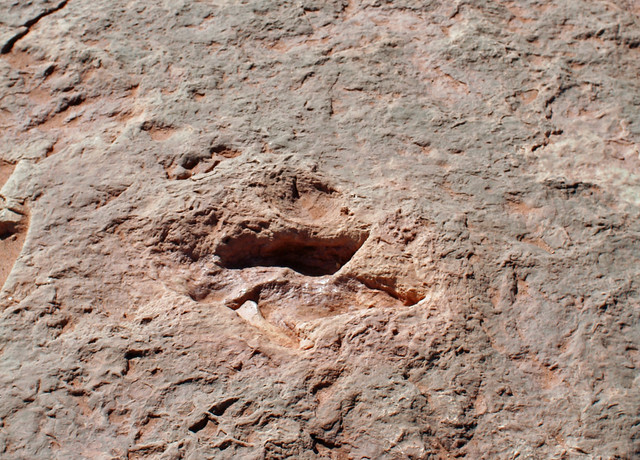
IMG_8172a

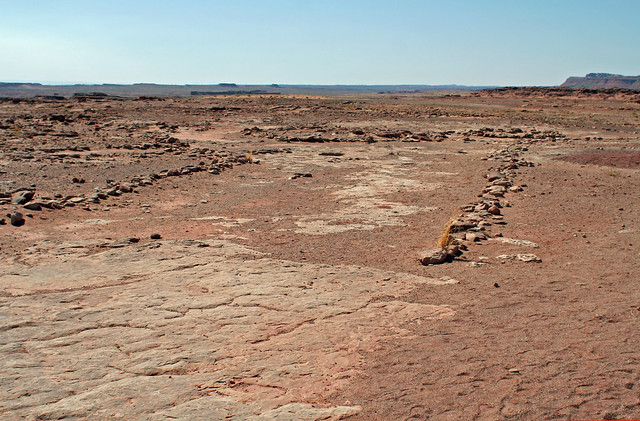
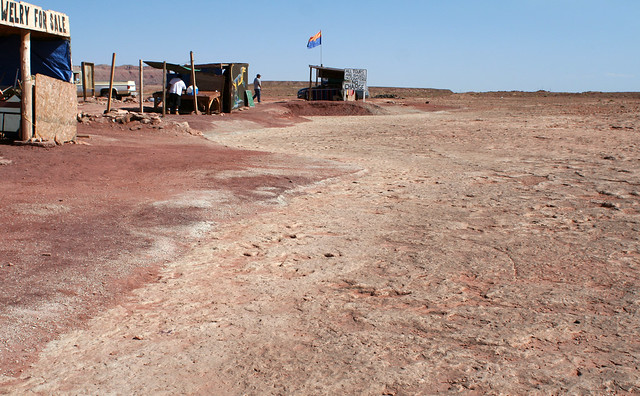
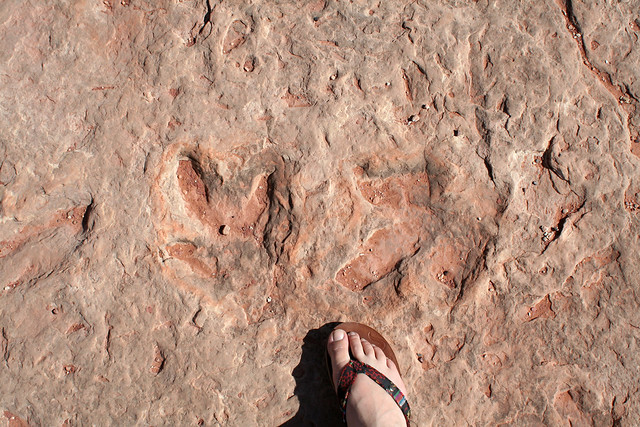
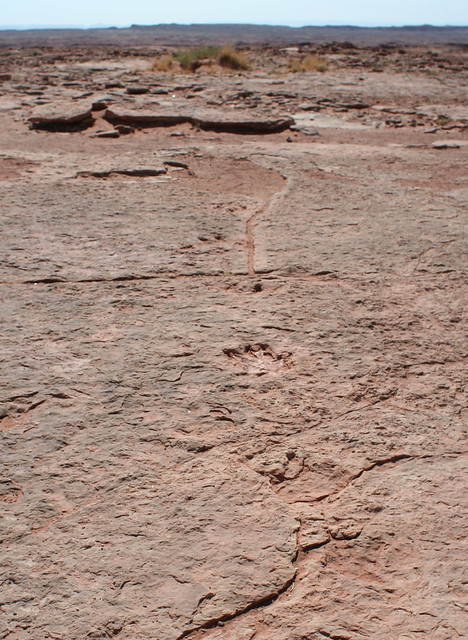
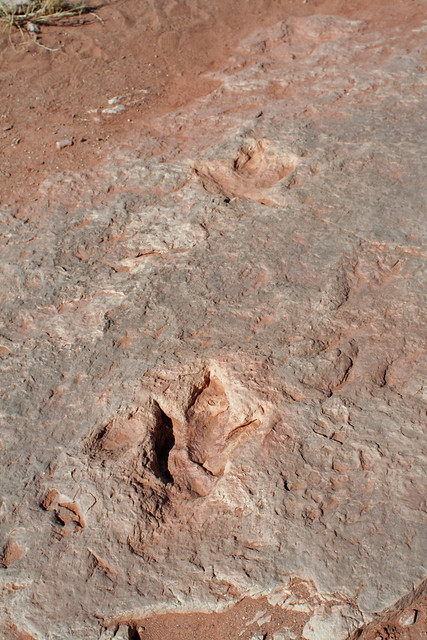
Turns that just outside of Tuba City, Arizona is a huge field of early Jurassic dinosaur tracks. Who knew.

There is a hand-painted sign by the side of the road and a gravel parking lot with a few venders selling Navaho crafts. Some of the locals offer to give guided tours, but I turned them down in favor of just wandering, carefully, along the edges of the tracks (there are no fences or signs, just piles and lines of rocks the locals have made to outline certain areas. I watched three kids run around right on top of some of the tracks and cringed a bit).

There is very little information online about this insanely cool place. There's some about the legends from the people who've lived next to them for thousands of years. There is one published paper by Wells from 1971 (couldn't find online). According to an article from 2012, the Navajo Nation plans to develop a tourist center at the site, but for now there hasn't been much development or scientific study of the site, which sort of boggles the mind. This brief note on the Experience Hopi website is about the only reliable info you'll currently find online. Wikipedia doesn't even have a stub article on the site. That's how bad it is (and probably why creationists, who love both made up shit and information vacuums, have latched onto the site and claim there are human footprints alongside the dinosaurs, thus disproving evolution.)


IMG_8177a


IMG_8185a


IMG_8186a


IMG_8174a


IMG_8171a


Wednesday, August 29, 2012

Archeologists Evicerate "Paleo Diet"

This made me lol into my Ramen tonight.

The seminar titles alone are worth the price of admission:

It’s When You Mate, Not What You Ate"

or

"Papayas Ain’t Paleo, and Neither Are You"

“The notion that we have not yet adapted to eat wheat, yet we have had sufficient time to adapt to kale or lentils is ridiculous. In fact, for most practitioners of the Paleo Diet, who are typically westerners, the majority of the food they consume has been available to their gene pool for less than five centuries. Tomatoes, peppers, squash, potatoes, avocados, pecans, cashews, and blueberries are all New World crops, and have only been on the dinner table of African and Eurasian populations for probably 10 generations of their evolutionary history. Europeans have been eating grain for the last 10,000 years; we’ve been eating sweet potatoes for less than 500. Yet the human body has seemingly adapted perfectly well to yams, let alone pineapple and sunflower seeds.”

-- "Dr. Karl Fenst, bioarchaeologist"