Showing posts with label urban wildlife. Show all posts

Wednesday, September 5, 2018

The Saddest Harvest


This is the third summer I've lived in this house, and it's the third summer I've made the sad collection you see in this jar: dead bumblebees collected from the back part of the driveway near the garage.

I don't think their deaths are natural. The slow but noticeable pile-up of tiny fuzzy bodies starts in early July, long before the cold nights start taking their natural toll on the population, and I maintain two bee baths nearby so it's not likely to be dehydration, either. And of all of my yard, it's only these 100 or so square feet where they accumulate; I'll find the odd dead non-native honey bee or wasp scattered all over the yard, but nothing near the numbers of bumbles in this one spot.

There is the possibility that this neighborhood simply has a lot of bumble bees. I've seen swarms of them on neighbor's lavender, and in my silk tree. The workers only live about a month, and it could be coincidence that I find so many in one spot. Maybe heat rising up from the asphalt happens to catch an abnormal number of weak workers already on their way out.

But I can't help but think it's related to pesticides. We don't use them*, and neither do our immediate neighbors, but I can guarantee that previous owners did. The house was built in 1910, so it's been through every single wave of modern pesticide use, possibly starting with the old fashioned lead or arsenic-based ones, followed by organochlorines, then organophosphates and carbamates, then pyrethroids and neonicotinoids. Most of the most popular pesticides in the last century last a long time in the environment, and could have left potential residues.

We have a curious lack of ants in the house, when many other locals have a huge ant population in their kitchens; we have a lack of wasp nests in the eaves, or under the porch, even this year, which has seen record numbers of wasps due to a mild winter. This probably means the perimeter and eaves were treated with pyrethroids in the last few years. And probably have been annually for decades, since pyrethroids first went on the consumer market. The soil and mulch left from previous owners, surfaces of the asphalt driveway, the foundation and eaves of the garage and the house, all probably have at least some residues of long-lasting insecticides.

Bee declines are more on the public's radar now than a decade ago, but of course everyone wants an easy answer and a "quick fix". The push to to ban individual insecticides like imidicloprid or other neonicotinoids  has the feel of a handy scapegoat, an easy-to-understand boogyman. What the science is clear on, however, is that the single biggest threat to pollinators (and most species, for that matter) is habitat fragmentation. Many of the same people so adamant about banning pesticides maintain pollinator food deserts in their own yards with a traditional manicured lawn.

My opinion is that residential use of pesticides for "frivolous" reasons (killing pests in ornamental plants including lawns) should be a lot more restricted, instead of banning their use in agriculture. At the same time, farmers should be given incentives for increasing biodiversity on their land, and reducing chemical inputs and reducing waste across the board (that includes long distance shipping, burning or trashing harvests when prices go down, etc).

I won't be having my soil tested because my actions would be the same no matter if it's pesticides or other things killing the bees: plant my vegetables in raised beds filled with fresh soil; mulch the heck out of everything else to bury any contamination; keep the bee-baths filled during the driest months; plant native flowers and shrubs that provide year-long food for pollinators, hopefully in a way that is so attractive from the curb I can convince my neighbors to follow suite.

In the meantime, every time I see another sad little fuzzy body in my yard, I get to ponder the follies of modern living.

Image description: A photograph of a glass jar holding about twenty dead bumblebees.

 *With a few, very tiny exceptions, such as fipronil or imidicloprid flea drops on the cat and dog.

References:
https://xerces.org/bumblebees/
https://xerces.org/pollinator-redlist/
https://www.chemistryworld.com/news/what-you-need-to-know-about-neonicotinoids/3008816.article
http://www.sciencemediacentre.org/expert-reaction-to-eu-ban-on-outdoor-use-of-three-neonicotinoid-pesticides/
https://www.epa.gov/pollinator-protection/colony-collapse-disorder
https://www.ars.usda.gov/oc/br/ccd/index/
https://www.smithsonianmag.com/science-nature/north-american-bumblebees-on-the-decline-41344352/
https://www.smithsonianmag.com/smart-news/the-american-bumblebee-is-crashing-too-293832/
http://npic.orst.edu/ingred/permethrin.html
http://npic.orst.edu/factsheets/chlordanegen.pdf
http://npic.orst.edu/ingred/imid.html
https://blogs.ei.columbia.edu/2010/06/04/the-problem-of-lawns/

Tuesday, July 5, 2016

Interesting wasp nest

In the wall of a fair booth I volunteered to clean out. It's only July 5th, usually you don't see them this big until at least the end of July or August. The nest was mostly inside the wall, with three exit holes on the outside wall, and two exits on the inside. It was probably three feet in diameter inside the wall cavity.

https://flic.kr/p/JF88XG

Saturday, September 12, 2015

Sketch from yesterday

The scene would have been impossible to photograph, but I thought it worth a minute's-worth of sketching to remember: two coyotes by the side of the road, one recently killed, one standing at a distance, panting and looking around, seeming to be at a loss.


The outskirts of Pendleton, Oregon

Sunday, December 22, 2013

Cold

Earlier this month we saw some very cold temps - the lowest I saw was -18F with wind chill.

I've never seen the birds hit the feeders as hard as they did that day.


IMG_7332a

Sunday, August 19, 2012

Black Widow

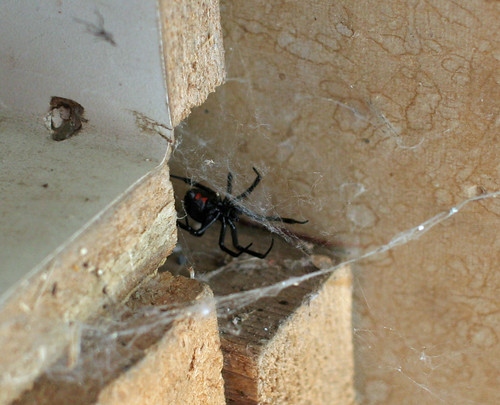
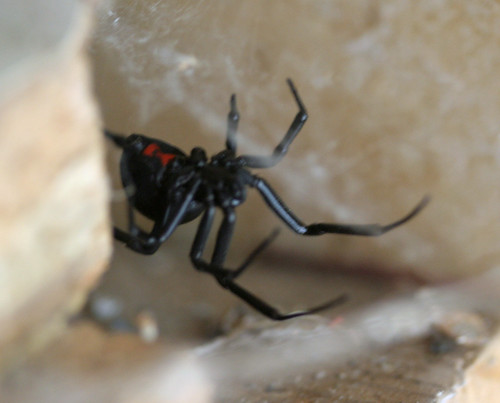
Found her on the patio today while I was rearranging some potted plants.


IMG_5806a

I was a bit sad that I had to kill her. She was just doing her thing, eating some ants and hiding under a pot.


IMG_5804a


Black widow spiders are ubiquitous in this part of the state. This is the seventh one I've found on my house this summer, and that's without looking (don't tell my husband). If I see them in the front yard I let them live because me and the dogs don't spend much time there. But this one was on the patio where the dogs spend a lot of time nosing around, and I just couldn't take the risk.


IMG_5799a

Sunday, September 11, 2011

An Epic Battle

Mantids are scary. If they were the size of cats, I think we'd be screwed.
I was already a little freaked out by them, with their too-intelligent eyes that follow you when you walk by. Then I had to go and witness this:

I was cleaning the large animal area at work the other day when I noticed three praying mantis sitting together on a fence post. Two larger ones which I assumed were females, and a smaller one, probably male. I admired them for a moment, then continued on with my work. A few minutes later, I glanced over at them just in time to see one of the females take a few steps and leap onto the other female, grasping her thorax. Soon it was a fight to the death. They grappled, biting at each other's faces and arms.

A few minutes after that, I watched the male tiptoe closer and closer to the fight, then finally hop onto the back of the attacking female and start to mate with her as she was killing (and eventually decapitating and eating) the other female. I don't know his fate, because I had to go back inside. But when I came out an hour later, only the (now engorged) victorious female remained on the fence, with a pathetic pile of shredded wings on the ground below her feet.


IMG_3541


IMG_3542


Nature, red in tooth and claw, indeed.

Thursday, June 16, 2011

unexpected road trip

A family member became suddenly and seriously ill last week, so we drove to Billings, Montana in a bit of a hurry. I wasn't even going to bring the camera, but my husband insisted. "We can't spend the whole time at the hospital," he said. "If you leave it you'll complain the whole time."

I'm glad he knows me so well.

Item #1: Urban wildlife around Billings.

A group of Richardson's ground squirrels in an empty lot between hotels and the freeway. I'm not sure where they're going to go when they're ready to move colony because there isn't another patch of grass this size for probably a mile in every direction.


IMG_2442a


IMG_2459a


IMG_2467a


Bunny rabbit, I'm assuming a desert cottontail, outside a restaurant also near the freeway.


IMG_2469a


Item #2: Pictograph Cave State Park. There are rock paintings. They are old. Also natural sandstone sculptures, nature's abstract art.


IMG_2516a

IMG_2483a


IMG_2481a


IMG_2493a


IMG_2502a


IMG_2518a


Item #3: Plant sexual organs, and them that sexes 'em up.


IMG_2427a


IMG_2429a


IMG_2506a


IMG_2508a

Tuesday, February 22, 2011

A Trip to Gramma's

roadtrip02

It's not every day your gramma celebrates her 90th birthday. It's an event we couldn't miss. We traveled on the west side of the Cascades on the way down, and on the east side on the way up. Tom, amazingly, drove the entire way, even after the gagillionth time I had him pull over for a photo op.


The scenery:

IMG_1754a
Somewhere in the Siskiyou Mountains, CA


IMG_1939a
Windmills near Wasco, OR


IMG_1834a
Near Butte Valley, CA


IMG_1919a
Lone shack near Shaniko, OR


The wildlife:

IMG_1759a
Great egret, near Woodland, CA


IMG_1778a
Whitetail deer, Hidden Valley Lake, CA


IMG_1781b
Abscessed(?) deer, Hidden Valley Lake, CA. Ouchy.


IMG_1787a
Wild turkeys, Hidden Valley Lake, CA


IMG_1902a
Pronghorn near Culver, OR


IMG_1925a
Hawk which I'm not going to try to identify right now, near Kent, OR


IMG_1881a
Pair of bald eagles chillin' near Klamath Falls, OR


IMG_1790a
Elk near Clearlake, CA


IMG_1906a

OK, this isn't wildlife. But this photo was taken while we were going 70 MPH down the freeway, so I get some kind of credit for timing, right?

Thursday, April 8, 2010

Hummers

My parents have been putting out humming bird feeders for about fifteen years. In the last three, the population visiting their house has exploded. Suddenly, the four feeders have to bed refilled almost once a day. During the 'hot' season (ie, right now, after they've returned from their wintering grounds and are setting up nests and sitting eggs) there's an almost constant presence at the feeders. Males establish territories around each feeder and fight each other and watch females come and drink. They're fierce little things. As my mom says, if they were the size of magpies, you wouldn't be able to hike in the woods without body armor.

IMG_8843a


IMG_8837a


IMG_8829a


IMG_8832a


I've never tried to photograph humming birds before. My lens was barely up to the task, but we made out OK.


IMG_8839a


IMG_8815a

Thursday, March 11, 2010

"Why don't they just shoot them?"

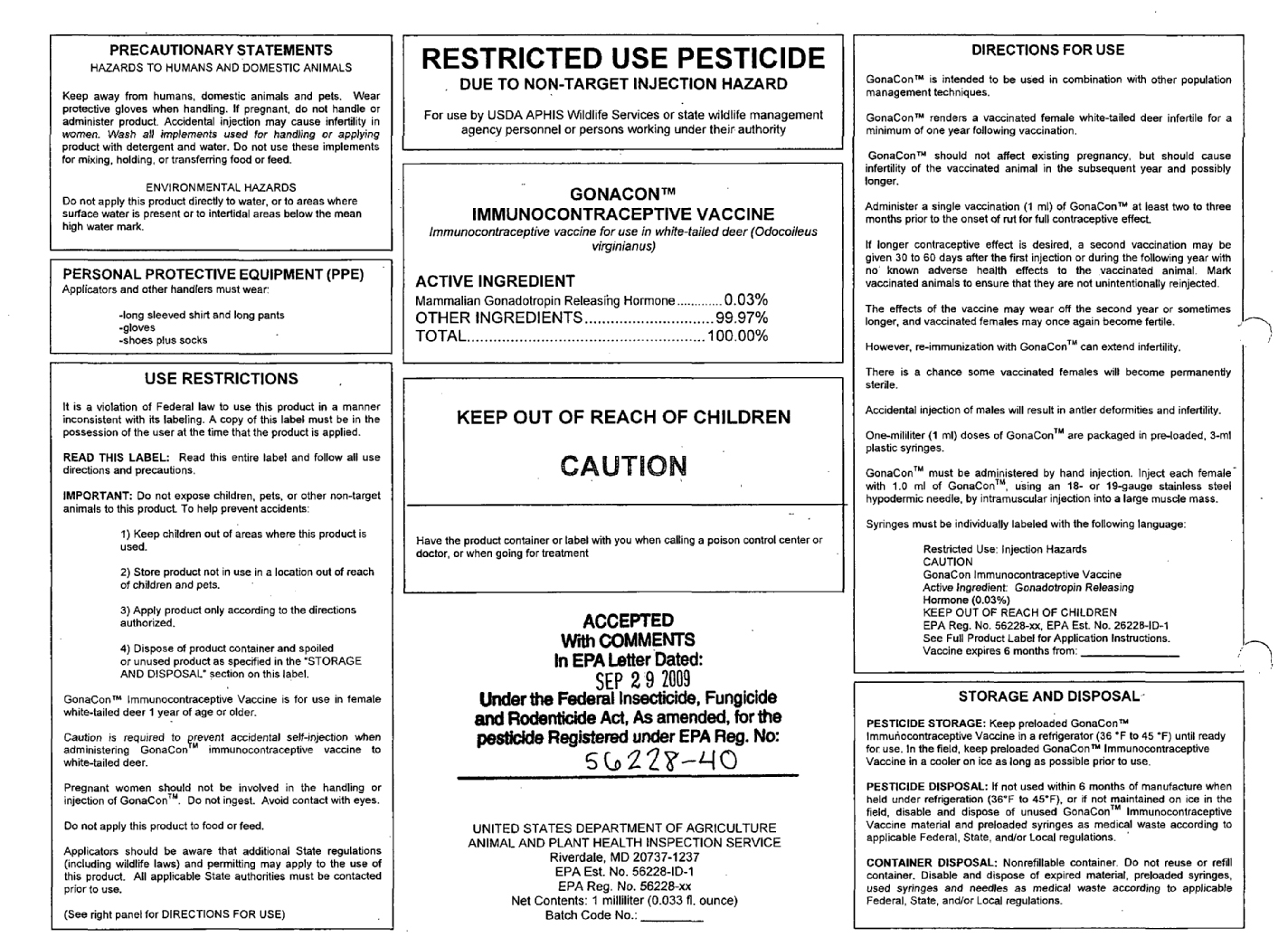
The title of this post is what my co-worker (a vegetarian and self-described "bleeding heart") said when I showed her the label for this new pesticide product:

deer contraceptive
Click to enlarge. Sorry for the blurriness. This is a screen grab of a scan of a photocopy. Thanks, EPA. You can access the original by going here and searching for EPA registration number 56228-40 or by going to regulations.gov and searching for docket number EPA-HQ-OPP-2009-0776

You may have heard the rumors that USDA was considering contraception as population control for deer (and wild horses and goats). They're apparently moving forward with this plan if they bothered to go through the process of registering a product with EPA (which confuses me - vaccines are NEVER registered as pesticides, they fall under FDA's jurisdiction. Why the exception for this one?)

Note that this vaccine can only be applied by hand. That means the animal first has to be trapped or snared, leading to great stress on the animal. Not to mention being extremely expensive.

It's only guaranteed to last for a year. Depending on life expectancy, it's safe to estimate that you'd have to treat the same individuals at least several times in their life.

USDA cites "great public interest" for their reason for pursuing this form of population control. I believe it. "Great public interest" was also the reason USDA pursued and eventually implemented the incredibly flawed National Organic Standards. I appreciate a government agency that's willing to listen to the public. But this is just ridiculous.

Hunting is known to be very effective for deer population control. Not only does it NOT require state or federal money to implement (and in fact generates money through purchase of licenses and tags), it is arguably more humane than trapping/snaring/tranquilizing. It's certainly more humane than starvation, and gives the hunter and his/her family a source of environmentally friendly protein to eat. This sounds like win-win to me.

NPR ran a story recently about this type of special hunt in Connecticut where deer had reached densities of up to 60 per square mile. (Also, do you notice that many wildlife biologists are also hunters/pro-hunting? I thought it was just an Oregon thing, but apparently not).

I do understand people's concern about risks. Some of these parks are very close to houses. Maybe contraception could be useful in small, isolated areas where there's no safe way to discharge a firearm. But, forgive me for being so blunt, if you're going to go to the trouble of trapping or tranqing an animal, why not just kill it right there? Why submit them to multiple trapping and handling and then releasing them back into habitat where they'll still be at risk of starvation?

I've worked for USDA. They can't even afford to maintain their Forest Service roads or rest areas even with fees and even in high traffic areas. Where are they going to get the money to implement contraceptive-based population control program that actually works?

One way or the other, whether it's cruelty through neglect because we removed their natural predators, or hitting them with cars, or trapping and vaccinating or relocating or hunting, humans are going to intervene in these animals lives. We have to choose the most humane way to do so. I have a feeling that hunting is still under-utilized for population control simply because so many people are thoughtlessly anti-hunting.

Dear USDA: Spend some of the money going toward this whole program on educating the public about hunting. Maybe show some ribby, tick-infested deer and their dying fawns staggering through the park they've denuded of vegetation and getting hit by cars during their desperate search for food. Maybe it will get through to some people that hunting is not necessarily evil.