Showing posts with label horses. Show all posts

Tuesday, January 28, 2014

Open Letter to Those Who Want to Ban Carriage Horses: Let's Play a Game

CIMG5807
Good looking carriage horse in Dublin, Ireland

We've seen it before. A group of well-meaning but clueless animal-lovers, aided by self-serving politicians, are on a crusade to save animals that don't need saving

I'll let other people write about how misguided, hypocritical, short-sighted, and just plain stupid this is. Here's a summary. Jon Katz writes well about it. Liam Neeson weighs in with some good points. Here is a 2008 opinion from a Salt Lake City, UT driver. Here's another one from her. This driver seems to like horses, not abuse them.


What I'd like to do here is play a fun game that I truly and sincerely wish these do-gooders in NYC would play with me: 


If I can find you at least 230 horses that are in worse conditions than the NYC carriage horses, will you please spend as much time, energy and money helping them as you are "saving" the carriage horses?

Let's start with these 13 semi-feral horses in Ephrata, WA from a decaying breeding farm. They need to be re-homed ASAP: the stallions are breeding the mares willy-nilly and none of them are even halter-broke or being cared for in any meaningful way.

Then there are the 400 unwanted "wild" (feral and semi-feral horses mostly released or lost and breeding unchecked in recent years, not the more truly wild mustangs found in other parts of Oregon) on the lands of the Confederated Tribes of the Umatilla Indian Reservation. The problem has gotten so bad that some tribal members are actually calling for a mass round up and slaughter. These are fair-to-good looking animals, they simply lack care and training.

Perhaps you could help the Buck Brogoitti Animal Rescue in Pendleton, OR. It is basically the only place that the authorities in Umatilla and surrounding counties has to bring large animals that are seized in animal cruelty cases, and it is funded completely by donations. They have at least a dozen horses available for adoption right now.

There is also the Equine Outreach Horse Rescue in Bend, OR. It is also one of the only places for hundreds of miles able to care for abused and neglected horses, and it also runs completely off of donations.

Or the Lighthouse Farm Sanctuary in Scio, OR. They take in horses that have no where else to go, and could use help buying hay.


Or you could visit the Hermiston, OR livestock auctions. The kill buyer will be there. Yes, I've met and talked to them. No, I won't tell you who they are, but you'll know them because they're the one bidding on all the larger horses that no one else wants, and they won't bid above about $300.

The Hermiston-based kill-buyer ships 30 horses every week to a slaughterhouse in Canada.

Let me repeat.

Thirty horses every week are sent to slaughter from Hermiston, Oregon.

If you'd like me to do the math, that's 1,560 every year. This particular buyer has been at it for at least 10 years. And these horses are not old, sick or lame, either. The majority are younger, healthy Quarter Horse or Paint mares. Their only sin was simply never getting trained and are therefore sold cheap and fast.

You want to "save" a horse? How about saving one from 3-7 days of stress, mental and physical exhaustion, and pain, finally ending with a stunner to the head. Buy one of these perfectly good horses before they go to slaughter, send it to a trainer, then sell it to a hobby-riding home. Because, while there are very limited number of homes who want a "pasture pet", there is always a market for sound, well-broke horses.

Leave the damn carriage horses alone. They're leading a meaningful life, enriching the lives of the humans around them, and being cared for better than any of the horses listed above. 

Saturday, January 4, 2014

Things Fiction Writers Need to Know About Horses


It can be a difficult road for those of us who are both avid consumers of  spec fic and also knowledgeable about certain elements of such genres.

Nothing is as ubiquitous to portrayal of the pre-modern lifestyle than the horse. And no other creature is as abused through sloppy research and lazy writing.

The worse transgressors are, of course, screenwriters, then novelists (especailly those using the Tolkein Play Book(TM)). And I suspect if you took a random sampling of horse art in comics, there wouldn't be an accurately drawn bit of tack in the entire lot. I'll give video game creators a lot of forgiveness due to playability issues with a realistic horse (constantly losing your mount every time you dismount to fight a forest spider would get old real fast). But novelists, now, you have no excuses. You're already researching stuff. That's what the internet is for.


I really appreciate the blog "Science in my Fiction", but they severely lack in the domestic animal category.

Let's talk a little about horses, shall we.

Horses are not dogs
I think this is the basic problem with unrealistic depictions of most fictional animals. Your average writer is a lot more likely to own or have available a dog than a horse. Therefore are a lot more familar with dogs than with horses, and instinctively (or purposefully) extrapolate traits from one animal to another. Humans in general share more similar social structure, diet and ways of communicating with dogs than we do with horses. We also have associated much longer; dogs about 30,000 years, horses at most 9,000.

So let's get this out of the way first: Unless specially trained (or magical) a horse:

1) won't come when called
2) won't stay put unless tied
3) won't fetch your slippers (or your sword)
4) won't guard your house/camp/village, and won't call an alarm either, if it can run away instead
5) won't fight by your side if you're unseated during a battle
6) don't want to be your friend. They may like you, but they want to be with other horses more (sorry to break it to you, 12-year-old me and also pretty much every 12-year-old girl everywhere ever)

While there can certainly be affection and mutual trust between horse and human, loyalty is not a default horse setting. And most simply don't have the capacity to follow commands once the human is out of sight. You want these traits in your fictional horses? Use some world building, please. A single sentence like "...the Wallyhoo war horses, specially bred for a thousand years by the magical wizards of the Great Plateau, would gladly <insert non-horsey trait here>" is all it takes.


A scared horse is a quiet horse
Real horses are a lot quieter than their fictional counterparts. Most of their communication is body language. They may whinny and nicker as a greeting, but they may simply sniff and nuzzle each other. They may shout a distressed call to their friends if they're left alone, or they may simply stare with concern. An angry horse may squeal, or make this growling screamy noise, but usually even the most violent of horse fights are silent except for the scuffling of feet and the occasional grunt.

A horse who is scared but accessing the situation will often snort, like this. On rare occasions of extreme terror and imminent pain and/or death, a horse will scream. But a horse who thinks they're facing an unknown predator (i.e. anything new including shadows), is not going to "whinny in fear" or make a bunch of commotion to attrack that predator's attention. They're going to be quiet until they deem it necessary to run away.  After that, the only commotion will be them fighting their rider/traces/pack saddle if it interferes with their escape.


Horses don't care about blood
If I had a nickel for every fantasy novel containing the equivalent of "...the horses went wild at the scent of blood", I'd have enough to make, like, a big coin mural or something.

Unless it's the blood of a herdmate, or a battle-hardened horse who's been taught to associate the smell of blood with fear/pain/excitement, your average horse could give two figs about another creature's blood.

At least once a year, my family skins and cleans deer elk and/or sheep in the same barn where the the horse stalls are. Do you know what the horses do as we fill buckets with blood and viscera five yards away from their faces? Watch with placid indifference. They had the option of running out into the pasture, but they never did. I once brought them my blood covered hands to smell. They sniffed with academic interest, probably just to make sure there wasn't a treat they were missing.

Horses don't need to be big
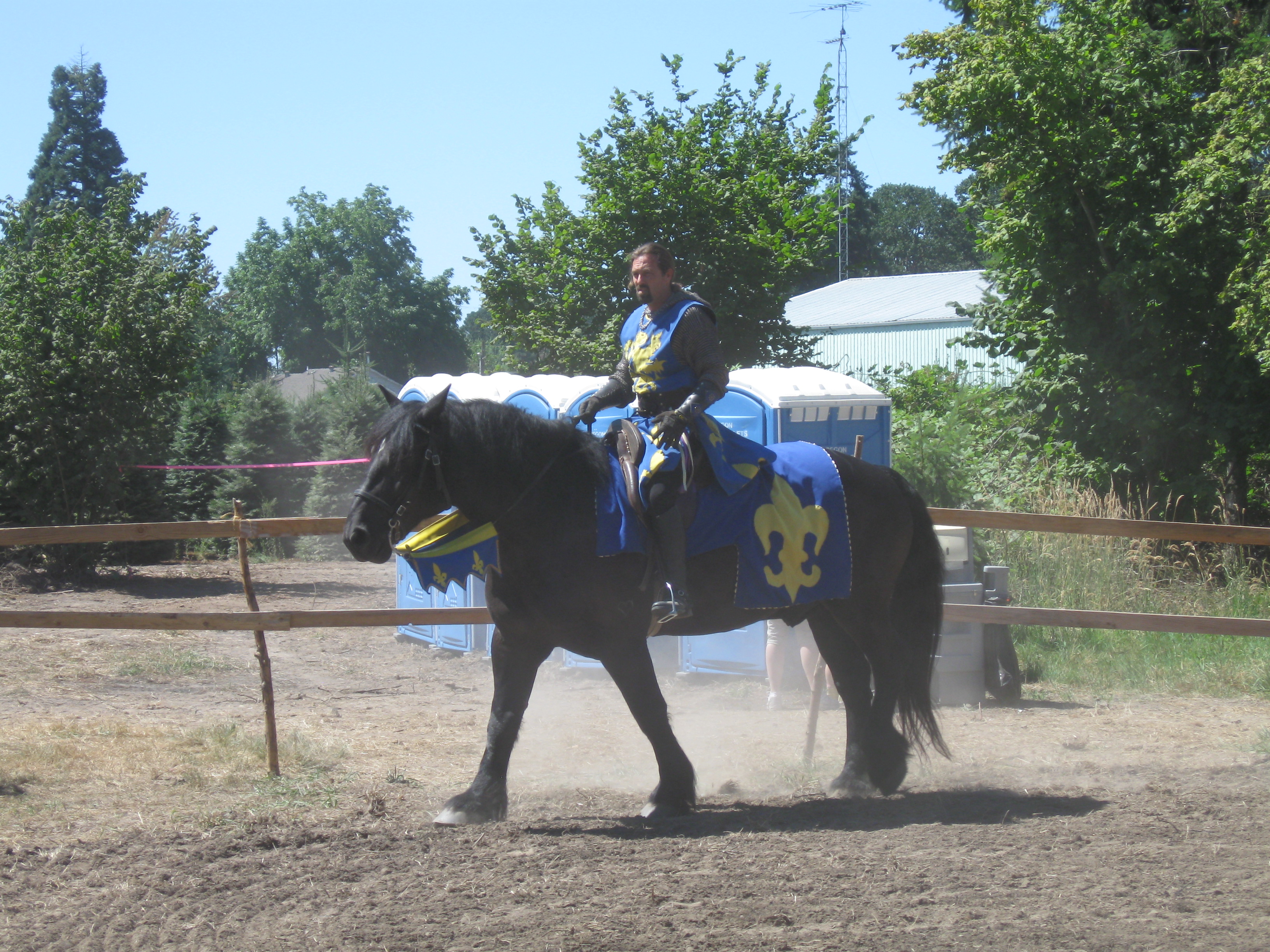
The irony of ren faires (though I love them dearly) is that the lowly equines of the  kids' pony ride look more like actual historic war horses than the ones used in the "re-enactment" shows.

A beast as large as the one pictured below probably didn't exist anywhere in the world until the late 18th century.


For millinea, horses have been getting the job done while being under 15hh. Yet, everywhere you look, in fiction and non-fiction re-enactments, you see modern-looking, giant horses doing everything, from pulling a plow to carrying a soldier into battle. It's downright insulting to horsekind to say that only those over a certain size can do any real work.

The average sized horse in 14th century Britain was 12-14 hands; Ghengis Khan's army of horses were all about 13 hh. The best bred horses in the ancient Greek armies averaged 13.2-14.2hh (including the famously "massive" Bucephalus).

Here's a couple of photos to get a feel for what 12-14 hh looks like. Keep in mind also that people in the middle ages were not much shorter than today.


Can you imagine a 12hh pony like this being in a cavalry charge? They were!


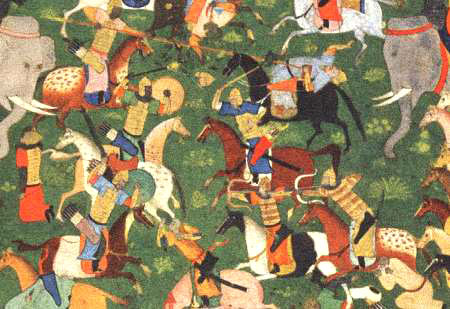
Compare it to this illustration of a Mughal nobleman (c. 1660) on what was probably considered a fine, large war horse (and is likely is under 15hh).


The riders on the Bayeux Tapestry have their feet dangling well below the girth (common in a lot of old horse art you'll notice), indicating the horses they're riding are quite small indeed.


We'd probably call it animal cruelty today if this This 13.2 hh pony were loaded with a grown man plus armor and weapons. But for the majority of history, this would have been considered a fine horse for a rich guy to ride in a battle: muscular, good bone, good hip, and short coupled back. It's our modern imagining of a destrier in miniature - except it wouldn't have been considered "miniature".

Farm horses didn't look like this:


They looked like this:


For an idea of how normal small size was up until recently, consider the law passed in England in 1540 CE. In order to improve the size of English horses, it became illegal to breed stallions if they were smaller than 15hh. Mares had been set an even lower bar, and could be bred as long as they were at least 13hh. A couple of decades later, Queen Elizabeth partially repealed this law because she was afraid horses would get so big and heavy that they'd sink in the English mud and become mired.


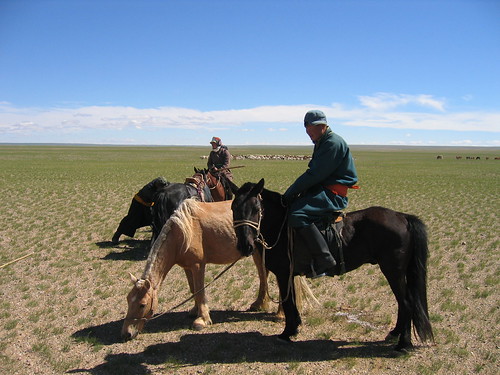
If you want to see what real horses were like, don't look to ren faires or movies or reenactments - look to Mongolia. The horses there have changed little over the last couple thousand years. They're still small, hardy, survive on little forage, and are expected to carry full grown adults and supplies over long distances.


 http://www.flickr.com/photos/tiarescott/33317871/


Stallion myths
Even the average horse-savvy person, if asked about stallions, will likely spout at least one myth, that's how much knowledge we've lost since gelding became common. There's a good summary of common myths here

Basically: stallions should be treated just like any other horse. Stallions aren't super special alien beings. In many countries where castration isn't common, stallions work alongside other stallion and geldings and mares often.

Also note: historically, mares were ridden into battle at least as often as stallions.


Know your gaits
On the whole, I'm not a terminology nazi. However, trot, canter, and gallop are not interchangeable. Also, they are not the only gaits that exist. There is this thing called pacing (see also: amble, tolt, rack, run-walk) that is very important to know about if your fiction world doesn't have good roads and carriages with advanced suspension. It's not as popular now, but historically a horse who was able to pace was more common than not in Europe. Riding long distances is easier because it's smoother than a trot, but about as fast.

Your character did not "gallop all night", because even the best horse, unless aided by magic, can't sprint for hours without rest. If you want to fudge and say "he ran all night", fine. But most likely, if you're traveling any distance on horseback, you're going to spend most of it at a trot (about 7 mph) (or, as discussed above, an amble or running walk, which is about the same speed). A healthy, conditioned horse being ridden by a human who is desperate to get somewhere far away and willing to risk her steed's health to get there, could probably goad a horse to trot or canter faster: say, 10mph, for many hours before the horse collapsed or slowed.


Don't be afraid of spots
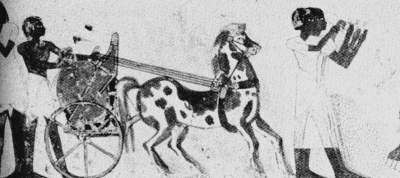
Bay, chestnut, black and grey are not the only colors horses came in. Horses of historical Europe come in all colors, spotted and paint included.

Don't be afraid to give your knight a spotted charger to ride.


"Breed" belongs in scare quotes
Up until very recently, as with all other domestic animals, horses were selectively bred and catagorized by type or use, not by "pure breeding". In the past you didn't refer to a horse by breed, but by its type, or perhaps the region or name of the stable it came from.

If you're creating a world based on pre-Victorian society, throw out your ingrained notions of "pure blood", and closed studbooks. Ignore the outdated but still widely published idea of "four original horse types". It is rubbish. Actual science tells us that all horses come from mixed ancestry of one kind or another. All of them. None are "pure". There is no such thing as an "unbroken line", (except in the sense that all horses have both a mother and father). For the love of all that is good and holy, do not read the "breed history" pages on breeders' or breed club websites. They are full of romantic lies and fairy tails. Gypsy Vanners did not pull the wagons of the Roma people. You may as well claim that the Chinese rode Appaloosas because there are ancient paintings of spotted horses in Asia.

Yes, there have been domestic horses on the Arabian peninsula for thousands of years, probably being selectively bred for much of that time. That doesn't mean that the Arabian horse "breed" has existed for that long, nor remained "pure" in the modern sense of the word.

Heck, even "selective breeding" doesn't mean the same. For most cultures for most of history, "selective" breeding means something like this: you let all your horses co mingle in the same pasture, probably open and shared with neighbors. They breed more-or-less like wild horses, stallions competing each other for mares. You wander out once a year and pick the best looking youngsters and bring them into the stable (or corral, or tie near your tent/hut) to be trained. Being the best-fed, these favorites end up breeding more often than others, but it's never exclusive. You occasionally cull ones you don't like, but mostly you just ignore them and nature kills them off, or they simply can't compete, or don't feel like mating.

If your horses are better in some way from your neighbor, they'll buy from you to improve their own stock, which in turn end up being sold down the road, or are lost or captured or run off during battle to become breeding stock for someone a continent away. Sometimes you buy a good looking mare you saw at the fair, or come across a wild band of horses and like the look of the stallion so you capture it.

Sometimes whole lineages are lost due to war or disease or famine or accident, but a few hundred years later, by accident or design, a very similar type is created somewhere else by someone completely different.

No closed studbooks; no castration (or rarely); no hyper-control over bloodlines; no extreme isolation stallions or mares. Mix-and-match was the order of the day, and this method produced fine animals for thousands of years.


Writers deserving of special mention
Anne McCaffery - knows horses in her bones, owned them while she was writing them into her stories. Black Horses for the King opened my eyes to many of the issues above.

Mercedes Lackey - excellent examples of how to world-build the creatures you want in a logical way. You want horses that act like dogs? Explanation! And then move on. Thank you.

The creators of Skyrim - get points for having horses that will totally run away and leave your ass stranded if there's something attacking them.

If you have suggestions of others (the good or the terribly bad) please leave them in the comments.

Sunday, October 14, 2012

Canadian Horse Slaughter Plants Grind to a Halt?

IMG_8681a

There are (somewhat) unconfirmed reports that all the facilities in Canada that slaughter US horses are stopping production as of this weekend. The rumor is that the European Union (the biggest buyer of US horse meat) has started actually residue testing US horse meat and finding that much of the meat has unacceptable levels of veterinary drugs.

The only thing that surprises me about this is that it took so long. EU members are notoriously finicky about "chemicals" in their food (consider all the fighting over GMO foods, and they have some of the strictest pesticide use laws in the world).

The EU released this brochure back in June. Page 5 has the most relevant bit: "Residue monitoring requirements for non-EU countries wishing to export food of animal origin to the EU: ...a centrally co-ordinated residue monitoring plan must be in place." There is, of course, no such thing in the US for horses, because horses are not treated like meat animals.

Allow me to go off on a tangent for a moment:

There are some people trying to build a slaughter facility specifically for horses right here in the community I live in. It's sort of a hot topic right now.

I recently read an infuriating op-ed in the local newspaper (the June 30th 2012 issue of the Hermiston Herald, although I didn't read it until last month). A local woman named Letitia Kidder, who supports having a horse slaughter plant in Hermiston, wrote what I'm sure she thought was a moving story about her first horse when she was a child, Whiskey, and why it was important that we always have the option of selling horses for slaughter.

Her horse went lame, and was (her words): "diagnosed with advanced navicular disease in both front feet, a crippling and painful disease... Her parents had already spent quite a bit of money on the veterinary diagnosis and care with special shoeing... then medication on top of that..." (emphasis mine).

Ms. Kidder then goes on to explain that she kept the horse on "a horse aspirin-type medication" for awhile, but couldn't keep him as a pet because "she would need a horse to ride," and her family couldn't afford two horses.

"The safe and affordable option was for him to be sold for meat purposes," she writes.

"Affordable"? For her 10-year-old self so she could have the luxury of a riding horse? Yes, certainly. But "safe"? For who? Not for Whiskey, he got death that was stressful at best, and terribly inhumane at worst, at the hands of people who didn't give a sh*t about him, her "beloved" pet. Not the French people who ate some steaks with who knows what level of phenylbutazone.

She, and a number like her in the community I live in, are still using the old argument that we "need" horse slaughter so that lame, drugged-up pet horses have a place to go (as if there were no other options). Except that the same horses they say are "saved" by slaughter, aren't supposed to be allowed to go in the first place. "Whiskey" probably wouldn't have even been bought by our local kill-buyer because of his lameness. And he certainly shouldn't be going to slaughter after all the 'bute he was given.

Sorry Ms. Kidder, your family would have had to suck it up and pay a vet to humanely euthanize Whiskey, or ask a neighbor to borrow a gun and a bullet. You would have had to spend money instead of make fifty bucks or whatever pittance you got from the carcass of your "little sorrel quarter horse with a heart of gold." (Seriously, she wrote that in her article advocating horse slaughter).

So. Residue monitoring of horse meat.

Here is how it works: kill-buyers want fat, healthy horses that they can buy cheap from the newspaper or auction, put on a truck and ship to Canada as soon as possible. Turn around is often less than a week; sometimes horses are bought and put on a truck the same day. The faster a kill-buyer turns around "product", the less s/he has to spend on feed, and the less likely a horse will be injured, go lame, or start showing signs of communicable disease, any of which will get it turned away at the border.

Horses that go to auction could be drugged with all kinds of things that the EU will test for later. 'Bute and Ace are so common, most horse owners have some lying around the barn, even though they're supposedly prescription-only.

There is no incentive for a horse seller to disclose that they 'buted their horse before the sale so it wouldn't look lame. There used to be no incentive for a kill-buyer to ask, either, as long as the horse passed the (very basic) USDA requirements for shipping (no runny nose, no blindness, and no lameness), it didn't matter. But now that shipments are actually being tested, that's going to change. And I have a hard time seeing ANY kill buyer who is willing to pay to have horses' blood tested for residues. Not only is such a test (relatively) expensive, but it would have to be sent to a lab, which would add days to turn around time. Unless the price of horse meat drastically increases, this change in policiy in the EU will make it not worth it for a horse trader to ship horses to Canadian slaughter plants. Hell, it probably wouldn't even be worth it if there was a plant right here in Hermiston.

If the EU really is going to continue to monitor imported US horse meat for drug and pesticide residues, the horse slaughter industry as we know it will end. And I won't miss it at all.


Thursday, August 2, 2012

I wanna pet the pony: Is it ever OK to approach loose horses?


A stranger approaches a horse grazing near her family. The mare gives him some very clear body language before going in for the bite. Simple, clear signs like ears pinned, that don't take a PHD in animal behavior to recognize.


(Snagged from Snarky Rider)

Suprisingly, the comments on the video are mostly calm and common sense. Even the poster of the video admits it "wasn't the smartest idea".

I wonder, however, if the man learned anything more complex than "don't approach horses you don't know".

As a general rule, it's a good lesson. However, I've done this myself, and I would do it in the future under the right circumstances. I've studied horses enough to know when it's probably OK to say hi, and when it's better to back off and admire from a distance, and I've never been injured (all my horse-related injuries were from horses I did know).

I'm not trying to preen; I'm well aware I'm a lucky person in general. I just think there's more of a lesson here than simply "don't interact with animals, they're dangerous". How about learning to respect animals as individuals and animals instead of either unpredictable and unknowable demons, or uniformly docile and friendly cardboard pop-ups straight from a children's book.

One time in Wales, I was out walking on a public trail that cut through private land and a stallion approached me. He was calm and relaxed and there were no other horses around so I stood there and let him sniff me over and, after a moment, I gave him a few chest scratches. Then I walked slowly backwards to the gate. I was extra cautious because I was alone and at least a half mile from the nearest building/road and, hey, it's often a bad idea to turn your back on a stud.

Bangor 77

The next time I walked that trail, I saw the same stallion and I approached him this time to take some photos. He remained calm and relaxed.

I think it was that same day, on a different part of the trail, that I ran into a mare with her foal. It was large, at least a yearling if not older. The mare wanted nothing to do with me, and walked away, but the colt came right up to me and after a minute started to become dangerously playful and pushy. So I backed toward the fence and left.


Bangor 74


These brief encounters may seem unnecessary, but done correctly and respectfully, interacting with  animals is very rewarding. Why would I give that up because there might be some risk? If that's the way I lived my life, I'd never get into a car.


CIMG6554

Tuesday, June 26, 2012

Man still riding horses at age 101

He started riding at age 80 and he's recently had to buy a new horse because his original is getting too old.

 Original story here

This guy reminds me a lot of my gramma. She doesn't ride horses, but she can still golf 18 holes. When she was 80, she fell in love and got remarried. That was over 10 years ago, and she's not slowed down much. Apparently no one told these people that they weren't supposed to do that kind of thing at their age.

Friday, February 3, 2012

Horse slaughter and puppy mills

"Slaughter has become the garbage can for the performance horse industry."
--Patricia Hogan, VMD, ACVS

I'm not sure if I've made my position clear, but I'm not against the killing of horses, per se. Not against people who eat horse meat. Not against rendering plants that turn horses into dog food, glue, and leather. Nor zoos and big cat sanctuaries who accept horses to feed their animals. Nor am I against taking old Bessy to the back pasture and putting her down with a bullet in the cowlick. Or even, if that's your thing, raising a nice fat Percheron and then calling in the mobile slaughter truck to turn it into steaks for your own freezer.

No. These things are not necessarily bad. Horse slaughter, however, as practiced right now, is inhumane and unnecessary.

The apologists say it's the only means that some people have of disposing of horses they can't care for or horses that are old/lame. They cry: better a horse suffer a short time at the slaughter plant than a long starvation, right?

Bullshit.

Horse slaughter is not about disposing of unwanted horses. That's just a side effect, and really a small one at that. Most of the horses in the above situation - old, sick, lame - either cannot legally go to slaughter, or the kill buyer won't buy them anyway. They make more money per shipment if the horses are fat and healthy.

Horse slaughter is about making money.

Like puppy mills, it's a symbiotic relationship between three parties: the souless (or occasionally clueless) breeders, the breed registries who apparently only exist to make money on new baby registrations, and the middle man, which in the case of horses is the meat buyer, and in the case of puppy mills, is the pet store.

The main difference is that in the case of the puppy mills, the "culls" being sold from the middle man (the pet store) end up in a home instead of in a Frenchman's stomach.

But the effect is the same: the middle man gets money, which in turns encourages the breeders to continue over-producing a product because, hey, if it don't sell at a premium price, there's still some money to be made.

In both cases the majority of the public just want a pet. Either a horse they can show or jump or ride the trails. Or a dog the kids can play with. Breeding only matters insomuch as it provides them with an animal that fits their needs.

In both cases there is simple fix: take money out of the equation.

Make horse slaughter illegal and breeders can't make easy money off of their unwanted three year olds that they didn't bother to train. Hopefully it forces them to slow down production and focus more on quality instead of quantity.

Make it illegal to sell puppies in stores, and you strike a blow to puppy mills. True, disreputable breeders will always find 'loopholes'. I can, for example, easily picture a puppy mill disguising itself as a 'rescue' and continuing business as usual, except calling the sales "adoptions". However, right now puppies and kittens sold in stores are overwhelmingly from puppy mills, and there's no need for it.

Indeed, the ease of online advertising also means it's easier for ethical breeders to compete with puppy mills for advertising eyeball time, whereas ethical breeders wouldn't dream of trying to compete by selling their pups in a store to the first person to slap down the cash.


IMG_9853a

Friday, January 20, 2012

Skyrim-inspired mural

Dogs piss on fences to show ownership. I paint on them. The design is from an inn sign from Skyrim.

Friday, August 13, 2010

Poe goes to the dentist

Continuing with our apparent theme of boring animal hygiene posts, I give you: the amazing Poe getting his teeth floated!

First, the happy juice:

Poe 3


Then droopy-face sleepy-times:

Poe 4


Poe on happy juice doesn't need anyone holding his head.

Poe 6


Poe 7


Tune in tomorrow, when I'm sure I'll have a fascinating photo essay of the cats getting their nails trimmed.

Tuesday, August 3, 2010

Moving week Links

The milkman in California still delivers local farm fresh milk

Fugly horse of the day with another great post about abuses in the gaited horse industry

Creative mixed-media art

The Illustration Art blog talks about the stigma of painting/drawing from a photograph rather than life. I rather agree with the author's conclusion.

Aw. Marines rescue kittens: (via Ginmar)

Animal sounds from different countries. (I freaking love onomatopoeia) (via)

Friday, July 23, 2010

Photos from the Philomath Rodeo 2010


You know, after bull riding, steer wrestling has got to be the most ridiculous sport in rodeo. At least with most of the others - bronc riding, roping, team penning, etc - you get (basically) what is performed on working ranches. Even break-away roping is just a contrived and insultingly 'girly' form of calf roping.

Steer wrestling, though? Let's jump off a horse running at full gallop, grab a 400+ lb steer and try to wrestle it to the ground. Yeah. Wikipedia tells me it originated in a wild west show. That sounds about right.

I'm certainly don't think that wrestling with a steer for competition or entertainment is wrong, it (like bull riding) just invokes eye-rolling from me from time to time.


Frankly, there is something entertaining about watching a big, tough cowboy being bested by a cow.


Saturday, July 10, 2010

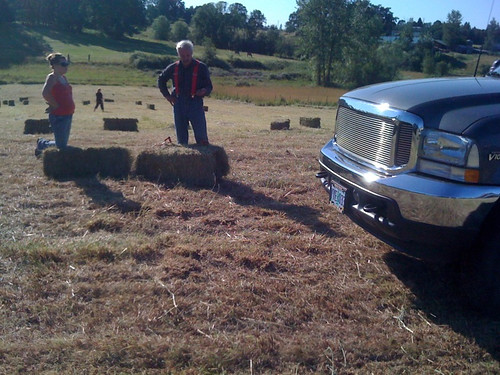
Hay, Heat, Hernias


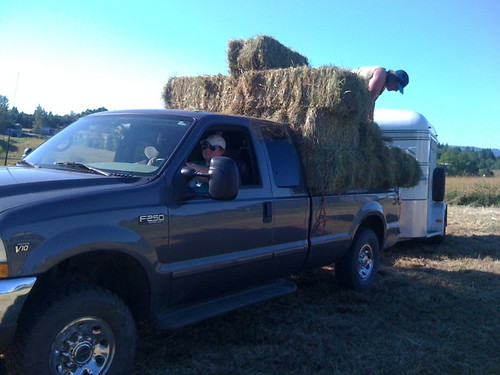
Where I live, the activity that involves driving out into a hay field in the middle of the summer heat to pick up, by hand, square hay bales and load them onto a truck or trailer, is called bucking hay (or, more precisely, "buckin' hay").

Question: what is this activity called for you? The other popular term I'm familiar with is "haulin' hay".


And if you are able to answer that question, that implies you're familiar with this activity. If that's the case, I salute you, comrade-in-arms! The unrelenting afternoon sun (can't stack dewy hay!); the dripping sweat; the billions of particles of dust and straw that stick to your skin and collect in crevices and undergarments; the million small cuts on your arms because it was too hot to wear long sleeves; having the point driven home that horses were created by nature mainly for the purpose of turning large amounts of dried grass into poop... there's nothing quite like it, is there?

Friday, July 2, 2010

Love/Obsession


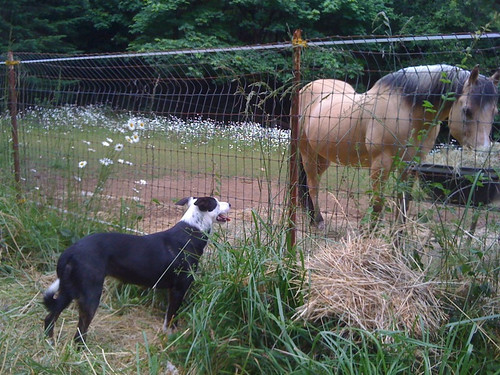
If I allowed it, Zelda would spend all day patrolling the fence line staring at the fascinating hoofed creatures on the other side.

Wednesday, June 23, 2010

do we call the cows "feral"?


I don't care how you feel about wild/feral horses. There is something very wrong about targeting them for removal from public lands so that private ranchers have less competition for grazing livestock. Especially when the official population estimates are starting to look a little fishy. Even if the BLM is not over-estimating their numbers, wild horses are still vastly outnumbered by livestock. I'm pretty sure we can do better to share that land.

Tuesday, May 4, 2010

Northwest Equine Expo

IMG_8704a


IMG_8663a


IMG_8698a


I try to go to this event every year. It's jam-packed full of interesting equine things. Including the cutest, pinkest princess on the tiniest pony EVAR:

IMG_8761a


And agility burros:
IMG_8718a


This was the first year I watched part of the 'Mustang Challenge' and I'm glad I did. Horse trainers have 90 days to do whatever they can with an untouched mustang. They show off the results at the expo and the winner gets a big prize and the mustangs are auctioned off at the end. The normal adoption price for a mustang is $125. Some of these were going for much higher. One went for $8,000.

IMG_8740a


IMG_8710a


A lot of the trainers focused on tricks, which were impressive:

IMG_8671a


IMG_8673a


But my favorite presentation of the day was a woman who kept it simple. She let the horse loose in the strange, noisy arena, then approached him with a saddle and tacked him up while he stood still on his own before mounting and riding him around. She didn't have the flashiest presentation, but it spoke volumes about her training technique and the how much she got the horse to trust her in such a short time.

Wednesday, February 17, 2010

Short but interesting discussion about working horses (specifically, the evilness or lack thereof of driving urban carriage horses)


http://slcslavedriver.blogspot.com/2010/02/facebook-anti-equestrienne-eco.html

Tuesday, November 17, 2009

Amusing note on muscle memory

iPhone


Muscle memory is funny. I'm making a saddle for a toy horse and the cinch is modeled off a western saddle. It's the type I'm most familiar with. So familiar, apparently, that just now when I went to test out the newly finished girth, I started tightening it way tighter than a toy saddle needs to be. 'Oh, right,' I thought to myself, 'this horse isn't real.'

Tuesday, September 29, 2009

Shrewsberry Faire

I love ren faires. But I admit I go to them for two main reasons.

The animals:

IMG_6964


IMG_6932


IMG_6940


IMG_6936


And the costumes:

IMG_6941


IMG_6953


IMG_6993


...and the animals in costumes:

IMG_6943


IMG_6925


... and the animals that are part of costumes:

IMG_6992


(Also, I apparently can't tell the difference between "save" and "publish". So this entry is back dated to when I wrote it.)