Showing posts with label wildlife. Show all posts

Tuesday, November 13, 2018

Stop Being Terrible at Werewolves: A Friendly Guide for Fantasy Writers


The modern concept of werewolves originated some time after we stopped being hunter-gatherers -  who weren't afraid[1] of wolves, and in fact made friends of them and turned them into dogs - and sometime before the Renaissance. Wolves were the last widespread, man-eating large predator in Eurasia. They could leap out of the dark woods to attack livestock and eat children and unarmed peasants. The perfect animal to hang our collective monster fears on.

This wolf, the "werewolf-wolf", is not based on real Canis lupus; it's simply a stand-in for all things savage and animalistic. Fantasy need not be "realistic", but a problem arises when writers create a werewolf that isn't a generic savage beast, but a detailed, fleshed-out species with its own society based on the way wolves actually operate in the wild. And it's almost always done poorly. I don't care if your lycanthropy is based on magic, Magik, viruses, or aliens;  If you want to base your fantasy creature on real-world animals, you need to base it on real, up-to-date science about those animals.

I recently had to quit an urban fantasy series[2] I liked because I just couldn't stand the werewolves any longer. The rest of the world-building was great, but bad science will get to me every time. Here's an excerpt from the first chapter of the first book in the series:

"'...eat, then come back out when you're ready.' ... He heard the command and stiffened, raising his eyes to meet mine. ... I knew better than to give orders to a werewolf - it's that whole dominance reflex thing. Werewolf instincts are inconvenient - that's why they don't tend to live long. Those same instincts are the reason their wild brothers lost to civilization, while the coyotes were thriving[3], even in urban areas."

Keep in mind, the werewolf character in that excerpt is young, injured, and came to this person for help. And yet even in such a state he still "instinctively" hates receiving even the mildest form of an "order", to the point that the person trying to help worries that he'll attack her because of the way she phrased a single sentence.

This lays the ground work for werewolf social interaction for the rest of the multi-book, best-selling series. Werewolves are obsessed with hierarchy and dominance. To the point of stupidity - they often get distracted in the middle of things they're doing, including fighting an enemy, to turn on each other and fight their own comrades and family. All of them (except for some very rare individuals) are constantly, every moment, every single interaction, battling to become the "Alpha" and control the rest of the group.

I read a fair amount of contemporary urban fantasy, and this is a very typical example of how werewolves are portrayed. And it stems from an outdated and over-rated idea of wolf psychology, which can be summed up in one word:

The "Alpha"

Please, for the love of doG, stop with the "alpha wolf", "pack leader", "dominance is everything" crap. That's not how real wolves (or dogs, for that matter) work. We (western science anyway) used to think that's how canines worked. But we've learned a lot in the last 40 years. In fact, one of the originators of the term "alpha wolf", who is still a wildlife researcher, has since strongly rejected it, going so far as to beg publishers to stop reprinting his older work.

I get why fantasy authors continue to use this outdated theory of dominance as a framework for werewolf world-building. It's simple, most laypeople are familiar with the concept, and it's satisfying to the chimpanzee inside our brains. But it's boring, it's unscientific, and it's a sign of lazy researching.

How To Be Better at Writing Canine-Based Fantasy Creatures 

Wolf packs are families. There is a father and a mother, who mate for life, and their children. There may also be aunts, uncles, grandparents, and cousins in the same pack. There is no all-powerful king. The mom and dad may not even have many leadership roles. They often do, simply because they're also the oldest and most experienced in the family, but it's by no means a given. It may be other family members who decide when and where to hunt, or where to get water, or when and where to explore/check territorial marks, how harshly to discipline trespassers, etc.

The main thing the "alphas" are concerned with is that they are the only ones allowed to have babies (this isn't a strict rule either! More on that in a moment). This is for good, evolutionary reason: puppies survive better if the whole pack focuses on sustaining just one litter at a time, sharing the duties of babysitting, providing food, and teaching. Too many puppies at once, and all the puppies starve or die from accidents because there weren't enough adult eyes watching.

This "law" of no babies is loosely enforced by the mom and dad by discouraging the rest of the family from mating. The type of discouragement, and how rigidly it is enforced, will vary a lot from pack to pack and depend on how plentiful resources are. There's no need to "fight" their parents for leadership - if a son or daughter wants to have babies, they just leave and start their own pack. Even if one of them did feel the need to fight their parent, what would be their prize? Wolves mate for life, and they choose each other. If a son kills his father, there is no crown or queen to inherit, he's just as likely to be driven off by the rest of the family as he is to "win" a kingdom.

If a daughter does get pregnant while still living with her natal pack, it is usually by a rogue male (scientifically known as a "Casanova male", which is fantastic) who's been creepin' around the edges of the family's territory. Under normal circumstances, these puppies would be ignored by the rest of the pack, and die of neglect. It's possible they may be outright murdered by their own grandparents and/or the daughter may be shunned or kicked out of the pack. When resources are plentiful, however, sometimes the parents allow their daughters to have puppies, too, and the whole pack raises all of them at once.

Another "law" that is often bent and broken: territory. Wolves are often very territorial, and spend a good amount of time patrolling and marking the family's property line. Trespassing wolves may be killed on sight, but not always. Sometimes, new wolves are welcomed into the pack. Sometimes, they're allowed to visit and even mate with some of the females, but aren't really welcome to hang out very long. Sometimes, families join together into "super packs" for awhile, then go their separate ways after awhile. Some children are kicked out of the pack when they're mature; some choose to leave on their own; some choose to stay with their parents for many years; some may leave for awhile and then come back.

Like human families, each pack is different. Some will be more egalitarian, while others will indeed have authoritarian parents that are every bit the stereotypical "alpha". But they are also dynamic. If a father or mother is too much of an a-hole, members may simply leave, which would be detrimental to the "alphas" because then they have less help raising their puppies, deincentivizing extremely aggressive kin behavior. If a younger member of a family fights or kills their parent (which does happen sometimes), it's a lot less less about "fighting to be dominant" and a lot more, "jeeze, dad was such an abusive dick, it's so much better since he moved out".

Wolves can indeed be brutal, but it's not a given. Wolves are flexible, adaptable, social, and intelligent. It makes no sense for werewolves to be mindless, rigidly adhering to hierarchy, and wasting energy fighting each other. The real lives of werewolves could be just as complex, dynamic, rich, brutal, bloody, as real wolves. Let's not limit ourselves.

Some examples of good werewolf world-building

Shout out to Hemlock Grove for creative and well thought-out werewolves that have an animalistic nature and all that fun duality symbolism without the weird baggage of dominance theory.

Shout out to DiscWorld for a well-formed and complex werewolf society that does not involve any "alpha dog" nonsense (that I've seen; I haven't read all the DiscWorld books). Although werewolves are quite harshly hierarchical, in typical Pratchett fashion, it's allegory about human monarchy/authoritarianism rather than anything to do with real wolf "pack dynamics". Bonus love to Pratchett for pointing out many times that wolves and dogs are not very different at all.

Shout out to Harry Potter, in which lycanthropy is treated mostly as a disfiguring disease. There isn't so much a society of werewolves, as there is a loose association of people who come together because they're infected by the same disease, and therefore face the same discrimination from the rest of the world. Werewolves who are bad, violent, or authoritarian, would be so whether or not they were infected with lycanthropy, not because of anything to do with wolf psychology. J.K. Rowling goes out of the way to point out in the text that werewolves don't act much at all like real wolves.


~~~*~~~


Footnotes
[1] The old paradigm of early dog domestication (where cave men hated wolves and wolves were scared of cave men) is falling out of favor. The newer theory, is that wolves and early humans were hunting partners to one extent or another as far back as the Neanderthals or earlier. For more info, read the wonderful book How the Dog Became the Dog, by Mark Derr (or google his essays), and the many essays on the subject by Scottie Westfall. This is also something I explore in my "Domestication Stories" series of short stories.
[2] Which I won't name. You can probably figure it out
[3] A side note of irritation for this quote specifically: new research suggests coyotes are much closer genetically to wolves than originally thought, and may actually be a subspecies of wolf, or that wolves and coyotes make up a species complex. This makes sense, because they are identical in almost every way to wolves. The only reason they're currently thriving, and wolves aren't, is that they are smaller. They can live off smaller prey and lower quality foods like fruit and garbage that simply won't sustain the mass of a wolf, a diet that means they slip under the radar easier than an animal that requires large prey. It means that  a century ago, when the government was giving out bounties on a whole list of "unwanted" animals, coyotes weren't as heavily persecuted as wolves were. Coyotes only managed to expand their range after humans systematically killed off most of the wolves in North America. Not because they're smarter or have somehow less "volatile instincts" than wolves.

Wednesday, May 10, 2017

Friday, December 30, 2016

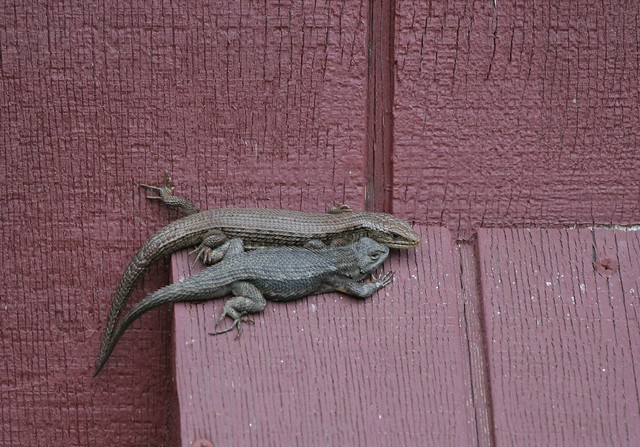
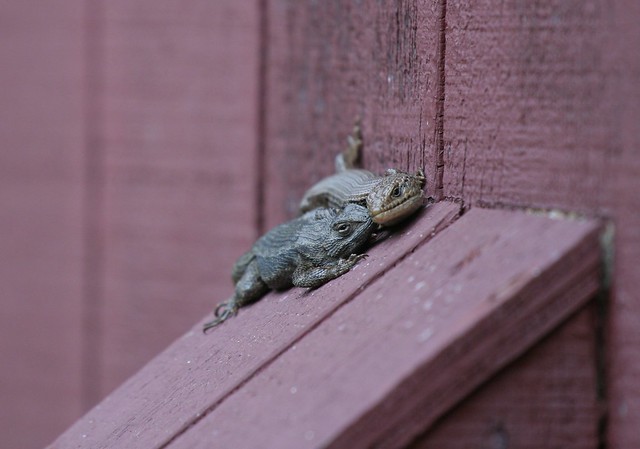
Unlikely Friends


IMG_9785a

IMG_9784a


A western fence lizard (Sceloporus occidentalis) and a northern alligator lizard (Elagaria coerulea) sharing the weak sunlight of a cool spring day in Oregon (taken last April. Because I'm slow these days).

They look very similar, and occupy similar niches, but they're not too closely related. It's probably the equivalent of a pig and a deer cuddling up together.

Monday, April 4, 2016

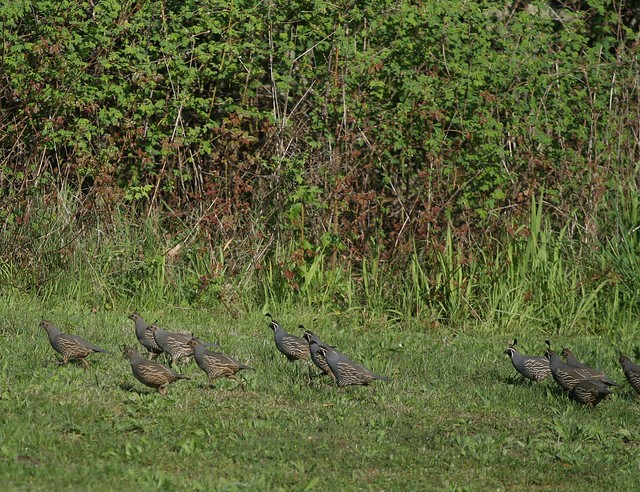
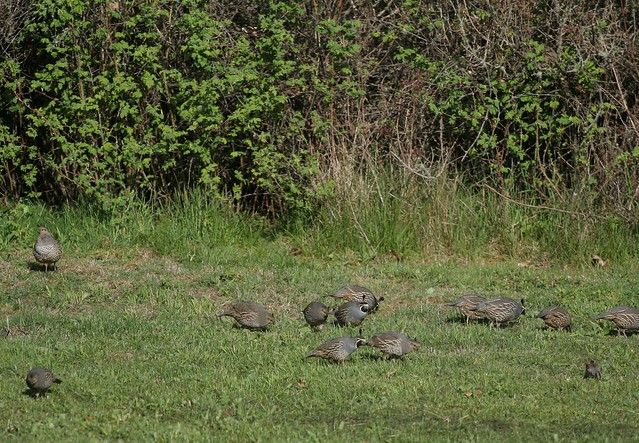
Quail

Some California quail in Finley Wildlife Refuge in early April


  IMG_9799a


IMG_9794a

Saturday, August 1, 2015

When Taxonomy Meets Dunning and Kruger

This started out as a short rant about how some people purposely misinterpreted a recent scientific paper because they have an agenda ... but who am I kidding? There's really only one fool who has "misinterpreted" the study, and if this person didn't have such a wide audience I wouldn't care. But for some reason, despite multiple abuses of science and historical facts over the years, Patrick Burns, aka Terrierman, continues to be considered some kind of expert. 

I normally let his posts slide on by without comment. But, like the festering sore he reminds me of, sometimes things just have to pop.

Here's just the latest example: Some scientists who are a whole lot smarter and more knowledgeable on the subject did some research on golden jackal DNA and decided that they'd found enough evidence to designate one of the populations as a new species, which will be called the African golden wolf instead of the African golden jackal. 

You've probably heard of it. It's the type of scientific finding that scientists publish widely and loudly because it's the kind of feel-good, easy-for-laymen-to-understand study about a recognizable charismatic megafauna. As they should, because it's interesting and we always need to do as much as we can to encourage the public's interest in science. Most scientists accepted it as another small building block in our understanding of the natural world, and then moved on.

Terrierman, using his typical "OMG LOOKIT ME I'M DIFFERENT AND SPECIAL method of discourse, dismisses the findings so quickly it left BURN marks on my screen[1][2]

"like, whatever"


Alrighty, then. Perhaps TM has some new insight that all the other experts missed? 

Yeah, not really. He has a scant few paragraphs full of condensation and non sequiturs. 
"If scientists have "discovered' anything in this instance, it is simply that Jackals are every bit as diverse as we have always known, and that a few populations may be a little farther along in the speciation process than what some other scientists have previously acknowledged. A little new information, but is a debate ender?  Not by a long shot."
Any biologist reading that paragraph would find it pure gobbly gook. Who called this a "debate ender" [3]? Even the NatGeo article he quoted points out that other biologists have some quibbles. What the heck is he even talking about when he says "speciation"? No scientist I've ever read has used the term speciation the way TM does

TM doesn't seem to understand how new species designations are assigned in modern times. There may not be a simple definition of what a species is, but there are many legitimate and accepted ways to designate a new one. As he himself points out, biology is messy, and what we see in our short lifetimes is a snapshot of evolution in constant motion. But just because there's gray area, doesn't mean the concept of a species is irrelevant or unobtainable.

The scientists who wrote the paper have solid, well-justified reasons to define this population as a new species, and they're laid out in detail in, y'know, the paper he's dismissing. He doesn't address a single one of their findings.

He's really hung up on how and when animals mate. It's a very odd obsession that he's seemed to have for years (see below), and he uses examples differently depending on how they can best serve his opinion. For example: it's well accepted science that animals will continue to hybridize long after it's useful to call them different species, as he has pointed out numerous times when it comes to the relationship between dogs and wolves! But he uses it to dismiss the African golden wolf designation because... "jackals have diversity".

Someone in the comments tried to gently correct him on his misconceptions, including his grim determination to call dingoes a separate species [4]. He responds with more handwaving that at times becomes incomprehensible. The comment section alone would need a separate post to explain all the gish galloping going on.

But here's the most telling comment from TM, at 5:01:
"The simple point is that your points all depend on ink from a library, while I am making a case based on real fur, feather, and fin.
You salute words, not fulling understand the fragility of those words historically or scientifically. How many genus and species have been created and merged, split and absorbed in the last 40 years? All ink and artifice as the animals themselves remain the same."

In the end, the only thing he has to fall back on is: "Enough of yer book learnin', you need STREET SMARTS...(like me)".

Yes. Let's all do science by instinct and gut feelings. Eliminate all the tedious counting and measuring.

What the heck would he make of all the other interesting puzzles of taxonomy, I wonder?

I'd like to introduce PB to the concept of "cryptic species". I know he's stuck in pre-1980's biology, but the wonder of DNA is it allows us to uncover all kinds of interesting things, like different species hiding in plain sight. Like African butterfly fish, where two species look identical despite 50 million years of separation

Or zebras, where the battle over names and subspecies designations has raged since the 1900's, and continues today, except better and smarter because of all the new knowledge we keep accumulating. The plains zebra alone has 50 possible names, and currently 6 relatively accepted subspecies. Every time a new study comes out, we add to and revise our understanding of the evolutionary relationships within Equus, just as we do with Canis. Using TM's logic, we should throw up our hands and ignore DNA, stop studying family tree relationships at all because it's complicated and there's gray area.

Or African elephants. When TM complains that "taxonomic debate these days is about humans looking to publish papers, get grants, name new species, and secure habitat protection"[9], the relatively recent designation of the African forest elephant as distinct from the savannah is exactly the type of thing he's whining about. Would he care that it was based on multiple robust studies of morphology, DNA, and behavior? What is enough evidence for assigning a new species for him?

These examples do not weaken the idea of "species" as a useful scientific and colloquial term; they're just part of the reality of cladistics. Anyone who knows what they're talking about has no problem rolling with fuzzy areas because discovering and defining the differences and similarities between closely related species is a rich mine for scientists. 

Whereas TM on the other hand, seems not only confused, but bored by any evolutionary relationship that a) was discovered after about the 1970's and b) is not very clear cut. He instead simply waves away complications by saying species isn't a useful concept (well, unless he says it is). How can he be against assigning species status based on autosomal DNA, but OK with assigning it based on geography and "culture"? He offers no reasons, just keeps repeating (and has since 2005 at least, see below), "just ask the animals, they know where the species boundary is." This is weird on several levels.

How does he know that they know? Is he telepathic? Does he mean it literally? Because I asked my dog and she didn't answer. And if he doesn't mean quite literally, does he mean "study the animals"... because... uh, that's exactly what the authors of this paper (and all the other papers he's dismissed over the years) did!

He just got done telling us that "species" isn't a useful term, anyway. Which is it? Do the animals "know" what species they are, or is there no such thing as a species?

Wolves and coyotes, and wolves and dogs, apparently don't "know", because they exchange genes a lot more often than he's implying. Notice that though he's forced to admit that canids mate, he very carefully never provides citations and always says "but it's not very often". He's relying on purposefully vague language. This allows him to dismiss any published data about gene transfer as irrelevant because "it's still a rare occurrence". There's no way for him to be proved wrong!

As many people have tried to point out to TM, it's a simple fact that dogs are a subspecies of wolf, whether you like it (or understand it) or not. [8]

Related: Desperately needing dogs and wolves to be different species despite the overwhelming data is a purely emotional response, and can only be due to his opinions and philosophies about dog ownership. What he repeatedly misses is the fact that, whether they are or aren't from a scientific perspective is moot when it comes to how we handle, train, and live with dogs and wolves. And no one argues otherwise except his very own strawmen.
This isn't an isolated case, either; Patrick Burns has a history of cherry picking data that fits his favorite theories, and applying purposely vague anti-science rhetoric when it doesn't.

Example 2: He thinks there are red wolves in West Virginia

"That's no coyote, it's a space station red wolf!"

From a scientific perspective, "red wolves" are at best barely recognized as a distinct species. We got more data and realized they're wolf/coyote hybrids, and that there is no real reason to classify red wolves simply by morphology, but it's still contentious, people get very emotional on the subject. It is a great example of a movement successfully using anti-science to muddle the waters to the point a layman would not be able to find accurate information on the subject. So perhaps PB could be forgiven for thinking that red wolves are still a thing, but.... even if red wolf was a species... there's no reason to think they're in WV [5]. Identifying a species from a single blurry photograph, in a place it shouldn't be, when it looks identical to another species that does live in the area... occam's razer, anyone?

Example 3: In a blog post he titled "Canis Soupus" 10/1/2010, he says some weird things. So many weird things, it almost deserves its own response in a separate post, but I'll keep it short and skip over most of the "WTF-ery".

Notice that this post is from five years ago, yet it's the exact same thing, almost word for word, that he keeps repeating when this subject comes up. Compare his comments over the years, and see if he's learned anything new: 

2005: "The simple truth is that dogs know they are not wolves, just as wolves know they are not dogs, and humans know they are not apes." 3/11/2005 "The Wolf Within"

2010: "And while wolves, dogs, coyotes dingos (sic), and golden jackals CAN interbreed amd (sic) produce fecund young, they rarely do, and the reason for this is that the REAL EXPERTS on species, the animals themselvs (sic), know they are very, very different." 10/1/2010

2015: "The real experts in these matters are not scientists, or even humans, of course, but the animals themselves. Jackals, dog, wolves, and coyotes seem to recognize major differences between themselves and give a hat tip to those differences 99.999 percent of the time." 7/31/2015 
This is also funny because he still treats dingoes like they're a different species[3] even as the graphic he uses doesn't even show dingoes because all scientists by 2010 group them with "dogs".

He pulled a quote from a NYT article. Unsurprisingly, he took the quote out of context. Ironically, the writer of that particular quote is Carol Kaesuk Yoon. She actually studied evolutionary biology, and in fact wrote an entire book on the subject of naming and differentiating species. A book I've actually read and highly recommend. You can read an excerpt, or listen to her talk about it, or read one of her essays on the same subject at the link above. 
She is an actual expert in the very area that TM is pretending to be an expert. Compare TM's rants to even a casual glance through her book, or even the freaking publisher's summary:
TM:
"In fact, scientists are starting to come to terms with an important idea, which is that a lot of animals are in the process of speciating ... and that the notion of species is a human idea that still needs a lot of work..."
Book summary:
 "...[this book] is a rich journey from Linnaeus, whose system turned classification from a hobby to a science, and Darwin, who ended the idea of rigid species definitions..."

Yes, that's right, TM is trying to pass off the well established, century-old concept that species have fuzzy edges as "new". What's worse, he's doing it to try to make scientists look like confused idiots too wrapped up in their book learnin', and himself look like a wise paradigm-shifter.

I wonder what Yoon would think of her own words being used as anti-science rhetoric? Well, I have a guess. Here is another quote of hers, taken from another NYT essay
"...the ordering and naming of life is no esoteric science. .. sorting and naming the natural world is a universal, deep-seated and fundamental human activity, one we cannot afford to lose because it is essential to understanding the living world, and our place in it."
Example 3.5: In 2006, in a blog post titled "The Wolf Within", 12/11/2006, which is mostly a repost from 3/11/2005 [6]. He says Darren Naish is awesome, which, like quoting Yoon, is ironic, because Darren Naish now heartily disagrees with him about canid taxonomy, and since 2006 has drastically revised his position on the origin of domestic dogs based on new data. He would also, I suspect, disagree with TM about how scientists nowadays are tedious, attention-seekers who don't know how to make "real discoveries" anymore.[7]

TM's post from June 2015 titled "A Dog is Not A wolf" is nothing but a rehash of all his previous posts on the subject. Nothing new, and he suddenly doesn't seem to want to cite Naish anymore... hmm...

Example 4: He denies that black wolves got their melanistic gene from dogs. ("And White Wolves Come from Mars" 2/6/2009)


Look how he uses the same language and dismissive tone as he does every time he talks about science he doesn't like. He uses a few simple, accurate statements ("melanism is common", "dogs and wolves are related") then adds in his unjustified opinion ("therefore, the scientists can't prove the gene is from dogs"). It's like the definition of a non secitur. He seems to think that one can be correct simply if one is forceful and confident, but that's nothing but the Dunning-Kruger effect.

Notice how he also doesn't link to or critique the study itself, just the newspaper article about it, of which the most damning fact he can come up with is the author doesn't speak in absolutes.  

Example 5: He thinks DDT didn't affect raptors ("Bald Is Beautiful" September 5, 2008)

... and was called out on it here

The best that can be said about TM is that he wrote a few good blog posts about dog breeding and working animals. Unfortunately, he thinks that gives him authority to post many, many bad blog posts on subjects he's clearly not well versed. What's worse, he does so with the most condescending, uncompromising, unearned superiority complex I've seen outside of a politician.

No one ever told him, in the case of science writing, "fake it 'til you make it" is not the best motto to follow.

He uses anti-intellectualism when it suits him, and as an insult for people who disagree with him when it doesn't. He cherry picks data in the worst way. He holds on to outdated theories with an iron grip, violently denying all evidence against them. His blog is mostly a long list of non sequiturs he uses to boost his opinions, and he does nothing but add to the white noise of the anti-science movement. This is all the more insidious because he cloaks himself in the trappings of "science-ness" - and is believed by a depressing number of people.

Please, if you're a regular reader of TM, don't allow him to get away with this any longer. Start looking at his words more critically. Post skeptical comments and see how he responds. Don't share his posts without double checking his facts first. 

----------------------------------------------------------------


[1] SEE WHAT I DID THERE
[2] see terriermandotcom (dot) blogspot (dot) com (yes, that really is the address he chose for his blog), 7/31/2015 "First New Canine in 150 Years?"
[3] Aside from his strawmen, of course. Oh, Patty looooves his imaginary strawmen opponents
[4] Back in olden times, before DNA was used in biology, it was logical to argue that dingoes were a separate species based on morphology and geography. Now, with new data, we know better. Dingoes are just dogs. You can call them a breed, or a population, or type, or regional variant, or whatever, but the science is pretty clear: they're dogs, closely related to other native breeds from east Asia.
[5] except to get attention for his blog
[6] He quotes himself almost as often as he quotes newspaper headlines.
[7] I can only assume that he finds all new species discoveries that don't involve Englishmen in tweed stomping through jungles as boring. Finding the new olinguito? Just some bookworms digging through a library, how boring!
[8]  Savolainen et al. 2002, Lindblad-Toh et al. 2005, Pang et al. 2009, vonHoldt et al. 2010, Larson et al. 2012Freedman et al. 2014...
[9] as if any of those things are automatically bad, or not useful, or not interesting, or even new (from his 7/31/2015 post "First New Canine in 150 Years?")

NOTE: I did not provide links because I don't want to encourage traffic to his site, which gets more than enough undeserved attention as it is. If you want to read his posts, my citations should be adequate to find them. If you can't, ask and I will provide a link via email. Or the screencaps in case some editing or "disappearing" occurs.


Friday, May 22, 2015

Baby Mantis

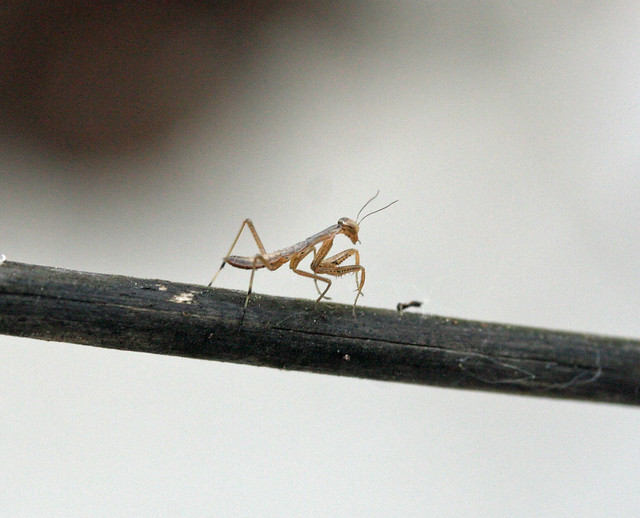
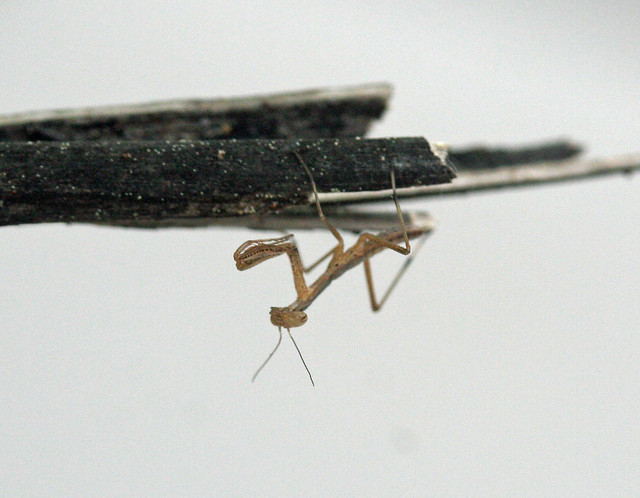
Found yesterday in the garden. About half a centimeter long. Probably a non-native Chinese mantis but I don't really know so back to the garden she went.


IMG_9346a


IMG_9423a


Sunday, May 10, 2015

Help a Naturalist Stuff His Weasel

Scottie Westfall, the writer of the Retriever, Dog, and Wildlife blog, needs help stuffing a weasel.

Not just any weasel; a white long-tailed weasel collected in West Virginia. There shouldn't be any white weasels in that part of the state. HOW INTERESTING you say. Sadly, it's been languishing in a freezer for over a decade. It's an interesting specimen that deserves to be professionally mounted.

Support by going to this page and pledging just $1 a month (with a special reward!)
or  make a one time donation through Paypal.


Wednesday, February 25, 2015

Bighorn Sheep of Interstate 84

Bighorn sheep went extinct in Oregon in the 1940's but are making a slow steady comeback. There are now an estimated 3700 in the state. Less than a hundred hunting tags are issued each year, and it's a "once in a lifetime" tag - even if you don't fill it, you never get the chance again.

It's a special treat to see one in the wild. And if you want to see one, I can tell you exactly where to go where you're almost guaranteed to see at least a few. I've personally seen a group as large as twenty. You don't need to hike, you just need to look out your car window while driving between mileposts 128 and 115 on I-84 in Oregon.


(Mile post 122 July 2013)


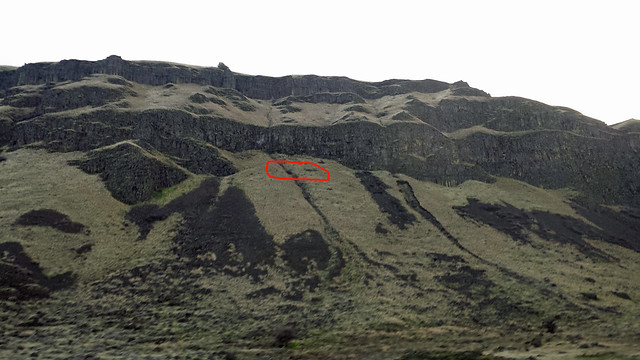
This is the habitat:

553b
(area circled has about a dozen bighorns in it, you just can't tell in this horrible blurry photo, taken December 2014)

At the top of the cliffs the land flattens out a bit and is private farm land, and beyond that is the John Day River. The Oregon Department of Fish and Wildlife has been re-introducing bighorns in several places along the John Day river, but much farther south. This tiny strip of land is shown as "bighorn sheep occupied habitat" on their map, but it looks like the closest reintroduction location is many miles to the south (see below) (plus, I can't imagine ODFW thinking that land that close to a freeway would be prime habitat for reintroduction).

I'm guessing the sheep traveled to this location themselves, following the river north to the Columbia from the Cotton Canyon area. They found this small but nice piece of real-state and decided to stay, and I can see why: the steep cliffs they like to keep them safe from coyotes, plenty of water and browse, and, though they have to deal with the constant sound of traffic, they're almost guaranteed to never be harassed by hikers, hunters, dogs, or domestic livestock.

(area in red is our bighorns, area is green shows next closest population)

FYI: there aren't really any safe places on this stretch of road to pull over for photos. I've seen some people do it, though I haven't worked up the courage to risk death-by-semi to get some shots of the wildlife with my nice lens.

Thursday, January 15, 2015

Wednesday, October 15, 2014

Coyote Poop

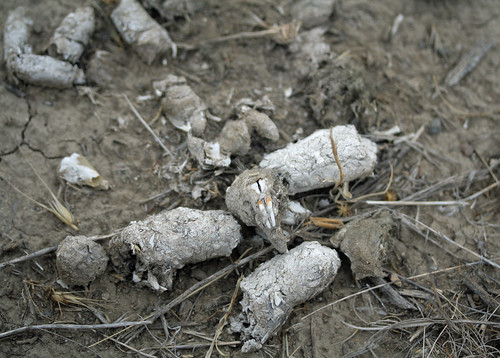
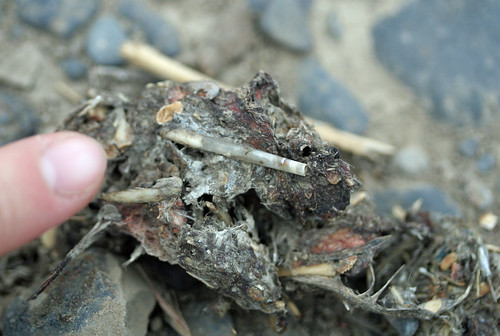
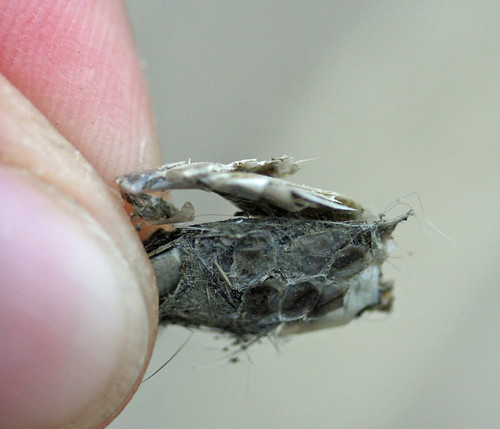
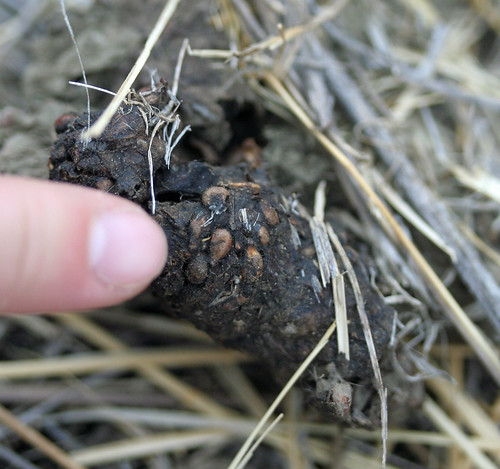
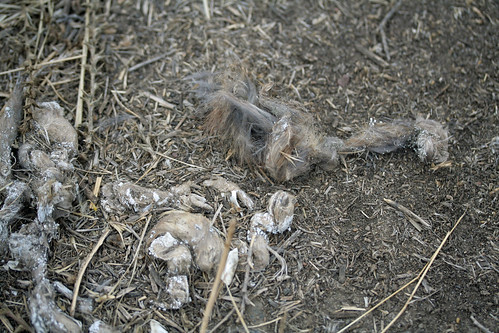
On a recent walk near the house I came across dozens of piles of coyote scat.  It felt like a good day to pull it apart and see what the local charismatic megapredators are eating nowadays. Quite the variety.


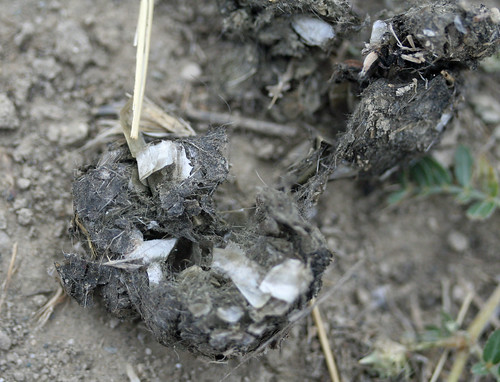
Here's the typical coyote scat you could find anywhere in North America. After a couple days it dries to a white color due to the large amount of undigested bone and teeth. Though this is the first time I've seen an entire face sticking out of a poop - learn to chew your food, coyotes!

IMG_8397a


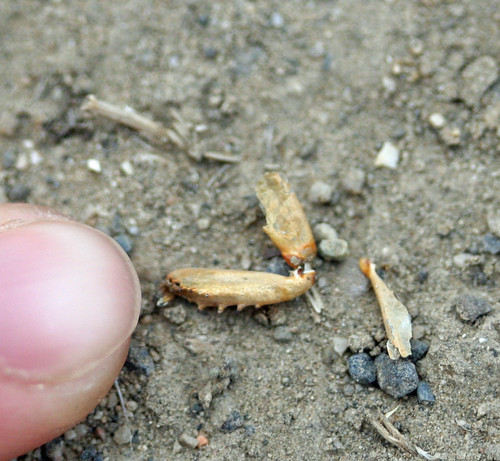
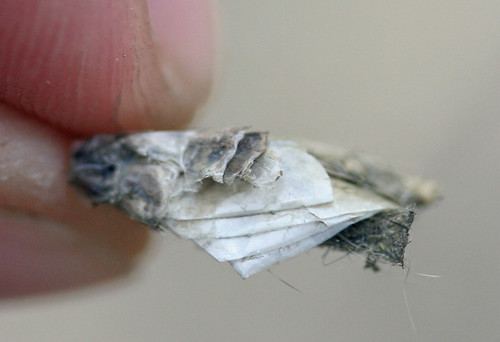
This looks like the foreleg of a mantis. Not surprising either, as they're still around due to the warmish weather we've been having, and big enough to attract the attention of a coyote looking for a crunchy snack.

IMG_8383a

IMG_8385a


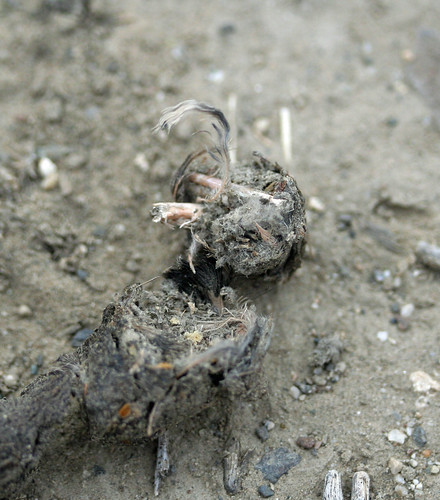
Feathers from a small bird.

IMG_8379a


Feather shaft and bones from a slightly larger bird.

IMG_8390a


Scales from a reptile, probably a snake, and juding from the size (and knowing how abundant they are right here) most likely a gophor snake.

IMG_8386a

IMG_8387a

IMG_8388a


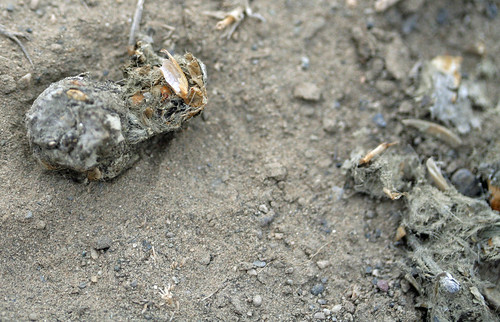
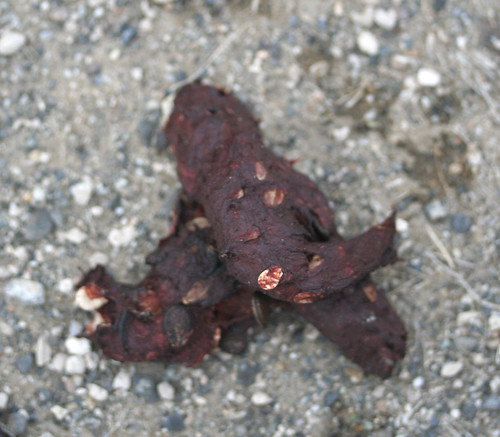
Watermelon seeds (and coloring). Less than a mile from this location is a large watermelon field with hundreds of abandoned melons still sitting out. It wouldn't surpise me in the least to see a coyote eating them. (There were also about a dozen smaller, looser piles nearby. I think someone ate too much candy and got an upset tummy).

IMG_8378a


These seeds look suspiciously like apple or pear seeds (any other guesses?) Also abundant in back yards this time of year.

IMG_8399a


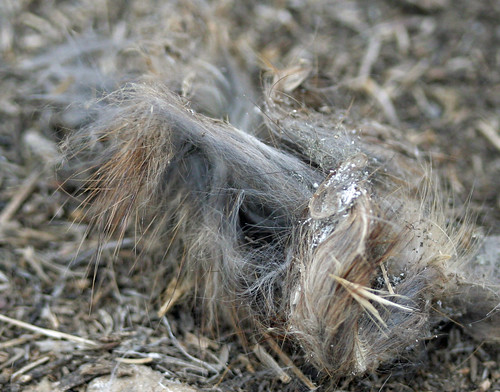
And lastly, this pile of fur right next to this pile of scat. It wasn't digested, is it prey fur, or from the coyotes themselves?

IMG_8395a

IMG_8392a

Thursday, August 28, 2014

Shore Birds

IMG_8218a
8/26/2014

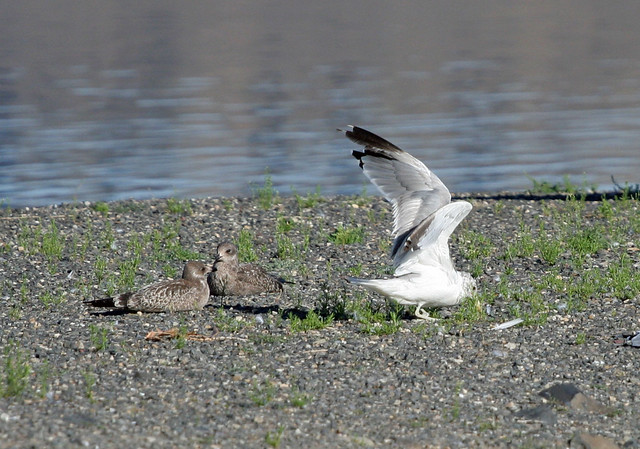
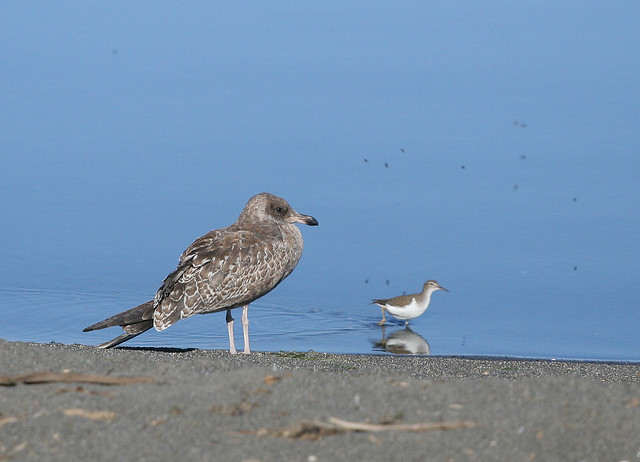
Little visit to a beach just up river from the McNary dam. A great place to see dinosaurs.

Today we got to see a seagull with only one foot.

IMG_8210a


A ... sandpiper... thingy? tiptoeing by a larger cousin. Help with identification would be nice. It looks like a solitary sandpiper, Tringa solitaria but they aren't supposed to be here.

IMG_8238a


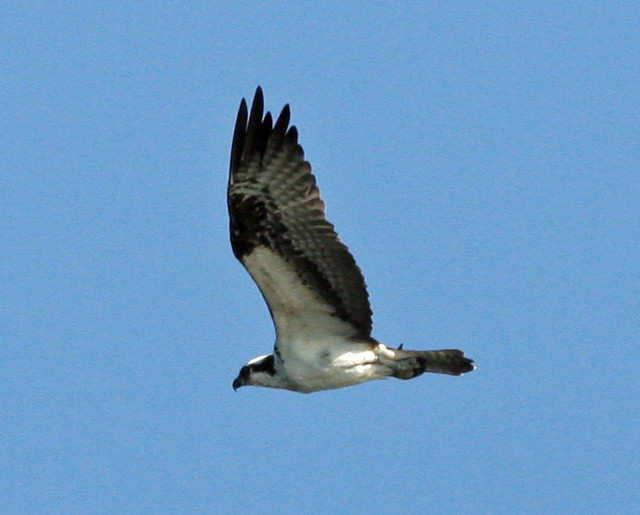
An osprey who had been fishing, but of course stopped once I got my camera out of the car.

IMG_8232a


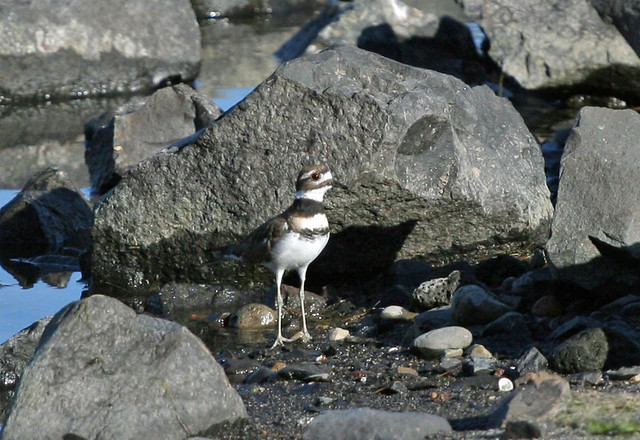
Another killdeer doing that bugeye thing they do so well.


IMG_8255a


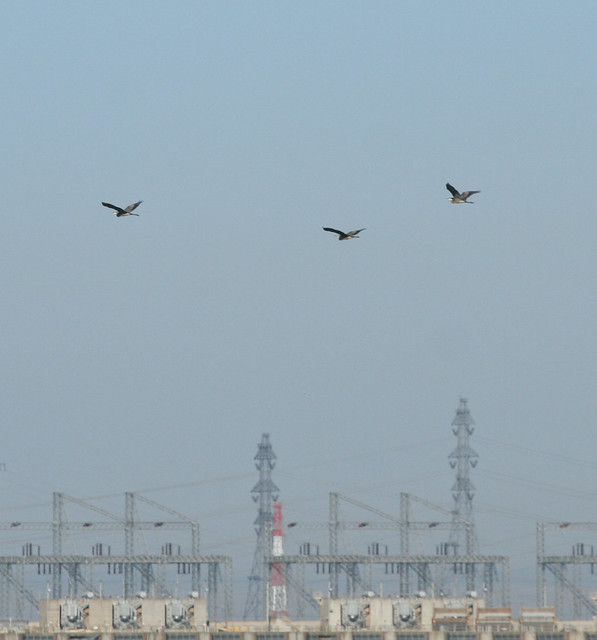
Some great blues being all graceful and majestic.


IMG_8235a

Sunday, August 3, 2014

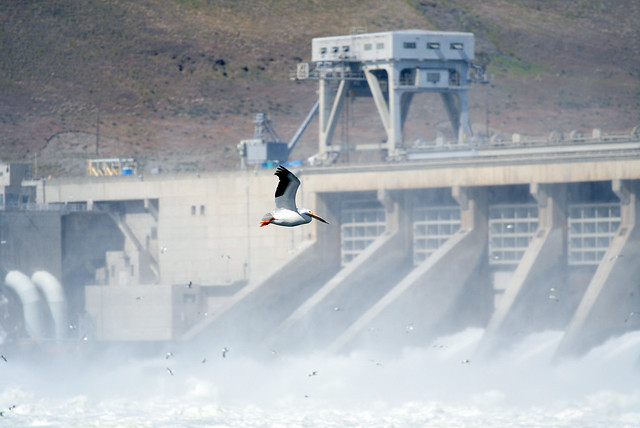
McNary Dam


IMG_7810a


A good portion of my electricity come from here. It's only a few miles away from my house as the crow flies, and sometimes I forget what a massive, and relatively rare, structure it is. The Columbia is one of the largest rivers in the world, and there aren't many places where people get most of their electricity from water.

These pictures are from a visit in mid-May of this year, when the river was fuller than usual.

This pipe is (I think) the downstream end of the juvenile salmon bypass system. Basically a tube that (hopefully) carries all the baby salmon around the dam so they don't get chewed up by the turbines. In the spring, they turn on these high powered sprinklers around the mouth of the pipe to deter birds from the tasty, tasty endangered species that are flung out of the mouth of the pipe. I imagine it would be like McDonalds having a pipe that spat chicken nuggets out onto the sidewalk, but then posting a guard holding a fire hose to keep people from eating them. Must be very frustrating to the seagulls.

IMG_7800a


IMG_7805a

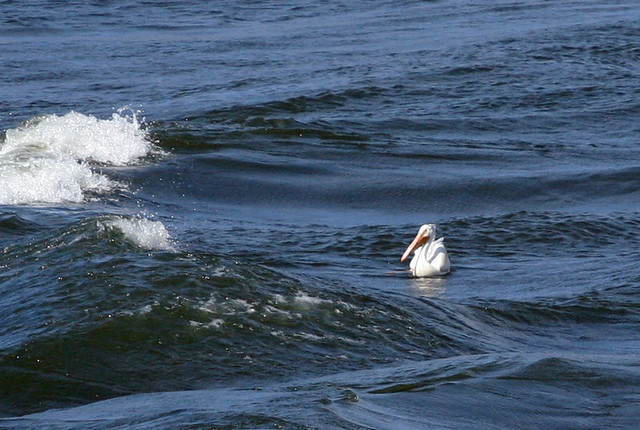
I watched this pelican fly upstream towards the spillway rapids, then ride the waves downstream, then repeat. She repeated this process three times in the time I was there watching. I don't know if she was surfing the waves for fun, or contemplating braving the fire hose to try to get at some salmon snacks.


IMG_7794a


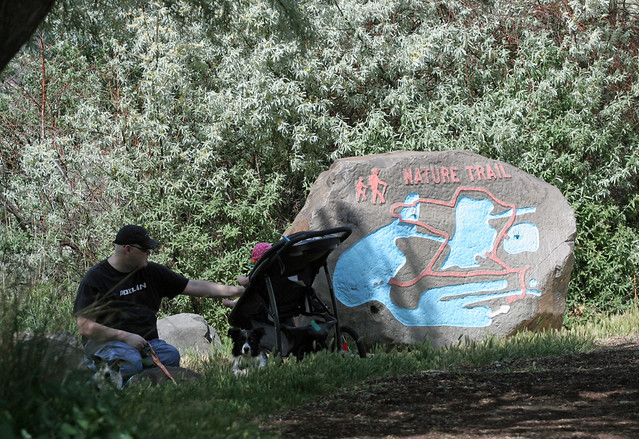
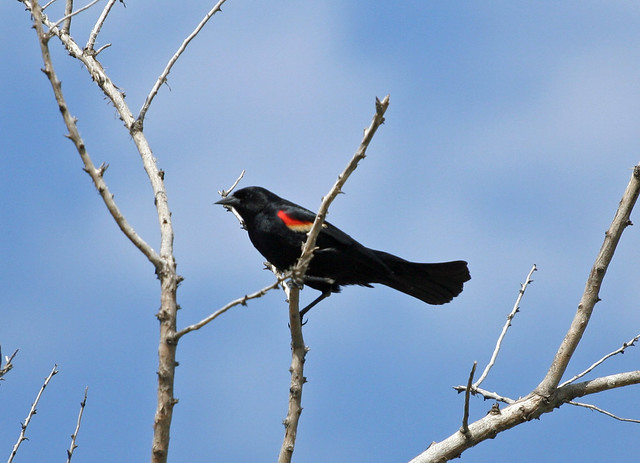
There's an Army Corps of Engineers maintained park downstream of the dam called Spillway Park. It has a large area of man-made wetlands and a network of walking trails. It's pretty obvious that they're "fake" wetlands; nothing looks completely natural, but they tried hard to make it appealing to a variety of bird species and it pays off. There are a lot of happy birds in those ponds.


IMG_7787a


IMG_7784a