Showing posts with label food/farming/hunting/gathering. Show all posts

Thursday, February 7, 2019

Old Homesteads in Western Oregon

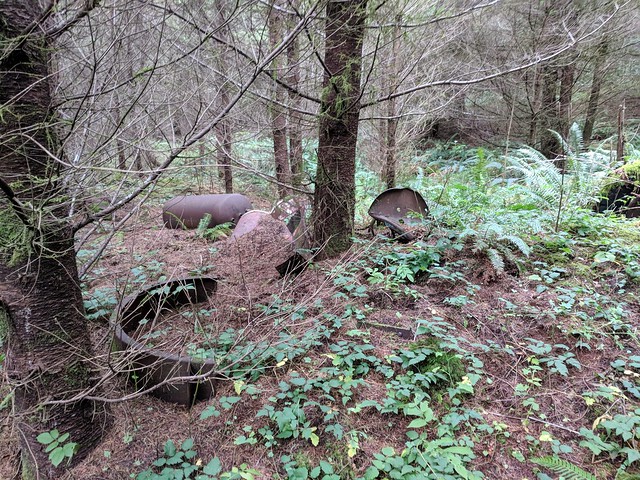
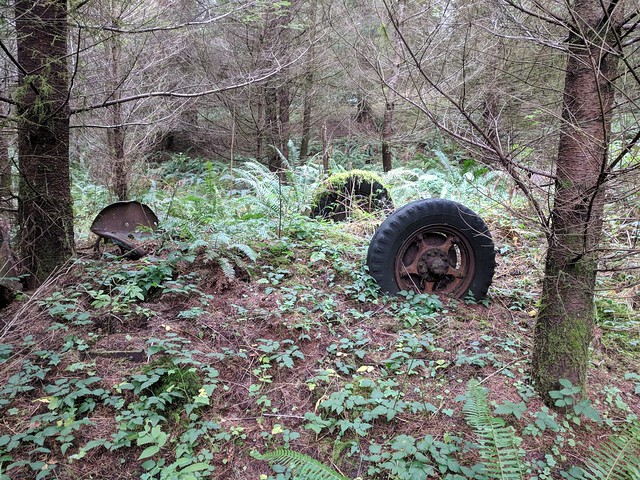
I grew up hiking and hunting in private timberlands in and around the coast range of Western Oregon. I've lost track of the number of homestead sites I've run across in the middle of the woods, in unlikely places. My dad worked for timber companies, and would show me different sites. Often the only way to mark them is the ancient apple or pear trees who remain, clinging to life as the forest grows up around them and shades them out. Or sometimes, an oddly-placed clump of domestic iris or lily that has no business in a wild Pacific forest.

Most of these sites I'm talking about sprung up in the last wave of land-grabber/white homesteaders in the late 1800's and early 1900's. Many of them lasted, at most, a couple decades before the occupants realized how hard it was to grow crops on a PNW hillside with thin, clay soil best suited for sword fern and douglas fir. Most of them were abandoned and the land absorbed by large timber companies who let the trees regenerate and the buildings quietly rot away. Or, like in the case of my childhood house, the majority of the homestead land is absorbed, while the house, outbuildings and useless-for-logging-purposes flat ground near the creek was sold as a residence.

In some cases, families clung to homestead lands for as long as they could, slowly selling land to the timber companies when they needed money. As the original houses rotted, they built new houses closer to the public roads and highways, often delegating the original home sites as garbage dumps (because even to this day in rural communities, it's much cheaper than a long trip to the landfill). 

So, if you're stomping around inside a tree farm and come across a spindly pear tree growing on a bench far from any road, or an old plow, or truck chassis, rusty artifacts like old water heaters or oil cans, someone once had a house there, and a few chickens, pigs, and maybe cows.

2018-11-24_09-59-46

2018-11-24_09-58-53

Wednesday, September 5, 2018

The Saddest Harvest


This is the third summer I've lived in this house, and it's the third summer I've made the sad collection you see in this jar: dead bumblebees collected from the back part of the driveway near the garage.

I don't think their deaths are natural. The slow but noticeable pile-up of tiny fuzzy bodies starts in early July, long before the cold nights start taking their natural toll on the population, and I maintain two bee baths nearby so it's not likely to be dehydration, either. And of all of my yard, it's only these 100 or so square feet where they accumulate; I'll find the odd dead non-native honey bee or wasp scattered all over the yard, but nothing near the numbers of bumbles in this one spot.

There is the possibility that this neighborhood simply has a lot of bumble bees. I've seen swarms of them on neighbor's lavender, and in my silk tree. The workers only live about a month, and it could be coincidence that I find so many in one spot. Maybe heat rising up from the asphalt happens to catch an abnormal number of weak workers already on their way out.

But I can't help but think it's related to pesticides. We don't use them*, and neither do our immediate neighbors, but I can guarantee that previous owners did. The house was built in 1910, so it's been through every single wave of modern pesticide use, possibly starting with the old fashioned lead or arsenic-based ones, followed by organochlorines, then organophosphates and carbamates, then pyrethroids and neonicotinoids. Most of the most popular pesticides in the last century last a long time in the environment, and could have left potential residues.

We have a curious lack of ants in the house, when many other locals have a huge ant population in their kitchens; we have a lack of wasp nests in the eaves, or under the porch, even this year, which has seen record numbers of wasps due to a mild winter. This probably means the perimeter and eaves were treated with pyrethroids in the last few years. And probably have been annually for decades, since pyrethroids first went on the consumer market. The soil and mulch left from previous owners, surfaces of the asphalt driveway, the foundation and eaves of the garage and the house, all probably have at least some residues of long-lasting insecticides.

Bee declines are more on the public's radar now than a decade ago, but of course everyone wants an easy answer and a "quick fix". The push to to ban individual insecticides like imidicloprid or other neonicotinoids  has the feel of a handy scapegoat, an easy-to-understand boogyman. What the science is clear on, however, is that the single biggest threat to pollinators (and most species, for that matter) is habitat fragmentation. Many of the same people so adamant about banning pesticides maintain pollinator food deserts in their own yards with a traditional manicured lawn.

My opinion is that residential use of pesticides for "frivolous" reasons (killing pests in ornamental plants including lawns) should be a lot more restricted, instead of banning their use in agriculture. At the same time, farmers should be given incentives for increasing biodiversity on their land, and reducing chemical inputs and reducing waste across the board (that includes long distance shipping, burning or trashing harvests when prices go down, etc).

I won't be having my soil tested because my actions would be the same no matter if it's pesticides or other things killing the bees: plant my vegetables in raised beds filled with fresh soil; mulch the heck out of everything else to bury any contamination; keep the bee-baths filled during the driest months; plant native flowers and shrubs that provide year-long food for pollinators, hopefully in a way that is so attractive from the curb I can convince my neighbors to follow suite.

In the meantime, every time I see another sad little fuzzy body in my yard, I get to ponder the follies of modern living.

Image description: A photograph of a glass jar holding about twenty dead bumblebees.

 *With a few, very tiny exceptions, such as fipronil or imidicloprid flea drops on the cat and dog.

References:
https://xerces.org/bumblebees/
https://xerces.org/pollinator-redlist/
https://www.chemistryworld.com/news/what-you-need-to-know-about-neonicotinoids/3008816.article
http://www.sciencemediacentre.org/expert-reaction-to-eu-ban-on-outdoor-use-of-three-neonicotinoid-pesticides/
https://www.epa.gov/pollinator-protection/colony-collapse-disorder
https://www.ars.usda.gov/oc/br/ccd/index/
https://www.smithsonianmag.com/science-nature/north-american-bumblebees-on-the-decline-41344352/
https://www.smithsonianmag.com/smart-news/the-american-bumblebee-is-crashing-too-293832/
http://npic.orst.edu/ingred/permethrin.html
http://npic.orst.edu/factsheets/chlordanegen.pdf
http://npic.orst.edu/ingred/imid.html
https://blogs.ei.columbia.edu/2010/06/04/the-problem-of-lawns/

Saturday, September 23, 2017

Apple cider without a press

IMG_20161110_103013


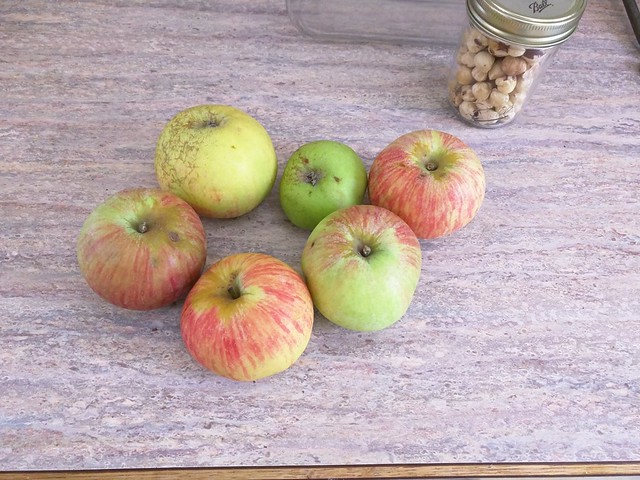
Do you have apples and a wish for fresh cider, but don't have the money/time/space to buy/rent/build a cider press? Then I have the solution for you!

Freeze 'em. Thaw 'em. Core 'em. Squeeze 'em with a lemon juicer. Strain, pasteurize.
It does not take as long as you'd think to hand-squeeze cider; frozen and thawed apples are softer than lemons.


Sunday, April 9, 2017

Garden

We bought a house in autumn 2016. It's in an old neighborhood with lots of old, established trees and shrubs and things. I'm trying to replace all the invasive ornamental plants with native ones. Here's the progress so far:

Pulled out all the english ivy that's creeping in from the neighbor (some day, I'll see if they'll let me kill all their ivy, too), and pulled out all this viney ornamental weed in the shade garden, whatever it was (it used to cover all the ground between the house and the path below).


Despite some slug damage, the wild ginger I transplanted last autumn is doing well, so I went out to the parents' property and liberated some more, plus some other native plants, mostly for the shade garden. Scored some sword ferns, oxalis, bleeding heart


I also got a couple cuttings of salmon berry, and salal.


We'll see how they root.


This clump of dirt and moss pictured above is actually a very old sword fern that was living next to my parent's house.


Here it is the oldest photo I can find of it, c. 1985, but it might have been growing there for many years before that. The house was originally built in the '30's or '40's. Dad's been thinking of killing it for years because it blocks one of the vents, so I saved it. Let's see how it likes being a suburban fern.

On a related note, it is surprisingly hard to find out how long a sword fern can live. Individual fronds only live a few years, but the rhizomes can obviously live for decades. If anyone knows of a reputable source that has this info, I'd love to know.

Monday, October 24, 2016

Ginger-Lovers Nutty Apple Crisp

My twist on apple crisp the way I like it. Well, love it... I actually died when I took the first bite, so this is my ghost speaking to you from the beyond the grave about this very important recipe. (Sorry to those who have any kind of food allergy, because this hits pretty much all of them).


Apple mix:
5 large apples, peeled, cored and chopped into little squares (or a 50:50 mix of apples and pears. Yum)
Tsp of cinnamon, maybe some nutmeg, pinch of cloves also good
about 1/4 to 1/2 cup of finely diced candied ginger (yeah, you read that right. I said ginger lovers, didn't I)
about 1/2 a lemon worth of lemon juice

Toss that all together and dump into a square glass baking dish.

Topping:
1/4 cup flour
1/2 cup brown sugar
6 tablespoons butter (salted, sweet cream)
Pinch of salt
Maybe some more cinnamon

Cut that all together, then mix in:
1/2 cup oats
1/2 cup chopped roasted hazelnuts (if you scavenged them from your neighbor's yard and roasted them yourself, you get bonus points), pecans or walnuts would also work swell

Dump topping over the apple mix and bake at 350 for about 45 minutes

Really good with vanilla ice cream. Tastes like autumn and Christmas both. Kinda spicy.

If anyone actually makes this recipe, I really would like to know. Not many people love ginger the way I do.


Sunday, September 25, 2016

Salmonberry Jelly

IMG_20160616_082731


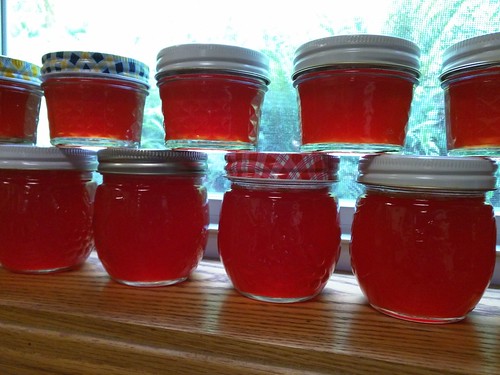
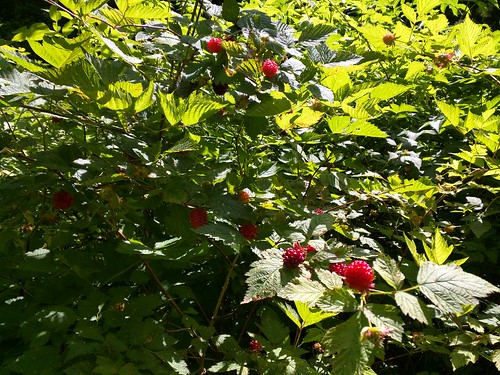
Salmonberry is native to the Pacific Northwest and is very important to native americans all up and down the coast, from what's now Alaska, to what's now Northern California. It hasn't been domesticated, so this is only available by knowing a good picking spot (and having permission to pick there).

I also feel obligated to balance the extreme fruit-bias in our culture by informing everyone that the entire plant is edible. The fresh spring sprouts can be eaten raw or steamed.

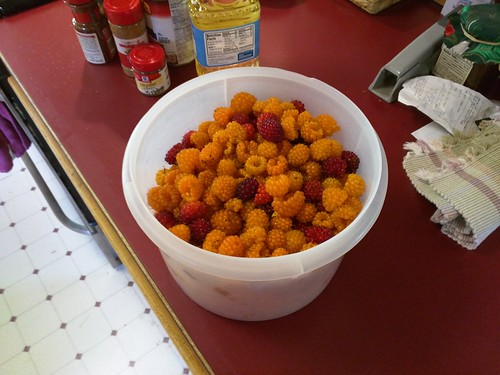
The berries can be tricky. It's hard to tell when they're ripe because they come in such a wide array of colors (pale orange to dark red).


Salmonberries Memorial weekend 2016
(All of these are the same level of ripeness, from bushes a few feet apart)


They have inconsistent (and most people say bland) flavor; birds and bears eat them before you can get them; and they tend to grow near stinging nettles and devils club.


Salmonberries Memorial weekend 2016

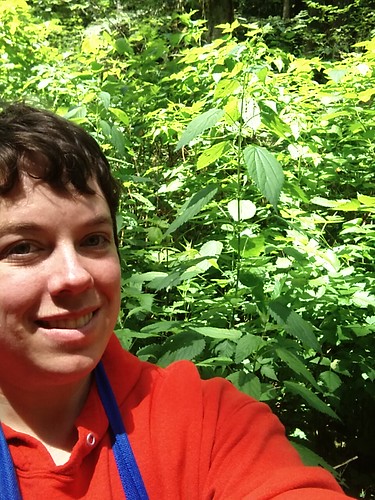
(me standing in front of a a nine-foot-tall nettle while picking)

But they're very juicy and I'm lucky to have a good spot on private land that no one else but the birds are using. My first trip to the patch was Memorial Day weekend. I got a decent amount, but the picking was better when I returned two weeks later.


Salmonberries Memorial weekend 2016


For making the jelly, I got tips from this awesome blog, but I did a couple things different. I definitely agree with her that I would never make salmonberry jam - the seeds are ridiculous. (She's also in a much harsher environment than me. Our Oregon salmonberries grow ten feet tall).

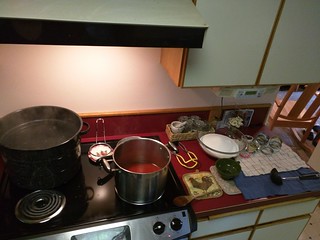
I froze the berries, then cooked them and mashed them up, then dumped them in cheesecloth to get the juice out. (I can't stop myself from squeezing the cheesecloth to get juice out. That's supposed to make the juice cloudy, but I didn't see a big problem.)

RECIPE
4.5 cups of Salmonberry juice
7 cups of white sugar
1 package powdered SureJell
Yield: 9 cups of jelly, packaged in six 8oz jars, and five 4oz jars, and some extra I ate on toast right away.

I see a 4oz jar of Alaskan salmonberry jelly is selling on Amazon for six bucks, I should get on that. 


IMG_20160615_133055

This was my first time tasting salmonberry anything (except fresh). It's very good. Reminiscent of raspberry (go figure), but it's own unique flavor.


Reference:
Pojar, Jim and MacKinnon, Andy, ed. Plants of the Pacific Northwest Coast, Revised, Lone Pine, 2004

Tuesday, October 13, 2015

Cowdogs of Eastern Oregon

A little background: when I moved to Eastern Oregon from the west side of the state in 2010, I immediately noticed that there were border collies everywhere. Every flatbed seemed to have one, and when I worked at the mixed-practice vet clinic that served a lot of the ranches, I met even more of them. Border collies and crosses are the most popular stock dog in Eastern Oregon and Western Idaho. And I'm fairly certain that the majority of them are not registered with any pedigree registry.

This is a stark contrast to the image put forth by vocal online border collie groups who think of themselves as WORKING (in all caps) people. Their dogs are registered with some kind of working dog registry like ABCA or ISDS, and, even though these registries are technically "open", often the dogs are as inbred as the "show ring" dogs, and suffer from popular sire effects, among other problems. These people tend to idealize the trial sheep dog, while putting down dogs who work cattle, even though sheep is a dying industry and there are many more actual working cattle ranches in north America. These ranchers are sort of left in their own quiet niche, doing things the way they've been done for many years, including things like outcrossing, crossbreeding, keeping and selling pet dogs, breeding dogs that are "good enough", instead of only "best to the best"... and other "shocking" activities, virtually unacknowledged by the internet or by the registry folks.

I want to hear more from the local ranchers about their dogs. I'm starting by interviewing my friend and former coworker Jess Schiller because she has some neat dogs. Let me show you them:

(All photos copyright Jess Schiller and used with permission)

----------------------------------------

Me: Can you start by telling people a little about the ranch and your dogs?

Jess: My husband Pat's family homesteaded this area four generations ago. I'm not good on the details, but Antone Vey came over from Portugal and started raising sheep. Since then the ranch has converted to a cattle operation starting with Herefords. Pat took out his first loan for cows when he was 18 and bought 40 pair from the Spray area and now we are up to 140 mama cows mostly red angus cross. Keeping up with the red tradition in his family.

We raise calves for market and potential breeder replacements for our herd. What we are is range managers and we use our cows as the means to do so. The term "graze it don't blaze it" well that's what we try to do. We graze on private ground both on Buttercreek and in Starkey. Pat's grandmother's cows however are on private and jointly managed US Forest Service allotments.

We start calving around end of January/February and we raise the calves and maintain the mamas until we sell the calves around October. We "summer" (move to summer grazing in the mountains) May to October-ish in Starkey. Then we move them "home" to Buttercreek from October to May. The pack is used to help us gather and sort. We have at least 4000 acres here and usually it's just Pat and I so they save our horses a lot of miles here and up in the mountains.

The girls Zee and Tip, who you've met, were the best working pair we've had.

Zee is really good at going a long ways out and bringing cows up top. She was great at pushing until she got hurt. Now Pat is so scared of her getting hurt because she's his baby and bull-headed, so she  doesn't get to work much. Zee has raised five litters of great working pups so she's out of practice with all of it but I have her helping me teach her son Cap who ended up being way too timid for Pat but is great for me.

Zee

Then we have Gus. He's a heeler/border collie mix. His job is a brush dog. The cows get into thick stuff, he goes in and they WILL come out.

Zip is Pat's boy and daddy to two litters out of Zee. We got him from my uncle three years ago because he had quit his job and didn't want Zip to waste away in a yard in town. It took Pat less than an hour to bond and after that Zip actually tried biting my uncle's girlfriend. He went through a grumpy strange, but not so much any more. He is such an attention whore it's ridiculous. But he is Pat's A number 1 cow dog. I'll have to send you videos it's so awesome to watch him work. So quiet and picks on the cows but if you throw a stick he's the biggest goober ever.

We have seven dogs right now, and the rest are pets. Rhett was a rescue from my cousin who realized border collies need to work. He's great with [my toddler] but not...so .. smart with cows. He's gonna get hurt with how he barrels in after cows and doesn't pay attention to what's going on. And Peter is my brother's dog. He's just special we can keep it at that.

First question(s): are any of your dogs, or any dogs in your extended family, registered with any breed registry? or have you ever entered any of your dogs in any kind of competition? (have you even heard of ABCA or ISDS?)

Negative to all. I did dog 4H once with my dad's cow dog... needless to say it didn't go well. He was getting pretty pissed with the baths for one and then the fact that I'm pretty sure he thought the show was the dumbest thing ever. Kinda like going for a pleasure ride with one of our ranch horses. They go out expecting to work.

Pat's family use to do sheep dog trials when his grandpa was alive. I'm pretty sure they had some spendy dogs from over seas. But those dogs have been gone for a long time.

Any of those trial dogs have decedents still around?

Not as far as I know. I'll ask Pat the next time I talk to him

After meeting all the different types of stock dogs around here, it seems to me that most ranchers don't care about  how "pure" their dogs' bloodlines are or bother with a working registry.

I think registered dogs in the ranching world are like papered horses. It's nice and really interesting to know their background but papers don't make the animal. And you can go out and spend a lot of money on a dog to find out the mutt you raised is better than that one.

So where did all your dogs come from? Obviously in the last few years you breed your own, but further back than that?

Let's see. Tip is Pat's red dog he got from Ryan Raymond a rancher out of Pilot Rock. We are pretty sure she has a little Carter in her. Which is actually a breed of stock dog that was developed in Long Creek. We sold Pat Carter one of our pups a few years ago.

Zee my lil girl came from a couple in Heppner that we've known for a long time. They have a long line of awesome girls and I think they are looking to start training for other people.

Zip, Pat's male that we got the last two litters out of, came from a rancher out of Arlington at the time him and his ex-wife raised dogs as well.

And Gus came from a neighbor. He is the heeler cross. Cap came out of him and Zee. He's the one I've been trying to spend a lot of time with because he is pretty timid and doesn't handle Pat's aggressive tone very well but he's coming along.

Cap guarding the hole while Jess fixed a gate the bulls knocked down


Would you say that your dogs are pretty typical of other ranchers in the area? You guys aren't an outlier in how you source/use/breed?

Nope pretty typical. It's all personal preference and you know border collies they are smart and you can teach them about anything and they are one-person dogs. Makes it pretty easy to like your dogs better than the neighbors'.

I know some people go out of area to get dogs. My girlfriend Jamie is trying out a new breed called an Idaho shag, I think it's an Airedale cross. She crosses that with a heeler you'll end up with about the dumbest block head. But those cows will move!

But really if someone is looking for a good rounded dog there is no reason to go too far. There isn't a lack of border collies around here that's for sure.

Can you talk a bit more about Tip? Is she the one I met who's red with a natural bob tail? she caught my eye right away because she doesn't have a "classic" border collie look. A lot of "registry snobs" would call her a mongrel. Would you call her a "border collie"?

Lol, they'd probably think our whole pack is mongrels. Tip's a great little dog. For the longest time we argued that she was a red border collie. Kinda like how with black angus every once in awhile they have a red one. But we are starting to think she has a little Carter in her. She was the only red bob tailed in her litter and I'm pretty sure both her parents were black and white but I'd have to confirm that with Pat. She's retired with benefits now since she fell out of a truck and broke her leg and hip. By the way, I dock the tails of all our pups and we prefer dock-tailed dogs. And I know some would argue that we've killed their balance but my dad's old Ed dog (the cow dog I tried showing in 4H) had a docked tail and he kept right up with those "sheep dogs" of West's (they use to run several bands of sheep on Rhea creek). When they loaded them the dogs would run across the sheeps' backs and Ed's lack of tail didn't seem to slow him down.

A rare photo of Tip, who hates cameras


I don't know much about the Carter, can you tell me a bit about that?

The Carter breed kinda died out. It's hard to find them any more. It was never wide-spread. But there were a few around. Pretty much one family started the breed. Short stalky curly breed. A few families around Heppner had some and I can't off the top of my head tell you where they came from. My father-in-law had one and he currently has a very old carter/Airedale cross. He is about one of the last ones I know of around here. Pat Carter had talked about maybe trying again. It'd be cool if he did. I have sold two pups down in the Long Creek area (90 miles south of Pendleton; Dirty rotten rough country. Hard on horses and dogs) and as far as I know they're doing great.

You may not realize this, but many of these "registry" folks I mentioned say it's not OK to crossbreed/outcross, or at least they're very afraid of it. It seems ridiculous to me. They act as if the only "good" working dogs are the ones with an inbred pedigree that goes back 40 generations.

OK my argument to that...it's just like cattle. Your cross bred cattle the calves are gonna come out stronger healthier and gain better than the pure-breds due to being heterogenous. It's been scientifically proven that cross bred animals do better. Now it's not quite the same in dogs since don't eat them in this country. But if you continue to breed the brains out of these animals all your gonna end up with is an animal that can run a course. If I'm not mistaken sheep trial courses are usually pretty similar. So all your asking that animal to do is look amazing for one small task. I'm a sucker for a cleaned up long coated border collie mostly because I know mine will never look like that! They look great and they can successfully do the exact same thing you asked them to do last weekend. Just like barrel horses it's a pattern they've done repeatedly and that's what they are gonna do.

I'm not trashing sheep dogs they are amazing to watch, but when a stock dog puts a hundred pair through a gate without a wreck and you're a half mile away on another ridge...  well that's pretty amazing to watch, too.


Many anti-crossbreeding people say that they "need a dog that will do work" and they can't afford to cross (for example, like a 50/50 Airedale/border collie) because the first generation wouldn't be able to work and they'd have a whole litter of useless puppies. What do you personally do, and what do the other ranchers you know do, with dogs they breed who end up being bad workers?

I guess I've never heard that. It sounds like an old wives tale to me. I think you could end up with a whole batch of purebred that don't work, either. Honestly I have one that doesn't work very well. He is probably one of the "purest" ones I have. And I don't think it really has any thing to do with the dog. At the time I was building fence when I got him so he became more of a pack dog than a stock dog. And his personality to I don't think he has the attention span to pay attention long enough for him to actually asses the situation. Maybe if I had started him on cows first maybe it would be different. He has it. But he gets so excited he barrels in and causes a wreck and then doesn't pay attention and almost get ran over.

I think the ones that don't work it has more to do with the handlers. These people who get these dogs for pets they can't expect them to be a house dog for most of their lives and then go out and chase a cow. Yes they do have natural instinct but they still need to be taught. Pat spent a lot of time on Tip and in turn she taught Zee and now Zee is teaching Cap. Having a mature dog with pups helps soo much.

As far as what everyone else does with bad workers I'm sure you could guess what some do. But I don't think that's usually the case. I think if you spend the time with the animal and be patient you'll get a fine worker. Also border collies are famous for being timid. It took Zee three years to stop running back to the pickup when Pat was hollering at the cows. Now it just makes her go harder.

Cap (left) and his dam, Zee

Thursday, March 12, 2015

NPR innocently asks, "does being vegan REALLY help animals?"

"Well OF COURSE it does!" (Says vegetarian who only talked to vegans.)

This article by Barbara J. King on the NPR website should have been titled "Why veganism is awesome: a vegan's perspective".

There are so many good, articulate writers and thinkers out there who are thoughtful meat eaters; the fact that this NPR writer didn't find ONE of them to talk to makes me mad. NPR is supposed to be better than this. Instead, we get yet another cookie-cutter, shallow, biased piece almost copy-pasted from the vegan movement's talking points. Although it's presented as an opinion piece, that doesn't excuse NPR for hosting such tripe.

My response, in bulleted list format because I'm lazy (also I've written about this before):

-I have friends who are vegan. They are good, earnest people who care deeply about animals, and I can dig that. Unfortunately, one of the many problems with the vegan "movement" is it is headed by radical animal rights activists just like the ones interviewed for this article. Anyone from PETA or  HSUS is not "reasonable", and are complicit in the deaths of thousands of dogs and cats annually through unnecessary euthanasia. They may care for animals too, but their goal is to force their values on everyone without listening to facts or reason. They should be the last ones to use as examples if you're really trying to have a balanced discussion or convince anyone to change their lifestyle. (Also, kindly remember that us thoughtful meat-eaters care deeply for animals, too)

-Veganism (or vegitarianism, or reducing use of animal products) is not the only way, or even a good way, to go about reducing the suffering of animals by human hands.

-Just because you're not eating them, doesn't mean animals didn't die for you. Soy harvest alone kills or displaces countless birds and small mammals. Sorry to wreck your warm-and-fuzzies, but that "95" number is completely made up by someone with an agenda.

-Growing plants is not automatically better for the environment than growing animals.

-All the proven health benefits of a vegan diet have as much to do with simply being more thoughtful about diet in general than in actually being vegan.

-No, it really isn't simple or cheap to live on a vegan diet. Especially if you have children. Stop the hand-waving. Maybe we can have a discussion about how to improve public school lunches? Or reduce urban food deserts? Or incentivize community gardens? Or, you know, ANYTHING besides  scolding or guilt-tripping because "I can do it, so can you"?

-While we're at it, let's acknowledge a couple things: 1) most vegans are white, middle to upper class, while most of the farmworkers who harvest the crops that make a vegan lifestyle possible are poor people of color; 2) some people really, truly can't survive on a vegan diet for health reasons; 3) food is very important to many cultures and insulting cultural dishes because they dare to contain meat is bigotry

-The word I'm looking for is 'ethnocentric'. (And also, if you're comparing yourself to Saint Paul simply because of your diet, that should be a clue that your ego is too big for you to be having a grown-up conversation, especially on freaking NPR)

-They try to imply that government or military misallocation of resources - like grains seized in Ethiopia during the height of famine- was because of factory farming? That's insane. I can't even.

-Can we PLEASE have a discussion that goes beyond "red meat"? Corn-fattened beef from feed lots is not the only animal product out there. Vegans love to hang their debate on it because it's pretty clear cut: yes, reducing this type of meat consumption is healthier; yes, feed lots are bad for the environment; yes, it's wasteful to feed them corn. We know this already. Can we talk about range cattle? Or farmed tilapia? Or backyard chickens? Or livestock fed off of marginal land unsuitable for crops? Or sustainable hunting? As someone who cares about this stuff, I hate seeing yet another black and white debate from vegans. "Beef or no meat at all" are our only choices? Really? Even the pesco-vegetarian author barely touched on how important fish is as a protein, yet dedicated many paragraphs to full-on anti-meat propaganda.


IMG_8797a

Tuesday, September 23, 2014

A Thoughtful Omnivore: How to Love Animals and Eat Them, too


Elk 2007

I recently had an acquaintance who is a vegetarian and animal shelter volunteer who, after finding out I hunt deer, expressed shock that I would advocate for no-kill shelter policies then turn around and kill other animals. I've run into this sentiment often. So, here: have an essay on why I'm not vegan.


Believe it or not, people like me, who hunt or farm and eat meat, can be just as thoughtful as vegans when it comes to animal welfare. We've just came to different conclusions about humans' relationship with animals.

Meat eaters seem constantly on the defensive when we interact with vegans (and/or act like assholes), and we shouldn't. The ethical and environmental concerns of modern large scale animal farms are pretty well-known at this point, though arguably not as mainstream as they should be. No one (except maybe some industry lobbyists) argues that 'factory farming' is awesome and should continue unchecked and unimproved. And likewise, most people are aware that the American diet contains waaaay more cow meat than is healthy or needed. We're in agreement on these subjects, just not in their solutions.

The most succinct essay I've seen on the issue is this one here, written by Jay Bost. Please go read the whole thing, here are some key points:
"The ethical reasons of why NOT to eat meat are obvious: animals are raised and killed in cruel conditions; grain that could feed hungry people is fed to animals; the need for pasture fuels deforestation; and by eating meat, one is implicated in the killing of a sentient being. Except for the last reason, however, none of these aspects of eating meat are implicit in eating meat ... eating meat raised in specific circumstances is ethical; eating meat raised in other circumstances is unethical. Just as eating vegetables, tofu or grain raised in certain circumstances is ethical and those produced in other ways is unethical"

"...  If “ethical” is defined as living in the most ecologically benign way, then in fairly specific circumstances, of which each eater must educate himself, eating meat is ethical; in fact NOT eating meat may be arguably unethical."

"A well-managed, free-ranged cow is able to turn the sunlight captured by plants into condensed calories and protein with the aid of the microorganisms in its gut. Sun [to]  diverse plants [to] cow [to] human. This in a larger ethical view looks much cleaner than the fossil-fuel-soaked scheme of tractor-tilled field [to] irrigated soy monoculture [to] tractor harvest [to] processing [to] tofu [to] shipping [to] human."

"For me, eating meat is ethical when one does three things. First, you accept the biological reality that death begets life on this planet ... Second, you combine this realization with ... compassion and choose ethically raised food, vegetable, grain and/or meat. And third, you give thanks."

That sums it up for me. Everyone has to get their protein from somewhere. If you get it from plants you are implicit in the deaths of thousands of birds and small mammals during harvest, habitat loss, and death of arthropods through pesticide use (yes, even in organic farming), not to even speak of the displacement of wild animals from cropland. If you get it from select animal sources, you can at least control the manner of their life and death and ensure it's as good and humane as possible, while also looking out for the environment.

Either way, you are directly responsible for animals dying. Vegans think that because they're not personally pulling the trigger, they get off the hook.

DEAR VEGAN WHO MIGHT BE READING THIS: I AM NOT ATTACKING YOU. if you choose to be vegan because you can't stand the idea of eating something with a face, that's fine. Or if you're vegan as part of a life seeking non-violence, more power to ya'. Or, if you find it easier to be healthy by eating mostly plants, I understand. I'm not attacking personal preference here. But I have yet to meet a vegan or vegetarian who doesn't think they are morally superior to omnivores. I find this a naive, counterproductive, and sometimes dangerous (and personally insulting) sentiment. If you're vegan, you need to understand that your lifestyle is just one of many good ways to live. And if you support terrorist organizations in your bid to encourage a vegan lifestyle, I will fight you on that.


I also have mixed feelings farm animal sanctuaries. (If you didn't know, they're animal rescues that specialize in livestock, mostly from factory farms or abusive conditions, and provide them with care for the rest of their natural lives, sometimes adopting them out as pets.) They are overwhelmingly founded and run by people who are also vegan/vegetarian and usually act as a sort of political backdrop to promote the vegan lifestyle and to fundraise for animal rights organizations such as PETA.

Unfortunately, these promotions usually center on showing us stupid meat-eaters that chickens are cute and have feelings and friends, and WOW didn't you LEARN something today boys and girls!? Thanks, but this isn't the 1940's, there is conclusive and exhaustive scientific evidence that livestock animals are beautiful complex creatures with rich social lives. You might be educating some ignorant city folk who think eggs pop into existence in a grocery store, but to hunters and farmers this is old news .

On the one hand, they seem mostly harmless. Some animals get to have really nice lives, some people get to feel good about themselves. It's a beneficial relationship that doesn't do direct harm to anyone (except arguably the land they use, but I'll get to that in a moment).

On the other hand, it seems like a waste of money, energy, and land. These are food animals, I don't see anything wrong with using them for food. It was the condition of their former lives that should be considered unacceptable, not the mere fact that they were going to end up as food.

Many of these places were converted from former working farms. The land could instead be used as a real, working farm providing ethical meat and vegetables to the local community. Part of me wants these animal-lovers who fund and run these sanctuaries to spend that money on, for example, dogs and cats in under-performing shelter systems, and leave the farmland in the hands of someone like the Salatin family who could raise some ethical, environmentally friendly food instead of wasting in on pets.

It begs the question: the vegans running these farms obviously find the living conditions their animals acceptable. Why then, if the same types of animals are living in nearly identical conditions on a working farm, but they happen to be used for food instead of dying of old age, why isn't that acceptable to vegans? (See: pigs at a sanctuary versus pigs at a humane meat farm).

Probably because....

Most vegans see all death as inhumane, no matter how it occurs
See the comments on this post, for just a few examples. The vegan commenters don't care if a cow dies slowly (bleeding out while conscience) or instantly (via boltgun). It's death itself they don't like.

I can't even begin to understand this mindset. On a personal level, I've worked as a vet tech assisting in euthanasias of companion animals; as a hunter of large game animals; and as a pseudo-hobby-farmer helping to kill and slaughter sheep. I have close personal experience with the various ways an animal can die that many people today lack. Most animal lovers agree: all deaths are not equal. We should always be conscience of making animals' lives as good as possible; killing them humanely is a big part of that, whether it's a food animal or not.

What's stranger is that vegans' hate of death doesn't extend to pets. Many vegans are pet owners, take their pets to the vet like everyone else, and seem to universally agree that there is such a thing as humane vs. inhumane euthanasia (injection of barbiturates is OK, gas chamber is not OK, for example). They even think there's such thing as humane euthanasia in farm animals who have grown old or sick or injured. Why can't it be possible for humane death in an animal who's body is then used for food?

Most people in the veterinary profession, and in fact all professional veterinary organizations, agree that bolt-gun or bullet to the head is as humane as euthanasia by lethal injection of pentabarbitol. If a vegan is really being logical, than they have to admit there is no difference between euthanizing a beloved pet at the vet, and shooting a cow in the head. It might be more disturbing to think about, but, suffering-wise, there's no difference.

Now, you can argue philosophically that we don't have the right to kill (or exploit) animals, no matter whether it's humane or not. That's a separate issue from the claim that all death is inhumane. My opinion is that humans have as much right to kill animals for food as we do to live at all ("exploitation" would take an entire separate post/book to discuss, as there are many conflicting philosophies and definitions). You can't exist on this planet without causing death, directly or indirectly. If you're thoughtful, and want to live as (pick a buzzword) sustainably, ethically, humanely, etc... as possible, one way of doing that is eating animal products.


IMG_1071
The author appreciates animals as individuals, as a species, and as food.

Sunday, December 15, 2013

Local species debate


 Rocky Mountain elk near Manhattan, MT.

A few months ago a bow hunter in Oregon (who also happens to be co-worker of my dad's) killed a possibly record setting trophy bull elk near the town of Sweet Home, Oregon. My dad says when the skull rests on the ground, the antlers tower over his head.

It hasn't been published in any hunting magazines yet because the official antler score depends on which subspecies of elk it is, and that is under debate. There are two subspecies in Oregon: Rocky Mountain (Cervus elaphus nelsoni the most numerous and widespread subspecies in North America, also called American Elk) and Roosevelt (Cervus elaphus roosevelti a relatively rare species found mostly in the Coast range mountains and foothills. Supposedly darker in color, larger, with shorter, thicker antlers that often have an extra tine near the top that sticks out at an angle. I say supposedly because, really, if you stood two average specimens next to each other, you probably couldn't tell the difference.)

Likely, it will be determined to be a Rocky Mountain elk because  Boon and Crockett use the I-5 freeway as a subspecies boundary. According to them (and other hunting organizations), Roosevelt elk are only found West of the freeway, and everything to the east is Rocky Mountain territory.

I'm sure this was an arbitrary choice on the part of Boon and Crockett - I-5 convienently runs almost straight north-south and bisects the Willamette Valley, and it's probably true that Rocky Mountain elk won't be found West of the freeway. But Roosevelts are definitely found on both sides of the freeway.

The red line is I-5, the orange line is the crest of the Cascade mountains. The red circle is the area the elk was killed. The mountain range is most likely the true subspecies boundary, if we can draw such a thing. This elk was smack in the middle of territory where both subspecies mingle, though you'd be hardpressed to find that information anywhere official.


The Oregon Department of Fish and Wildlife doesn't have their own boundary per se, but they do have management units. The trophy elk was taken either in the Santiam or Mekenzie unit, and both of those units are considered "Western Elk" not "Eastern Elk".


It's OK, though. No one really agrees about the ranges of the elk subspecies.


 Most of the maps you see online look something like this. Which is interesting in a couple of ways. One, it implies there's no overlap between the Roosevelts and rocky mountain populations, which is obviously wrong. Two, the ranges are too small overall. Not only are elk found throughout the Cascades, well into Northern California, they also are on both sides of the mountain range. Here is a photo of some elk in Bend, OR, which is located well to the East of the Mountains and well outside the range for either elk species. Here's another in Malheur, also well into a "white zone".

Hunters report elk throughout the entire state of Oregon, though most range maps show large empty white areas in the east and south.

This map from California Fish and Wildlife at least shows the ranges of the Roosevelt and Rocky Mountain touching. But I took this photo of some elk about 80 miles northwest of Sacramento, quite a few miles farther south than the official Tule elk population.

It makes sense - like their cousins the white tailed deer, elk habituate to humans fairly well. They do well in a wide range of habitats and eat a wide variety of plants; they breed fairly quickly and reach sexual maturity quickly. Though I doubt we'll see the same explosion in urban and suburban populations like we had with the white tail, elk populations are just going to go up.

And the boundaries between subspecies are probably a lot murkier than most people realize. I have no doubt subspecies are interbreeding in the Cascades and foothills on either side. And I wouldn't be at all surprised if northern populations of Tule are mingling with southern Roosevelt. Big whoop, subspecies interbreed all the time. But it'd be nice if someone besides the locals were tracking this kind of thing.

Saturday, September 7, 2013

I Make Dog Food


"Make" in this case is almost over stating it. My fridge and freezer needed to be cleaned out, so the dogs got a mix of what wasn't completely bad. I try to make it a good mix of protien, carbs, veggies/fruits, but I don't obsess over precisely balancing anything, and I'm quite loose with portion sizes.  Most of the time the dogs get kibble (which I call 'astronaut food'). This batch fed two border collies for about 5 days.


Ingredients:
Bear meat, really sinewy. The most work I put into this 'recipe' was cooking it in a stew-like substance. Hence how soupy the end product turned out.
Strawberry pulp leftover from making ice cream earlier that day
A stray can of tomato juice left here from when my mother in law visited. No one else is gonna drink it, so into the pot it goes
Left over white rice
Old, hairy carrots
Frozen peas
Garden tomatoes that were getting a wee soft
Freezer burned turkey
Freezer burned ham chunks
Leftover ravioli
Yogurt
Fresh spinach that wasn't so 'fresh' anymore
Random packet of oyster crackers I spotted nearby

Add a bit of salt and mix it all together and voila: dog food.
This is how much they love this stew: normally I set their food bowls down about 10 feet apart in the kitchen. I stand nearby until they're done because otherwise Zelda will kick Sammy off her dish. If I stand nearby, no such shenanigans occur. When fed this delish home made food, they have to be fed at least 15 feet apart or in separate rooms, because they growl and snark at each other the entire time they eat.

Sunday, February 17, 2013

Big Game Hunting 2012

I haven't been hunting as much since I moved up state. I was spoiled back home: I knew every nook and cranny of "our" hunting grounds (private land we have permission to hunt on). I have a pretty good feel for the movements of the black tail deer: when they're up eating, when they're bedding down, the "look" of a good spot to find them, how the weather effects their behavior, what time to be up, and when to call it quits and try again tomorrow..

Here, I'm not familiar with the terrain or the subtle differences in deer species. I don't know any good spots, and what's worse, it's a lot more crowded. People come from all over the country to hunt deer and elk here (whereas not many people care for hunting tiny little black tails in the coast range which is steep and brushy as a rainforest). I've heard from many locals that opening week of rifle deer season is a feeding frenzy.

I've never had to deal with crowds in the woods, and I it's not worth it to me to deal with it to get some venison. And honestly it's a bit intimidating to try to"break into the market" as it were, especially with a forest so crowded with trophy hunters who take themselves too seriously and think they own certain sections of public land.

I'd much rather drive five hours to my old stomping grounds.

Dad and I both drew a controlled cow tag for a landowner preference hunt in 2012. For those who haven't heard of it, basically a large landowner, in this case a private forestry company, asks the Oregon Department of Fish and Wildlife to issue special hunting tags just for a specific region for controlling elk populations that are getting too big. And, in this case, damaging newly planted trees. The hunt was for the month of January, but I could only drive down for four days

It's a large area, and there's one or two herds (50-100 individuals) who travel through it. We drive the network of logging roads until we cut tracks, then, depending on the age of the tracks, we'll park and follow them until we find either a good place to come back later and ambush them, or run into the elk themselves. This is the method that's bagged us, between my dad and myself, an average of one elk every year for the last 10 years. The trouble is, if the herd isn't in the boundary of the hunt, there's nothing you can do about it. That's what happened this year.

Alas, this is, as a wise man once said, why they call it hunting and not gathering.

It didn't help that was pregnant and couldn't hike very much. I got dizzy and short of breath after only two miles of uphill hiking with hardly any brush. I wanted to yell, "hey! stop being stupid, I'm trying to procure some high quality protein for this fetus!" But since I didn't know who to yell at, I went back to the pickup and ate a granola bar instead.


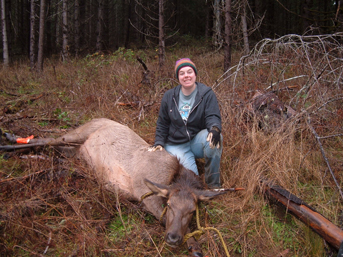
This is the last elk I got, back in 2008:


Elk 2007

Tuesday, November 20, 2012

Some Thanksgiving Links

There's a reason this blog has been lacking in content recently, and soon I will tell you.

For now, here's some semi-random Thanksgiving related links for you.

This is very close to the 'pumpkin' pie recipe I use (for the last four years anyway, since I discovered delicata squashes). Guys. It is so much more delicious than canned pumpkin. If you're a fan of pumpkin pie, try making it from a delicata squash.

Food photography at its best. I want to fall into this picture and hang out/live in this rustic place.

Raising and slaughtering turkeys - the way it should be done.

I've never poached anything (hunting or cooking), but this photo of poached wild turkey makes my mouth water.

And here's a fully-random photo of my dad picking chanterelles on a very wet day Thanksgiving day in 2009.


Mushroom hunting with dad


Have a great week everyone.

Wednesday, August 29, 2012

Archeologists Evicerate "Paleo Diet"

This made me lol into my Ramen tonight.

The seminar titles alone are worth the price of admission:

It’s When You Mate, Not What You Ate"

or

"Papayas Ain’t Paleo, and Neither Are You"

“The notion that we have not yet adapted to eat wheat, yet we have had sufficient time to adapt to kale or lentils is ridiculous. In fact, for most practitioners of the Paleo Diet, who are typically westerners, the majority of the food they consume has been available to their gene pool for less than five centuries. Tomatoes, peppers, squash, potatoes, avocados, pecans, cashews, and blueberries are all New World crops, and have only been on the dinner table of African and Eurasian populations for probably 10 generations of their evolutionary history. Europeans have been eating grain for the last 10,000 years; we’ve been eating sweet potatoes for less than 500. Yet the human body has seemingly adapted perfectly well to yams, let alone pineapple and sunflower seeds.”

-- "Dr. Karl Fenst, bioarchaeologist"

Sunday, June 3, 2012

State of the garden

I planted my garden last week. Finally finished building the raised beds (from recycled fence boards, like I promised), and spent a veeeery long Saturday filling them with soil/compost/manure. We don't own a wheel barrow, and I didn't want to buy one for just occasional use, so I carried all that dirt from the back of the pickup to the backyard beds in a bucket. Pro tip: if you're in this situation, the head balance method of carrying really is the best. It distributes weight evenly and doesn't strain any one muscle group. Try it sometime. Don't worry about the neighbors staring.

Anyway, like usual, I'm going a bit crazy with plant lust. I can't enter garden departments without getting twitchy and leaving with at least one plant start or package of seeds. It's worse than ever because of the new yard. Last year, with only a north-facing apartment patio, I was forced to have only a single tomato plant. Now, I've filled the raised beds and I've got a huge patio to stick pots on. I just finished  planting my fourth container of peas because I can, dammit.

Being able to grow your own food is powerful, in ways I don't quite have the word-skill to describe. I'm not even growing that much; a mere snack compared to my family's yearly intake. But, still. They're alive, and they're growing, and they're there because I put them there, and I get to eat them.


IMG_5031


IMG_5026
I have power tools, and I'm not afraid to use them

IMG_5043

IMG_5047

This is what it took to fill three raised beds that are approximately 4'x5'x1': a pickup bed full of soil, six 60 lb bags of finished compost, and half a pickup bed worth of half-green horse manure I picked up from a friend's pasture. And I did it all myself because Tom was having allergy-induced asthma that weekend.


IMG_5048

The underground automatic sprinkler system is an interesting conundrum. One the one hand, they're really nice to have to water such a large yard, and very convenient to use. On the other, I wouldn't have wanted all that water-wasting grass in the first place, and I don't like the lack of control I have for watering the raised beds; I have to water them and that section of lawn at the same time.

I live in a freaking desert. If this were a house we planned to live in for the rest of our lives, I'd probably rip it all out, expand my garden to fill most of the yard, install soaker hoses or drip lines, mulch the dog's play area, and turn the front yard into dry landscaping with native plants. But since we're probably going to be selling the house in a few years, I feel the need to keep all the grass and sprinkler system as a selling point.


IMG_5049
 I've got ten strawberry, four tomato, two cucumber, three zucchini, and two cantaloupe.


IMG_5044
There are potatoes volunteering in the "failed" compost bins. They're free to do their thing. Perhaps in a few months I will scrub the cat poop off some little potatoes and have them with dinner!


IMG_5090
Sweet pepper, miniature pumpkins, a pot of perennial flowers of some kind that came with the house, black-eyed susans, and a freshly-planted pot of thyme, and another one planted with some kind of native lupine seeds I collected from a wild plant, like, six years ago. Who knows if they'll actually germinate.


IMG_5089
Cilantro which has already gone to flower (pollinators love them, by the way); Pea plants and future pea plants (I've already been eating peas for the last week); A jade plant on a field trip; future chives; future additional cilantro; parsley.

I think there will be more, later.


Saturday, June 2, 2012

FOOD

It's the season. I've got food on my mind (even more than usual). Here are some links.

~Ethical meat-eater putting her money where her mouth is (Honey Rock Dawn)
~Then the New York Times chimes in: The Ethics of Eating Meat (denialism blog)
~And of the course, the always-interesting (and one of the few blogs I think I always seem to agree with 100%) Locavore Hunter: Eating invasive species really is a great idea, why aren't more people doing it?
and (you took the words right outta my mouth): Deer meat more ethical than soy burger.
~Centuries of traditional cheese making in Poland (The Big Picture)
~Small-scale agriculture: it's important, yo (Nourishing The Planet)
~What does a cage-free, free range egg look like? (Urban Chickens Network)
~Family farming 2012: cattle round up (The Pioneer Woman)
~Skipping summer gardening to conserve water, what an idea (Ghost Town Farm)
~Another book I want to buy, An Everlasting Meal
~Antibiotic residues in feather meal, (Aetiology)

Lastly, some finds from the always awesome Shorpy Historical Photos
~Family farm portrait, South Carolina, 1908
~Hand-plucking chickens, Iowa, 1936
~Small farm in Georgia, 1935 (free range pigs!)
~Farmer with lamb, Kansas, 1936
~A kid and his calf, Iowa, 1940
~Fresh Thanksgiving turkeys, 1910
~Kansas City livestock exchange, 1906

Thursday, May 31, 2012

Thursday, March 1, 2012

The State of the Garden

Took a short break from animal rescue the other day to get some garden preliminaries out of the way. Mostly planning, and a little planting.


IMG_4239a

The enormous patio area will be home to the container garden. Separate pots for mint, cilantro, chives, parsley, thyme, rosemary, dill, strawberries. It's easy access from the kitchen, has a variety of sunniness levels and will look good with a bunch of pots.

I'd like to have them on various stands, both to add visual interest and to make it less likely the cats will use them as litter boxes. To that end, I've experimented with stacking these concrete blocks and stepping stones (left in the garage by previous owners) to see if they'll work as plant stands. The jury's still out. Once the weather improves, we'll also be moving our (awesome) barbeque that my parents got us for christmas a couple years ago out here. I'd like to get some patio chairs and table and maybe build a bench (maybe from the scrap lumber I've got).

Note I've also finally hung up a bird feeder. Someday perhaps, there will even be birds visiting it.


IMG_4237a

This is the SE corner of the yard. I tossed the Halloween pumpkins here to rot, and rot they have. I guess I'll get some pumpkins growing here in a few months. If they sprout, I'll thin them and give them a nice compost pile and water, if not, oh well. It might be fun to try training the vines up the fence. I placed the decorative concrete thingys there temporarily, but will probably get around to making that more permanent.


IMG_4240a

The SW corner of the yard. I think I'll put two or three containers of snap peas and a trellis in this corner. I don't want to plant directly in the ground because there's gravel in this corner I don't want to remove, and plus I'm guessing this soil has been saturated with lawn pesticides and fertilizers from the previous owners. Raised beds and containers are great!


IMG_3866

This garbage pile is just on the other side of the back fence, and is on city-owned land. It's obvious the previous owners have been tossing stuff here, probably since the house was built in 1979. I'm sure it's breaking the law, though I doubt in the small rural town I live in I'd ever be fined, it's still an eyesore. I've been slowly cleaning it up and plan to have it completely cleared by the end of summer.

I also have discovered quite a bit of useable scrap lumber in there. I think the previous owners tossed a lot of it back there in the last few months before they sold the house, because some of it is in practically new condition. I should have enough scrap from this alone to build my two raised beds and have enough left over to make a couple simple benches for the patio. Sure, it won't be treated wood and will probably rot out in 3-5 years, but who cares. It's free, it'll work, and I don't even know how long we'll be living in this house.


IMG_4247a
Here are the piles of sorted scrap wood I've collected so far.


IMG_4250a
Another component of the container garden. I collected seeds from Halloween's mini pumpkins (grown locally really locally, like, 2 miles from my house, so I know they grow well in this area!) I tossed some half-composted leaves in with some potting soil and planted the seeds. Covered with wire mesh to keep cats and dogs out. I'll probably move it next to the fence with a trellis in a few months.

IMG_4249a
My not-fully-thought-out compost bins. I thought one would easily get me through the winter and spring, but I forgot that I switched to compostable cat litter. It now makes up the bulk of my household compost. I've had to build a second one, and now it's almost full, too. I need a new plan, but this is OK for now. Hopefully the warm weather will mean faster break down time.


IMG_4248a
I'm putting the raised beds along this side of the house. It faces south and in the summer will be in full sun aaaaallll day. The tomatoes should love it, but I do worry about it drying out too quickly. It's also nice because it's out of any "pathways" for humans or dogs, and will be less likely to be used as a springboard/agility obstacle/etc for the dogs. I want to have lettuce and spinach here, but I'll probably have to rig up some shade so they don't get toasted. Maybe a vertical trellis with cukes or something.


IMG_4255a The front yard. Some kind of bulbs are already coming up. I'm not sure if I'll be keeping them, but I'll water them and keep them alive for now just in case. If I get ambitious, I may put some hanging baskets of flowers here. That pot is my poor, sad lavender plant that I killed last year. I'll probably recycle the container for one of the patio herb gardens.


IMG_4256a
Other part of the front yard. I want to plant native shrubs. I'm thinking 2 sage brush, and in front of that, 4-6  rabbit brush. Should be attractive, attract native pollinators, and be low maintenance.

I really wanted to get some chickens this year, but with all the animal fostering I've been doing I just don't think it's in the cards. One thing I've been very careful to avoid so far is burn out. I know myself well enough not to add more permanent animal residents to my life unless I cut back on fostering dogs and cats (which isn't going to happen).