Things I've learned from working at a vet clinic and animal shelters:
-You can't fix everything all at once
-There is no such thing as a "perfect" pet home
-You never know the whole story
-A person's bank account is not an indicator of how good of a pet owner they will be
-There is no such thing as a completely healthy bulldog
-People will lie to you. (It doesn't automatically make them bad people)
-People will make mistakes. (It doesn't automatically mean they shouldn't own pets)
-People really can learn from their mistakes if given the opportunity
-Many more people than you would think are able to successfully keep multiple, large dogs without a fenced yard
-People get way more defensive about their dog having fleas than almost any other aliment
-DVM's can succumb to observational bias just like anyone
-Landlords will always complain about their tenants no matter what
-I really need to take a refresher course in conversational Spanish
-You may not understand why someone feels the need to spend a couple thousand bucks to import a rare breed of dog from Eastern Europe just because they read online that the breed would "make a good jogging partner", but it really doesn't matter what you think. Not everyone needs a lecture on their decisions
-"Pit bulls" really, truly, are a popular type of pet
-There is a definite correlation between a dog's status as "outdoor only" and how likely they are to be leash trained
-There are a lot more people than you'd guess that have "outdoor only" dogs that are loved and receive regular vet care
-People in the thick of animal rescue do not give enough credit to members of the community who help animals in small ways

Sunday, June 28, 2020


Saturday, July 6, 2019
Domestication Stories: The Death and New Life of the Guardian
The bear came in the dead of night, when the fire was low and everyone was asleep except one watchman. Later, his father told him the bear had been very thin, and had come out of hibernation too early. Drawn to their temporary camp by the smell of the fresh horse meat hung in strips from the drying rack.
All the boy knew is that he woke to a frightening weight crashing down on him and a roar so loud and close it seemed to shake the whole earth. For three terrifying heartbeats, he couldn't move or breath, or see. Then, just as suddenly, the crushing weight lifted, and he jumped to his feet, throwing off the blanket fur and looking around wildly. He froze. The weight that had pinned him to the ground a moment ago was a bear, and now its huge, humped back was now less than two arm lengths away.
Time seemed to slow. He was vaguely aware of the others around him, rising from their blankets and groping for weapons, and of the odd, jerky motions of the bear as it bit and clawed at a spear that protruded from its shoulder. He took one step backward, then another, and that's when the bear paused and turned its eyes to him.
There was nothing between it and the boy. He heard his father shout something, but it was too late, the bear, full of hunger and frustration and pain, swung his body around and took a single step toward him, lowering its head. There was no time to run, or to grope for his spear. The bear would maul him to death in seconds, before his father or the other hunters would have time to attack.
But then, a dark furry shape hurtled out of the darkness and rammed into the bear. A wolf, from the Pack-that-Follows. It clung to the bear's neck ruff and shook and scrabbled and snarled. The bear roared again and swiped frantically at the wolf with both arms. Attention diverted, the boy wasted no time and threw himself backwards into the bushes, out of the way.
He looked up in time to see the bear throw the wolf to the ground, but it had given the hunters time to grab their weapons and now they closed in on the bear from all sides. The fight was over in moments, spears and finally a stone club finished off the bear. and it lay limp right next to the fire. There was a round of shaky, tired cheers and then several family members set to work immediately to skin and butcher the bear. It would be bad luck to try to sleep with it lying there in the middle of camp.
But the boy had eyes only for the still form of the wolf. He crawled over on hands and knees and touched the wolf with a shaking hand. It didn't respond, the muscles slack in that familiar way of of an animal newly-dead. He carefully turned the head toward the fire light, and it was as he feared: The wolf's face had a striking dark stripe from forehead to nose tip. His favorite wolf from the Pack-That-Follows, one of the handful who had a name.
Uncle came up and laid a comforting hand on his shoulder as he began to weep. He stroked the wolf's fur for the first, and last time. Even the friendliest wolves like this one, the ones who would venture close to the fire for dinner scraps, wouldn't allow a person to touch them. So incredibly soft and thick. For a moment, the boy wondered what it would be like to have a wolf sleep next to you at night. How safe and warm you would feel.
"Stripey was so brave," he said. "He saved my life."
"Yes," Uncle replied. "He was Her gift to us, we must be thankful for the time he was with us."
The boy looked over his shoulder at the activity around the bear's carcass, then into the brush where the rest of Stripey's pack would be. He couldn't see or hear them, but they were probably watching, as they always did.
"We should give the Pack some of the meat," he said. Uncle nodded.
"I'm sure your father will agree."
"What will we do with Stripey's body?" It seemed to wrong to butcher it, even for the luxurious fur. This was not just any wolf.
Uncle seemed to understand. He went around to the rest of the family and told them to leave Stripey where he lay. None argued. In the morning, he and the boy wrapped an old blanket hide around Stripey's body.
"Come," he said to the boy, and picked up the wolf and walked out into the brush.
They walked for some time, pausing now and then to collect branches. By the time they reached an appropriate place - a low spot between hills, where stones peeked out of the earth to show it was a favored place of the Stone Mother - he was carrying an armload of branches so large he could barely see over it.
Uncle chose a place with a natural depression in the earth, next to a large boulder, and placed Stripey's body into it. He took out his knife and gently removed Stripey's head and set it aside. The rest of the body he re-wrapped in the blanket and together they covered it in all the branches and twigs they'd collected.
"How will he hunt without his head?" The boy asked, his tears returning. Uncle put an arm around his shoulders.
"He has a different job now."
A week later, when the hunting party returned to the Winter Caves with their bounty of food to share, Uncle also helped the boy clean up Stripey's skull and choose a place for him near the doorway to his family's dwelling. The boy had never paid much attention to the Guardian bones that others had placed in different parts of the cave. They were just part of his landscape. Now he realized that each one was significant. He made sure to listen more carefully when stories were told, and to tell Stripey's as well, and he also made sure to bring extra scraps to the Pack-That-Follows. As long as he lived, he would make sure no one forgot the bravery of this Guardian.
Notes:
125,000 years ago, a family of Neanderthals in what is now called England placed wolf skulls at the entrances to their dwellings. It was around the same time that an important genetic divergence event took place among wolves in Eurasia, (according to mDNA, anyway) possibly showing the beginning of the separation between wolves and wolves who would later become dogs. We don't know much else about that period of time. We don't know Neanderthal's relationship with wolves, or their rituals or spirituality, but placing their skulls near doorways implies a spiritual connection. I think it's possible those skulls could have been from camp-following wolves. Wolves who are physically identical to, but were just a little different, from other wolves. Just a little more likely to hang out close to people, and for people to start to recognize individuals and form favorites and attachments to them, even if these wolves weren't yet very "tame".
All the boy knew is that he woke to a frightening weight crashing down on him and a roar so loud and close it seemed to shake the whole earth. For three terrifying heartbeats, he couldn't move or breath, or see. Then, just as suddenly, the crushing weight lifted, and he jumped to his feet, throwing off the blanket fur and looking around wildly. He froze. The weight that had pinned him to the ground a moment ago was a bear, and now its huge, humped back was now less than two arm lengths away.
Time seemed to slow. He was vaguely aware of the others around him, rising from their blankets and groping for weapons, and of the odd, jerky motions of the bear as it bit and clawed at a spear that protruded from its shoulder. He took one step backward, then another, and that's when the bear paused and turned its eyes to him.
There was nothing between it and the boy. He heard his father shout something, but it was too late, the bear, full of hunger and frustration and pain, swung his body around and took a single step toward him, lowering its head. There was no time to run, or to grope for his spear. The bear would maul him to death in seconds, before his father or the other hunters would have time to attack.
But then, a dark furry shape hurtled out of the darkness and rammed into the bear. A wolf, from the Pack-that-Follows. It clung to the bear's neck ruff and shook and scrabbled and snarled. The bear roared again and swiped frantically at the wolf with both arms. Attention diverted, the boy wasted no time and threw himself backwards into the bushes, out of the way.
He looked up in time to see the bear throw the wolf to the ground, but it had given the hunters time to grab their weapons and now they closed in on the bear from all sides. The fight was over in moments, spears and finally a stone club finished off the bear. and it lay limp right next to the fire. There was a round of shaky, tired cheers and then several family members set to work immediately to skin and butcher the bear. It would be bad luck to try to sleep with it lying there in the middle of camp.
But the boy had eyes only for the still form of the wolf. He crawled over on hands and knees and touched the wolf with a shaking hand. It didn't respond, the muscles slack in that familiar way of of an animal newly-dead. He carefully turned the head toward the fire light, and it was as he feared: The wolf's face had a striking dark stripe from forehead to nose tip. His favorite wolf from the Pack-That-Follows, one of the handful who had a name.
Uncle came up and laid a comforting hand on his shoulder as he began to weep. He stroked the wolf's fur for the first, and last time. Even the friendliest wolves like this one, the ones who would venture close to the fire for dinner scraps, wouldn't allow a person to touch them. So incredibly soft and thick. For a moment, the boy wondered what it would be like to have a wolf sleep next to you at night. How safe and warm you would feel.
"Stripey was so brave," he said. "He saved my life."
"Yes," Uncle replied. "He was Her gift to us, we must be thankful for the time he was with us."
The boy looked over his shoulder at the activity around the bear's carcass, then into the brush where the rest of Stripey's pack would be. He couldn't see or hear them, but they were probably watching, as they always did.
"We should give the Pack some of the meat," he said. Uncle nodded.
"I'm sure your father will agree."
"What will we do with Stripey's body?" It seemed to wrong to butcher it, even for the luxurious fur. This was not just any wolf.
Uncle seemed to understand. He went around to the rest of the family and told them to leave Stripey where he lay. None argued. In the morning, he and the boy wrapped an old blanket hide around Stripey's body.
"Come," he said to the boy, and picked up the wolf and walked out into the brush.
They walked for some time, pausing now and then to collect branches. By the time they reached an appropriate place - a low spot between hills, where stones peeked out of the earth to show it was a favored place of the Stone Mother - he was carrying an armload of branches so large he could barely see over it.
Uncle chose a place with a natural depression in the earth, next to a large boulder, and placed Stripey's body into it. He took out his knife and gently removed Stripey's head and set it aside. The rest of the body he re-wrapped in the blanket and together they covered it in all the branches and twigs they'd collected.
"How will he hunt without his head?" The boy asked, his tears returning. Uncle put an arm around his shoulders.
"He has a different job now."
A week later, when the hunting party returned to the Winter Caves with their bounty of food to share, Uncle also helped the boy clean up Stripey's skull and choose a place for him near the doorway to his family's dwelling. The boy had never paid much attention to the Guardian bones that others had placed in different parts of the cave. They were just part of his landscape. Now he realized that each one was significant. He made sure to listen more carefully when stories were told, and to tell Stripey's as well, and he also made sure to bring extra scraps to the Pack-That-Follows. As long as he lived, he would make sure no one forgot the bravery of this Guardian.
~~*~~
Notes:
125,000 years ago, a family of Neanderthals in what is now called England placed wolf skulls at the entrances to their dwellings. It was around the same time that an important genetic divergence event took place among wolves in Eurasia, (according to mDNA, anyway) possibly showing the beginning of the separation between wolves and wolves who would later become dogs. We don't know much else about that period of time. We don't know Neanderthal's relationship with wolves, or their rituals or spirituality, but placing their skulls near doorways implies a spiritual connection. I think it's possible those skulls could have been from camp-following wolves. Wolves who are physically identical to, but were just a little different, from other wolves. Just a little more likely to hang out close to people, and for people to start to recognize individuals and form favorites and attachments to them, even if these wolves weren't yet very "tame".
Thursday, February 7, 2019
My wine jug terrarium after 5 1/2 years
On September 24 2013, I tossed a pothos cutting and a chunk of lichen into a wine jug with some dirt:
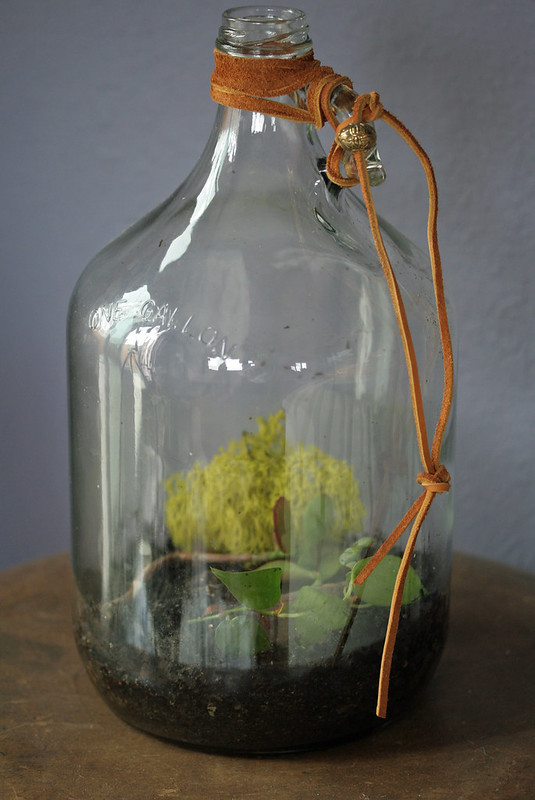
February 7th, 2019:

It went through a rough period in 2014, when my toddler knocked it over and pushed a ball point pen in there (which remains to this day), but it persevered.
February 7th, 2019:

It went through a rough period in 2014, when my toddler knocked it over and pushed a ball point pen in there (which remains to this day), but it persevered.
Old Homesteads in Western Oregon
I grew up hiking and hunting in private timberlands in and around the coast range of Western Oregon. I've lost track of the number of homestead sites I've run across in the middle of the woods, in unlikely places. My dad worked for timber companies, and would show me different sites. Often the only way to mark them is the ancient apple or pear trees who remain, clinging to life as the forest grows up around them and shades them out. Or sometimes, an oddly-placed clump of domestic iris or lily that has no business in a wild Pacific forest.
Most of these sites I'm talking about sprung up in the last wave of land-grabber/white homesteaders in the late 1800's and early 1900's. Many of them lasted, at most, a couple decades before the occupants realized how hard it was to grow crops on a PNW hillside with thin, clay soil best suited for sword fern and douglas fir. Most of them were abandoned and the land absorbed by large timber companies who let the trees regenerate and the buildings quietly rot away. Or, like in the case of my childhood house, the majority of the homestead land is absorbed, while the house, outbuildings and useless-for-logging-purposes flat ground near the creek was sold as a residence.
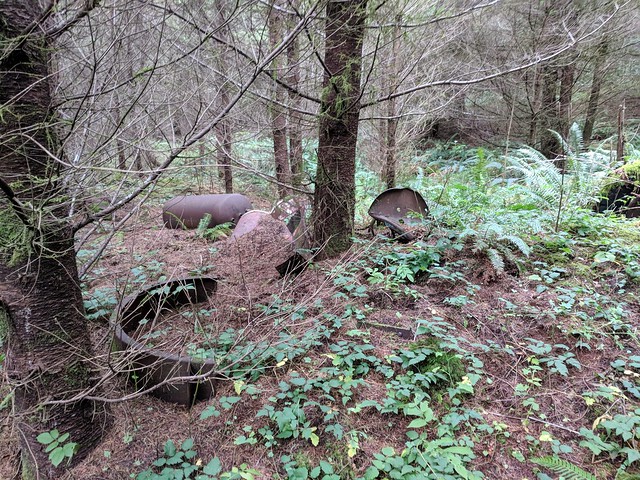
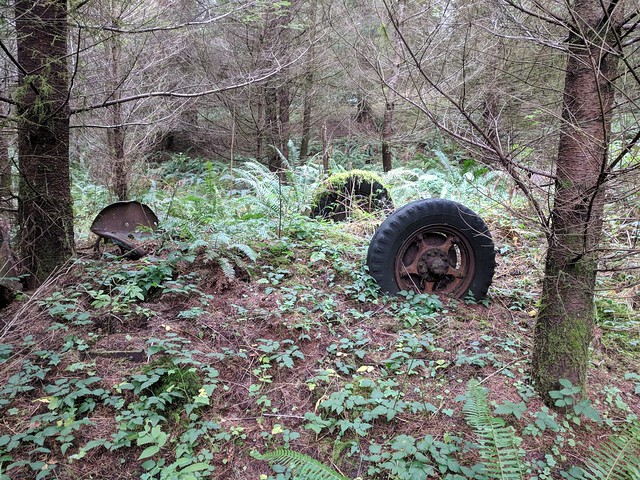
Most of these sites I'm talking about sprung up in the last wave of land-grabber/white homesteaders in the late 1800's and early 1900's. Many of them lasted, at most, a couple decades before the occupants realized how hard it was to grow crops on a PNW hillside with thin, clay soil best suited for sword fern and douglas fir. Most of them were abandoned and the land absorbed by large timber companies who let the trees regenerate and the buildings quietly rot away. Or, like in the case of my childhood house, the majority of the homestead land is absorbed, while the house, outbuildings and useless-for-logging-purposes flat ground near the creek was sold as a residence.
In some cases, families clung to homestead lands for as long as they could, slowly selling land to the timber companies when they needed money. As the original houses rotted, they built new houses closer to the public roads and highways, often delegating the original home sites as garbage dumps (because even to this day in rural communities, it's much cheaper than a long trip to the landfill).
So, if you're stomping around inside a tree farm and come across a spindly pear tree growing on a bench far from any road, or an old plow, or truck chassis, rusty artifacts like old water heaters or oil cans, someone once had a house there, and a few chickens, pigs, and maybe cows.
Friday, December 7, 2018
Domestication Stories #2: What it Means to be Alone

Content warning: some violence and gore
Flatnose was going to die. He knew it would happen soon, and he knew he deserved it. He'd accidentally killed his own brother during a squabble. His own father had been the one to begin the banishing-chant, and he hadn't fought it, simply walked out of camp with the clothes he was wearing and a single spear in his hands.
That was over a season ago, and he wasn't quite ready to lay down and let the cold take him. But it might be out of his hands now that winter was fully upon the land. He'd never been great at plant identification, or at trap-making - those had been skills that other family members had excelled at so that he didn't need to. He hadn't eaten anything but bark and lichen for many days, and his last protein had been a handful of moth larvae barely worth the calories expended to dig them out of the rotting stump. This hunt might be his last chance.
So here he was: on his belly on the frozen ground, crawling toward a small group of deer bedded down in some shrubs. He'd been stalking them for hours, and was almost close enough to strike. It was a desperate way to hunt large animals. The best way was to steer a herd into a ravine or bog where they couldn't escape or fight well, but that method required familiar lands, and a family working together. Nearly impossible for a lone man.
Suddenly, he heard something approaching from the hill behind him and to the east, crashing through the brush, making no effort to be stealthy. Flatnose lifted his head and watched in silent despair as the deer sprang from their beds. A pack of wolves ran past him and charged after them. In the span of a few breaths both wolves and deer had run over the next hill and out of sight.
He lay for awhile, listening to the wind and fighting the urge to lay his head on the ground. Wolves were often messengers of the Stone Mother, She may have sent them to tell him it was time to stop hunting and give up. One could never fully know the minds of the Gods, though, and there was one, small hope: if the wolves made a kill, he might be able to scavenge from it.
It took several tries to rise to his feet, he was that weak. He backtracked his own trail to where he'd stashed the small bundle of belongings he'd managed to make and collect since his banishment, and started to follow the wolves' tracks. It was easy tracking when the trail was this fresh: perfect little paw marks melted in the top layer of frost.
Within a couple hours, he saw birds circling up ahead. The wolves must have made a kill. Would it do him any good, though? Alone, he didn't have a chance of scaring them off, but it was possible that once they'd filled their bellies they would leave - the pack had looked strong and healthy, they may not feel the need to guard the carcass. If he could beat the bears, lions, hyenas, eagles and birds to it, anyway. He crested a ridge and there, at the bottom of the slope, were the wolves. The pack had indeed managed to take down one of the deer, an adult, and were were eating voraciously, the way wolves do, as if it were their last meal. Flatnose's mouth watered at the sight of all that food, so close, and yet untouchable.
He made a fire while he waited. The wolves didn't even seem to care, another jarring sign of his loneliness. A group of humans would have caused a pack of wolves to stop everything to watch them, or maybe even preemptively attack. A lone human held little threat. As long as he kept his distance, they ignored him.
Flatnose huddled by the fire, and concentrated simply to stay awake. He was running out of time. The sun was sinking, and he wasn't sure he could survive another winter night without either calories, or proper shelter. The wolves had slowed down, the two larger ones had finished, and he had some hope he'd be able to try his hand at stealing some meat soon. Just as he thought this, he caught sight of movement out in the distance. A large, dark shadow, coming down from another hill. A lion.
The wolves noticed at about the same time, and turned in unison, hackles and tails raised. Six wolves could take a single lion, but they might not want to risk defending food from such a dangerous foe when they had full bellies. If the lion took possession of the meat, Flatnose chances of getting any disappeared. A lean, lonely lion was much more likely than a fat and healthy wolf pack to guard the carcass or drag the entire remains to a lair and guard it until it was completely eaten.
This, then, must be Her test. He had to do something before the wolves decided to leave. He took a deep breath and threw off his hood and gloves. He broke off the biggest branch of heather he could find, and lit it in the fire. And then, with his only spear in one hand, makeshift torch in the other, he ran down the hill.
He kept wide and far away from the deer carcass, circling to get the lion between him and the pack. It would divide the lion's attention. Some of the wolves looked his way, but the lion was still their priority for the moment. They snarled and danced outside the range of its claws, making feint attacks as the lion was snarled back and swiped at them with deadly claws, slinking closer to the deer. Neither predator wanted to engage quite yet, and there was a temporary standoff. Now or never.
Flatnose only had one spear. He had to aim for a spot that was impossible to miss, that wouldn't simply glance off bone. As he got close to the lion, it stopped and turned toward him, ears pinned and teeth bared. Before it could attack, he threw the torch in its face. It flinched and swatted at the fire. In the one heartbeat that the lion was distracted, Flatnose leapt forward and thrust his spear into the lion's belly. It screamed and spun around, yanking the spear from his hands as the cat swiped wildly at him. He fell backwards, rolling out of reach, but bruising his ribs and elbow in the process.
It was a huge risk, spearing it in the gut. It could make it even stronger and angry, and now it might target him instead of the wolves. He scrambled to his feet as quickly as possible, backing away, but the lion wasn't coming after him yet; it was pawing and chewing at the spear stuck in its body, glancing back and forth between the wolves and Flatnose. In pain, surrounded by threats, it couldn't decide what to do. For a moment, Flatnose felt great sympathy for the lion. It was a gaunt young male, hungry and alone, just like Flatnose. It didn't realize that its life was already over, one way or another.
Mercifully, it didn't need to die the agonizing, drawn-out death of a gut wound, for at that moment, the wolves decided to attack after all. Flatnose stumbled away from the furious swirl of animals as quickly as his weak limbs would carry him. Back to the relative safety of his fire. He was dizzy with exhaustion and relief: he'd attacked a lion, by himself, and survived mostly unhurt.
He couldn't see the battle, obscured by brush and gathering darkness, but he could hear it just fine, and could tell it was not going well for the poor lion. Shortly, everything went quiet and the wolves came trotting back into view. Several were limping, but none seemed seriously hurt. He could swear they seemed smug. They settled in near the deer carcass, laying down to lick at wounds or curl up to sleep. They weren't leaving the area anytime soon. Flatnose wouldn't be eating any venison tonight, but he didn't need it now. He had roast lion in his future.
He made a new pair of torches and took them back down the hill, once again keeping well clear of the wolves and their food. They watched him, but none made a move toward him. Whether it was their exhaustion, full bellies, or that they still didn't see him as a threat, or maybe even that they saw him as an ally who helped them with a common enemy, or simply the grace of the Stone Mother, tonight they would tolerate him. Now that they weren't competition for a meal, he actually hoped they would stay for awhile. After being alone so many months, it was comforting, having other creatures nearby that were neither food nor enemy.
The lion's body was resting just a few lengths from the deer, in a small hollow. Flatnose used the torch to make two new, bigger fires, one on each side of the lion. It might be enough to keep away other scavengers that came in the night. It was all he had the energy for, but he was optimistic. For the first time in awhile, he had some plans to make for the future: Tonight, he would eat until his belly was swollen and painful. Then he would sleep. Then he would get up and eat some more. He would keep the fires going; he would build a shelter; he would find some water to drink; he should try to tan the lion skin, it would be a welcome addition to his pathetic bedroll of stitched-together small animal hides, or maybe he would try to make a water-tight cooking bag so he could make stew, which was a less-wasteful way to cook than roasting. His only spear was shattered, and he was banished from all the sacred yew groves, but perhaps the Stone Mother would see fit to show him the way to a different grove of trees so he could make more. She seemed to think he should live for tonight, maybe he would live through the winter after all.
~~*~~
Notes:
While I was in the middle of writing this story, an extremely pertinent interview was published in Psychology Today: 'Dumping the Dog Domestication Dump Theory Once and for All' I highly recommend reading it.
'What it means to be alone' takes place 150,000 years ago. Not much has changed since the time of SmallWatcher. Although the climate has fluctuated in that time, both people and wolves have adapted with no apparent changes to their habits or tool-uses. Flatnose's people, Neanderthals, still dominate the hunting grounds of Eurasia, living in traveling family groups and sharing the landscape with wolves and other predators. The creature we know today as the dog is still 100,000 years away from being fully created, but humans and wolves still have frequent interactions that are leading up to that final domestication.
Humans and wolves share what Christoph Jung in the above interview describes as, "astonishing similarities in their social behavior, their psychology and social communication." Both are also excellent hunters. Part of being a successful hunter, especially a human with a big brain, is to put yourself inside the mind of other animals, so you can predict their moves and habits. From there, it's a short step for a social creature to sympathize and feel close kinship to other animals, especially predators that are so like himself, even when those predators are often competition for the same food.
Subscribe to:
Posts (Atom)